
Small Businesses Remain Resilient, But Need Help on Cost Control, Digital Transformation and Succession Planning
By David Evans, Chief Content Officer at The Financial Brand
Simple Subscribe
Subscribe Now!
Need to Know
- 74% of SMB owners expect revenue increases over the next 12 months, down slightly from 78% in 2024 as business owners balance growth expectations against persistent economic uncertainties.
- 79% of businesses maintained or grew revenues over the past five years, demonstrating resilience through pandemic disruption, supply chain challenges, and interest rate volatility.
- 77% experienced cost increases averaging 18% over the past year, leading 76% to raise prices by an average of 12% — margin compression that challenges profitability and may constrain future investment.
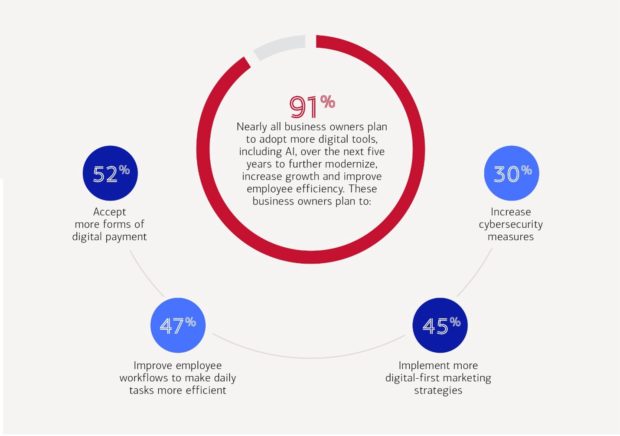
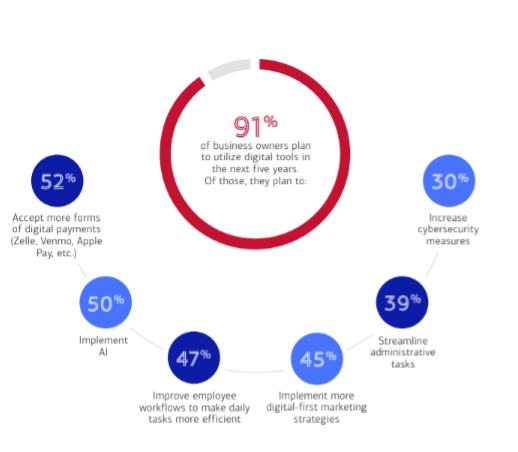
- 91% plan to adopt more digital tools over five years, with strong focus on more digital payment forms (52%), implementing AI (50%), improving employee workflows (47%), and digital-first marketing strategies (45%).
According to the 2025 Business Owner Report, recently published by Bank of America, business owners enter 2026 with steady, measured optimism about their prospects and economic conditions.
Seventy-four percent believe their revenue will increase over the next 12 months, representing a modest four-percentage-point decline from 2024’s 78% projection. This slight pullback reflects realism rather than pessimism. Business owners recognize economic headwinds while maintaining confidence in their ability to navigate challenges.
Their outlook on broader economic conditions shows similar cautious positivity, with 53% believing local economies will improve, 48% expecting national economic strengthening, and 45% anticipating global economic gains. The 2025 Business Owner Report surveyed 1,072 owners with revenues between $100,000 and $50 million
What would strengthen their confidence? Fifty-three percent cite tariff policy stabilization as essential, closely followed by lower interest rates (52%) and cooling inflation (52%). Thirty-nine percent point to stronger supply chains as confidence builders.
Banking executives should recognize that business borrowing appetite correlates directly with these factors — as tariff clarity emerges or rates decline, pent-up demand for financing could surge rapidly.
Meanwhile, 59% plan business expansion over the next year while 26% do not, indicating clear majority momentum toward growth. However, staffing plans show more conservative positioning:
52% plan to maintain current employee levels – suggesting that business owners plan to grow through productivity improvements and operational efficiency rather than aggressive headcount expansion
For banks, this pattern indicates opportunity in financing productivity-enhancing investments like technology, equipment, and process improvements rather than purely headcount-driven growth.
Financing Intentions Remain Strong Despite Rate Environment
According to the BofA study, 83% of business owners intend to obtain financing, revealing robust demand for capital despite elevated interest rates. Among those planning to finance, business credit cards lead at 53%, followed by personal savings at 41% and traditional bank loans at 32%. Personal credit cards round out common sources at 29%.
This financing mix reflects several strategic considerations:
Business credit cards provide flexibility and help manage cash flow volatility — particularly valuable as 77% report cost increases averaging 18% over the past year.
Traditional bank loan usage at 32% indicates that despite rate concerns, many owners still see value in institutional borrowing for substantial investments. Still, the interest rate environment creates complex dynamics in borrowing decisions. Fifty-eight percent of business owners report that current rates impact their borrowing choices — but 47% are less likely to take out loans while 31% are more likely to borrow. Similarly, 17% are less likely to refinance existing loans while 23% are more likely to refinance. These mixed responses suggest that rate sensitivity varies significantly by business situation.
Some owners view current interest rates as prohibitively expensive and delay investments, but others see rates as reasonably stable or even favorable compared to potential future increases, prompting action now rather than later.
The refinancing split likely reflects whether businesses locked in lower rates previously versus those carrying higher-rate debt who can benefit even from modest rate declines.
Dig deeper:
- How to Blunt the Threat of Smart Contracts and Stablecoins to B2B Payments
- Contextual Banking: How Vertical SaaS Cracks the Code of Embedded Finance
- How U.S. Bank Is Retooling for a New Generation of Business Owners
Cost Pressures Drive Price Increases and Margin Compression
Over the past 12 months, 77% of business owners report cost increases, with costs rising an average of 18%. In response, 76% have raised prices, with average increases of 12%.
• The six-percentage-point gap between cost increases and price increases represents margin compression that challenges profitability across the small business sector.
The magnitude of these increases far exceeds typical annual patterns and reflects cumulative inflation impact over recent years. Even as headline inflation moderates, businesses continue experiencing elevated costs that don’t decline but rather stabilize at new higher levels.
Supply chain issues impact 75% of business owners, while labor shortages affect 61%, up five percentage points from fall 2024, with 50% of those impacted working more hours due to staff shortages and 40% raising wages to attract competitive talent.
For banking executives, these operational pressures create several implications.
- Working capital needs will intensify as businesses manage higher costs and potentially slower collections if customers resist price increases. Lines of credit become more valuable for smoothing cash flow volatility.
- Businesses need financing for investments that improve efficiency and productivity — automation, technology, process improvements that reduce per-unit costs even as input costs remain elevated.
- Advisory services can help businesses analyze pricing strategy, cost structure, and margin management become increasingly valuable beyond pure lending relationships. Banks that position themselves as partners navigating operational challenges rather than simply capital providers will strengthen customer loyalty and retention.
Digital Transformation Becomes Universal Priority
Nearly all business owners plan to utilize digital tools over the next five years, representing a sea change in how small businesses approach technology. This isn’t limited to tech-savvy startups or urban businesses; it spans industries, geographies, and demographic profiles. Among those planning digital tool adoption, priorities include:
- accepting more forms of digital payments like Zelle, Venmo, and Apple Pay (52%)
- implementing AI (50%)
- improving employee workflows to make daily tasks more efficient (47%)
- implementing more digital-first marketing strategies (45%)
- streamlining administrative tasks (39%), and
- increasing cybersecurity measures (30%).
The payment acceptance priority reflects customer expectations that businesses offer multiple payment options beyond cash and traditional cards. Younger consumers particularly expect seamless digital payment experiences, and businesses unable to accommodate these preferences risk losing transactions.
For banking executives, this digital transformation wave creates multiple opportunities:
- Businesses need financing for technology investments, including software subscriptions, hardware upgrades, implementation consulting, and employee training all require capital.
- Banks can differentiate by offering digital tools that integrate with business operations — real-time payment processing, automated reconciliation, cash flow forecasting, and working capital optimization.
- Advisory services that help businesses evaluate technology options, assess cybersecurity risks, and develop digital strategies become valuable relationship builders.
The banks that help customers navigate digital transformation successfully will become trusted partners rather than transactional service providers — strengthening loyalty and expanding wallet share as businesses grow more sophisticated.
Succession Planning Gap Threatens Business Continuity
Business owners show divided approaches to succession planning, with 60% having plans in place, but 40% lacking exit strategies. This gap proves particularly concerning given that 70% are not focused on exiting within the next five years.
The disconnect between lack of immediate exit plans and absence of succession strategies creates risk for business continuity, employee stability, customer relationships, and banking relationships alike. Many owners may assume succession planning only matters when exit is imminent, failing to recognize that health emergencies, family situations, or unexpected opportunities can accelerate timelines dramatically.
Among those with succession plans, the most popular exit strategy is transitioning the business to family members (32%). Family transitions dominate because many small businesses represent multi-generational enterprises where owners view businesses as family legacies rather than purely financial assets. These transitions can be emotionally satisfying but operationally complex, requiring careful planning around valuations, estate tax implications, management capability development, and sibling or cousin dynamics when multiple family members have ownership interests or expectations.
The 40% of small businesses that lack succession plans represent significant banking opportunity — and risk. Opportunity exists to provide succession planning advisory services, connecting owners with estate planners, M&A advisors, and family business consultants. Banks can facilitate family transitions through financing that enables purchasing generation to buy out selling generation while maintaining business liquidity for operations. Risk arises because unplanned ownership transitions — through death, disability, divorce, or disputes — can destabilize businesses, jeopardizing loan performance and relationship continuity.
Banking executives should proactively engage business customers on succession planning regardless of owner age or stated timeline, positioning these conversations as risk management and value preservation rather than end-of-relationship planning.


