
Why the Mid-Term Elections Won’t Slam the Door on New Bank Charters
By Juan Pablo (J.P.) Perez-Sangimino, senior director at Klaros Group
Simple Subscribe
Subscribe Now!
Bankers, fintech founders and investors keep asking my firm whether a Democratic win in the midterms (or in the 2028 presidential election) would shut the door on new bank formation.
Our answer is no.
Although congressional committees controlled by Democrats could make the Trump administration’s banking regulators uncomfortable, with hearings, letters and subpoenas, they can’t replace the agency heads, and, as we’ve seen, the agencies are more open to innovation than they’ve been in years.
The 2028 presidential election will matter more because it will decide who appoints the next slate of regulators.
But even then, a Democratic win in 2028 would likely mean a slower, more selective pace of approvals — not a closed door.
Need to Know:
- The Trump-appointed heads of the Comptroller’s Office (OCC), the FDIC, and the Federal Reserve’s supervision arm will remain in place following the midterm election.
- A Democratic majority in either or both chambers of Congress would have subpoena power and a bigger platform, but little ability to reverse agency policy.
- A new president in 2029 could change the pace of bank charter approvals, but it’s unlikely they will halt completely.
- The GENIUS Act, passed with Democratic votes in both chambers, requires the OCC to decide stablecoin issuer applications within 120 days — or they are deemed approved.
Actions Taken by Agency Heads to Foster Bank Formation
Key insight: Whatever the midterms bring, the officials driving today’s chartering agenda will still be in office, and a change in congressional control gives them little reason to change course.
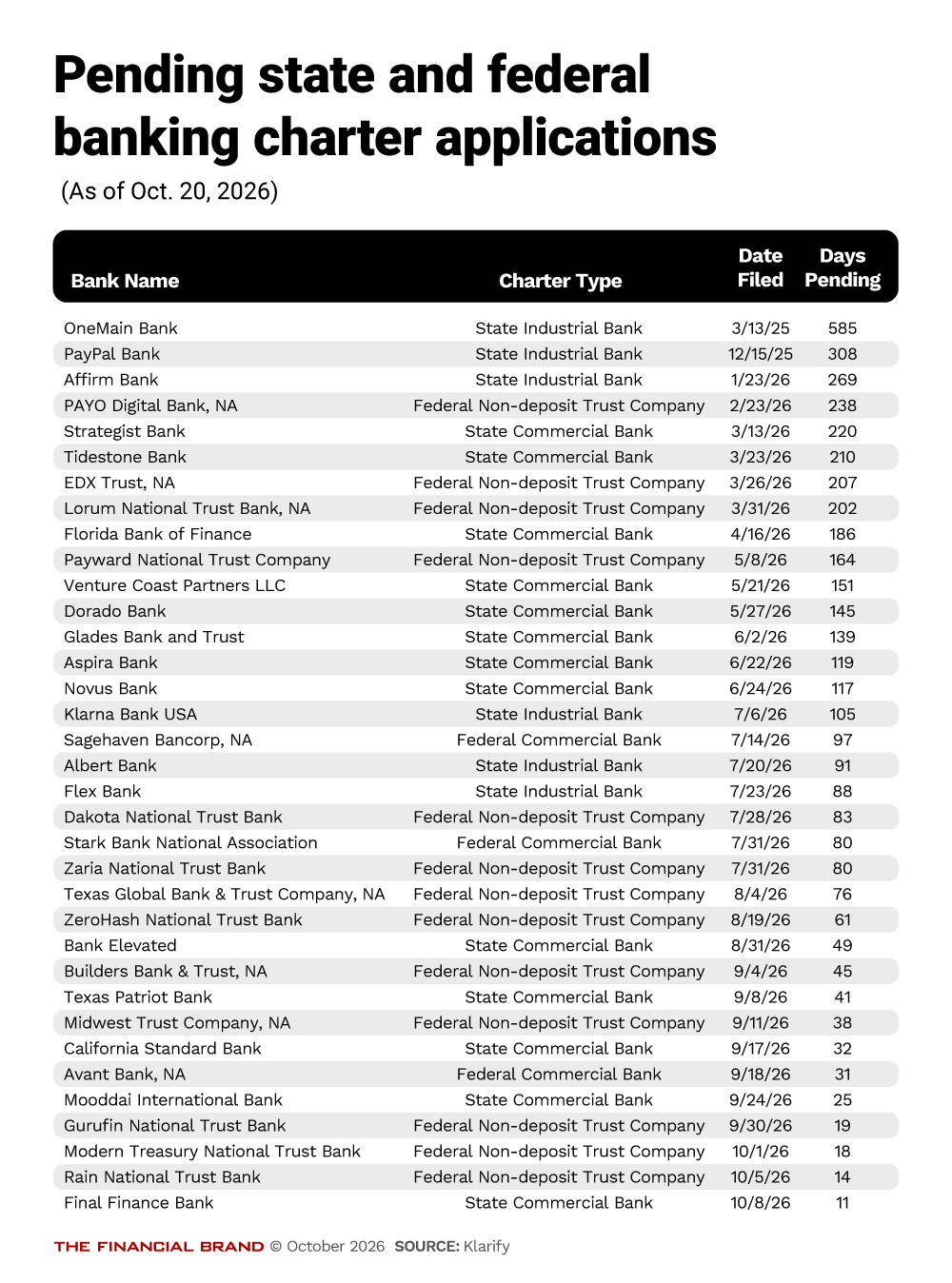
At the OCC, Comptroller Jonathan Gould made reviving de novo chartering a top priority almost immediately upon taking office in July 2025. The numbers show the OCC has successfully implemented Gould’s priority: Gould confirmed that as of August 2026, OCC had received 40 charter applications in about 18 months. OCC data show just 48 applications from 2011 through 2024, including three years with none at all. The same OCC data show 14 de novo approvals in 2026 through early August, compared with nine across all of 2021 through 2024. (The table nearby illustrates how many charters of all types are pending.)
At the FDIC, Chairman Travis Hill was sworn in January 2026. In February, he told the Senate Banking Committee that the FDIC was “actively working on ways to improve the de novo deposit insurance application process” to “encourage more new bank formation.”
In August, FDIC followed through by splitting its review of deposit insurance applications into two phases:
• In the first, FDIC reviews the business plan, financial projections, and proposed management, interviews the organizers, and decides within 120 days whether to grant a contingent authorization. The document lists the conditions the bank must meet before opening.
• In the second, organizers have up to 12 months to complete steps such as finalizing organizational documents and compliance policies before receiving final approval and undergoing a pre-opening exam.
The goal is to tell organizers where they stand before they spend heavily on raising capital, hiring and building systems. The 120-day clock tracks the window the OCC already uses for conditional charter approvals.
At the Federal Reserve, Vice Chair for Supervision Michelle Bowman started her four-year term in that role in June 2025. A former community banker and state bank commissioner, she said in early 2025 that regulators should consider whether the application process itself has become “an unnecessary impediment to de novo formation.”
In a speech in early October, she called the Fed’s competitive analysis of bank mergers “antiquated and harmful to community banks.” She said agencies should go further to promote new banks by clarifying capital requirements, sticking to reasonable processing timelines, and issuing conditional approvals where appropriate. That speech followed a June statement in which the Federal Financial Institutions Examination Council reaffirmed its support for de novo bank formation. Still, the Fed has moved more cautiously than the OCC and the FDIC.
Read more: FDIC Insurance Still Matters Even When Stablecoins Are Fully Backed. Here’s Why
Congress Has Little Power Over Charter Decisions
A Democratic majority would have real oversight tools. Committee chairs set the agenda, so agency heads could expect more hearings, more letters and document requests, and subpoenas if they don’t cooperate. A Democratic Senate could slow or block confirmation of future nominees, but couldn’t rescind a confirmed agency head.
Key insight: What Congress can’t do is change charter decisions on its own, for three reasons:
• First, the agencies decide applications under existing law and under policies set by their leaders, and Congress can’t curtail those leaders’ terms short of impeachment, an extraordinary step. Gould, Hill and Bowman are already confirmed, and a midterm doesn’t change that.
• Second, charter decisions aren’t rulemakings, so the Congressional Review Act doesn’t reach them.
• Third, the power of the purse doesn’t work here. The OCC, the Federal Reserve, and FDIC don’t depend on annual congressional appropriations.
The implications: This means that the likely result would be more scrutiny, not an entirely new direction. Expect approvals to come with more conditions and somewhat longer timelines for the most controversial applicants.
2028 Bodes a Change in Pace, Not Direction
The presidential election could matter more:
• The president can remove the Comptroller, provided the reasons are communicated to the Senate.
• FDIC board members serve fixed terms, but recent Supreme Court decisions have expanded the president’s power to remove agency heads. Although the scope of those rulings hasn’t been tested, a new president could probably replace FDIC leadership as well.
• The Fed is different. Governors can be removed only for cause, a protection the Supreme Court left in place in Trump v. Cook. Bowman’s term as Vice Chair for Supervision runs into 2029, and she could remain on the board after that, so the Fed’s approach would likely change more slowly than the OCC’s or the FDIC’s.
Key insight: Therefore, it is possible that a Democratic president could have new leadership in place at the OCC and the FDIC within months of January 2029.
The possibilities: New leadership would likely mean closer review of crypto and commercial company applicants, tighter approval conditions, and slower decisions on pending applications.
Guidance could be rewritten quickly, but charters already granted would very likely stand. A new administration can’t revoke a charter simply because it disagrees with the decision.
Regulators can close a bank only on grounds set by statute, such as insolvency or an unsafe or unsound condition. A new OCC could supervise recently chartered banks more closely, and conditional approvals for banks that haven’t yet opened could lapse, but an operating bank’s charter is not something a new president can take back.
Read more: Why Square and SoFi’s Crypto Push Should Worry Community FIs
GENIUS Gives New Charters a Bipartisan Backstop
In the GENIUS Act (Guiding and Establishing National Innovation for U.S. Stablecoins) a Democratic administration would inherit a statute that much of its own party voted for. The Act, signed in July 2025, passed the Senate 68-30 (18 Democratic votes) and the House 308-122 (102 Democratic votes). Democrats Kirsten Gillibrand (N.Y.) and Angela Alsobrooks (Md.) were among the senators who introduced it. The bill passed over the objections of Sen. Elizabeth Warren and Rep. Maxine Waters, the party’s senior voices on financial services, so Democratic support is real but not uniform.
That opposition matters because Warren and Waters are each in line to chair the committee that oversees the banking agencies if Democrats win their respective chambers.
Warren, the top Democrat on the Senate Banking Committee, has already pressed Gould in writing. In February, she questioned the speed and political ties behind the OCC’s approval of Erebor, and in May, she argued that crypto firms are using national trust charters to avoid the obligations that come with being a bank. As chair, she could back those letters up with hearings and subpoenas.
Waters is expected to lead House Financial Services if Democrats win the House. Neither could block an approval, but crypto companies, trust charter applicants, and applicants with close political or commercial ties should expect closer public scrutiny and could face longer timelines.
That said, GENIUS already puts the OCC in charge of deciding which uninsured national banks may issue payment stablecoins, and it requires the agency to review their applications, regardless of who runs it.
GENIUS also limits the extent to which a future OCC could slow these applications. A substantially complete application that the OCC does not act on within 120 days would be deemed approved, and a denial must explain the agency’s reasons and what the applicant could do to be approved.
A less-friendly OCC could still say no, but it could not simply sit on applications indefinitely, as applicants say regulators have done in the past.
The law also created what is effectively a new type of federal license: the OCC can approve nonbank companies as federal qualified payment stablecoin issuers. And because the law permits uninsured national banks to issue stablecoins, it arguably permits national trust banks, which are chartered under 12 U.S.C. § 27(a), to do something they could not do before, although bank trade groups dispute that reading.
Looking ahead: GENIUS shows what Democrats will support: new activity inside the regulatory perimeter, with strong consumer protections and clear accountability. Under a Democratic administration, the likelier outcome is a slower, more selective version of today’s approach to chartering — not a return to the period when an entire year could pass without a single de novo approval.
What This Means for Applicants
Keep moving. Today’s window is the widest in more than a decade, and the next two years are the best time to take advantage of it. Whoever wins in 2028, the strongest applications will have solid capital, experienced management, and strong compliance programs, along with a clear explanation of how they serve consumers and small businesses, not just the sponsor.
The Bottom Line: Neither the midterms nor, most likely, 2028 will slam the door on new banks. Elections can change how closely regulators review applications and how many they approve. The GENIUS Act, which many in the Democratic Party voted for, also provides stablecoin applicants with statutory protections that a new administration can’t undo on its own.
Read next: Stablecoin Is Ready for Credit Unions. Are Credit Unions Ready for Stablecoin?


