
Why the ‘K-Curve’ Demands Proactive Strategies from Banks Right Now
By Steve Cocheo, Senior Executive Editor at The Financial Brand
Simple Subscribe
Subscribe Now!
The K-Curve phenomenon is bringing a longstanding economic trend into sharp focus. How banks, credit unions and fintechs handle the challenges will impact everything from marketing to product design to credit management.
“There’s always been the notion of the ‘haves’ and the ‘have-nots,’ that part of the population is doing better than others,” says Bill Handel, general manager and chief economist at Raddon, a Fiserv company. “But the degree of polarity that we have now is pretty striking.”
“The results of economic cycles are becoming more and more extreme, in terms of how lower-income and higher-income people and lower-wealth and higher-wealth people experience them,” says Jennifer Tescher, founder and CEO of the Financial Health Network. FHN is a nonprofit, with financial industry sponsors, that studies and makes recommendations on financial services affordability and fairness.
Key insight: Banks and credit unions are more than mere bystanders to the K-Curve and its ripple effects — their behavior can actually influence the bifurcation.
Naturally, financial institutions need to address its implications for their credit portfolios. But they can also be proactive, examining how not to exacerbate the problems for the lower “arm” of the K.
Key insight: Going this extra step is especially critical for institutions’ younger consumers, Millennials and Generation Z, according to Handel. Student loan debt, delayed homeownership and concerns about employment in the face of AI adoption are hitting them harder, he says.
The challenge: “The industry has talked for years about being the trusted financial advisor,” says Handel. “Those are always great words to put out there. But more than any time in the past the industry has that opportunity, because AI and other digital technologies will free staff to help consumers make better decisions.”
Need to Know:
- The K-Curve describes the post-Covid recovery trend, so-called because of two trendlines, one for consumers who are doing better, and a lower line for those who are doing worse. Frequently, it is represented in terms of spending, but other factors are also at play.
- The upper part of the K consists of people whose spending is bolstered by assets, especially investments rising with the stock market. The lower part reflects people whose livelihood depends chiefly on their income, which has been eroding in the face of inflation.
- The potential for credit risk affects both, because both the strongest credit categories — super prime borrowers — and the weakest — subprime — are drawing down more credit.
The K-Curve is Showing Up in Credit Numbers
Recent research by TransUnion indicates that the K-Curve is being seen in consumer credit markets.
As seen in the table below, the portion of consumers who are super prime (credit scores of 781 and more, out of 850) has actually grown, to 40.7% of consumers, as of the end of 2025. However, the portion of subprime consumers (300-600) has also grown, to 14.8%. Notably, the pickup for the subprime segment took place over 2022-2025.
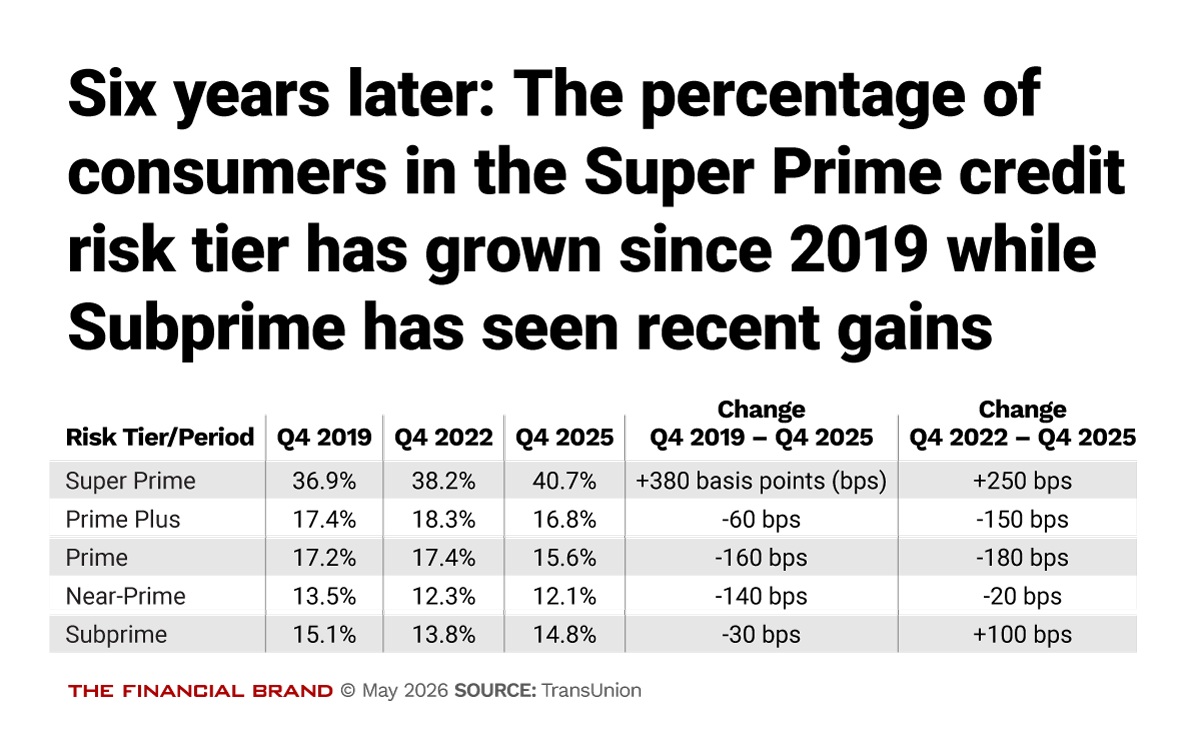
At the same time, the middle tiers in the credit score range — prime plus, prime and near-prime — have shrunk since 2019, reflecting more polarity.
Super prime credit customers tend to hover around the same balances in their ongoing use, according to Atsuko Watanabe, senior director, research and consulting, at TransUnion. On the other hand, “subprime consumers are struggling,” she says. “They have access to existing lines as well as new lines, and they tend to build balances at a much higher rate.” They also lack the liquid assets that many higher strata customers have, such as tappable home equity.
Key insight: Consumers in the middle groups that experience greater credit stress are migrating down into non-prime risk tiers, according to Watanabe. TransUnion found that 23% of prime consumers and 26% of near-prime consumers moved down the credit scale between 2024 and 2025.
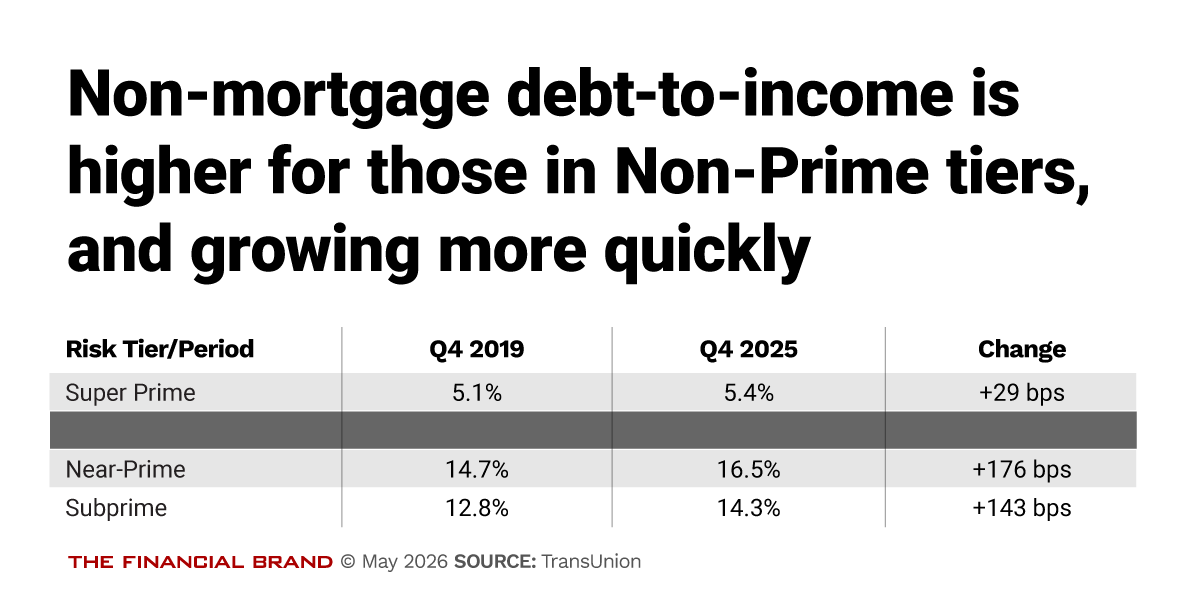
TransUnion evaluated debt-to-income ratios, exclusive of mortgage credit, for comparability’s sake. The ratio includes credit cards, auto loans, personal loans and student loans. While super prime borrowers saw an average increase of 29 basis points from 2019 to 2025, near-prime consumers saw an increase of 176 basis points and subprime borrowers saw a rise of 143 basis points.
Credit as a lifeline. Non-prime consumers are still obtaining access to new credit accounts, with subprime borrowers’ share of credit card accounts, for example, growing from the third quarter of 2019 through the third quarter of 2025. Deep subprime borrowers’ (below 549) share of originations grew by 320 basis points.
TransUnion says this indicates “sustained demand and measured lender participation despite a more challenging credit environment.” The company found that super prime borrowers received an average 11.5% increase in the size of new credit card lines. By contrast, near-prime borrowers had an average increase of 5%, high subprime borrowers had an average increase of 7.1%, and deep subprime had an average increase of 5.5%.
Read more: Consumer Credit Boomed in 2025. Why 2026 Shows Few Signs of Slowing Down
Can Lenders Avoid Making Things Worse?
“Right now, debt is keeping the non-wealthy afloat,” says Jennifer Tescher of Financial Health Network. But she doesn’t see this as sustainable forever.
The earlier point about approving additional credit for lower-tier borrowers reflects the current stance of many lenders, but that’s something that a shift in the economic picture could change.
The middle way: “To avoid exacerbating the K-Curve, you have to ease up on the gas gradually,” says Tescher. “If you throttle too slowly, you risk driving illiquid customers into insolvency. You don’t want to let people take on too much more debt.”
On the other hand, Tescher adds, “if you throttle too quickly and slow down too fast, it may create a bigger cascade of problems for people.”
Key risk: Closing the credit tap too fast will have ripple effects. Tescher points out that someone might be looking for a new, cheaper apartment. Slamming down their credit line suddenly could hit their credit score, just as a potential landlord might be checking it, she points out. Similarly, a consumer trying to refinance a car loan to reduce their costs could be disapproved.
“It’s a tough line to walk, but lenders have to be really careful,” says Tescher. She recommends earlier engagement with borrowers who seem to be having trouble.
“You don’t want to throw people into a bigger tailspin than they may already be in,” Tescher says.
Read more: The Mortgage Hack That Could Make Community Banks Competitive Again
Are New Forms of Credit Helpful or Harmful?
The fintech age has introduced variations on credit that weren’t on the table not long ago. Among experts interviewed regarding the K-Curve, the feelings about some of these new forms was mixed.
Case 1: BNPL. Take the rapidly growing buy now, pay later idea, which comes in multiple forms. These range from fintech-operated merchant-subsidized no-interest or low-interest plans to longer-term plans to bank and credit union credit- and debit-card linked options that shift a card purchase into an installment plan subject to fees rather than interest rates.
In some cases, BNPL can help people on the lower K tier. Raddon’s Bill Handel uses the example of needing a new refrigerator. That’s roughly a $2,000 purchase. If they put the fridge on their credit card, they’ll be paying double-digit interest rates for quite some time.
“That becomes a very expensive refrigerator,” says Handel. “On the other hand, they could carve it up into four payments of $500 and take care of it.” Where BNPL encourages payment discipline, he likes the idea and considers the choice constructive. What worries him is the tendency more people are showing to use BNPL for groceries, entertainment and more small purchases.
Too many plans. Another concern is consumers who open a plethora of plans. Individual providers might limit the number of open plans a consumer may have — but consumers have numerous BNPL providers and options to choose from.
“The problem lies in when the customer ends up with five or six buy now, pay later plans,” says Jennifer White, senior director, financial services intelligence, at JD Power.
She says she understands the appeal of having a plan rather than adding a purchase to a revolving balance at high interest.
“But good solutions in the moment can become not so good for some consumers when they’re overused,” says White. Vulnerable consumers with too many open plans just face a new form of credit bog.
Case 2: Early Wage Access. This form of finance — sometimes at a fee, sometimes subsidized by an employer, sometimes a product feature, notably among fintechs — has appeal. “Let present self borrow from future self,” seems doable, even attractive.
Tescher says such plans can be helpful, but they can also endanger a consumer who is already on shaky ground.
“For people who are insolvent, who are spending more than they earn, it becomes real problem because you are really just taking money out of one pocket and putting it in the other pocket,” says Tescher. “You still have the same amount of money.”
Some of these plans amount to little more than small-dollar loans, says Tescher.
Don’t just ape fintechs. Tescher says banks and credit unions tempted to adopt fintech product templates must think them through carefully.
“Just because some nonbank companies are doing exceedingly well by offering these products doesn’t necessarily mean that they are doing their customers a favor by offering them,” says Tescher.
Read more: Consumers Say It’s Not You, It’s Chime
Talking to People, But Not Necessarily Saying What They Want to Hear
Raddon’s Handel suggests that as banks and credit unions move towards a more consultative model that they ask tougher questions:
• To themselves. “If all the metrics that you put in place suggest that you can make a loan to an individual, you should ask if you should make the loan.”
• To applicants. Say someone wants a car loan. Cars are important, but should someone buy an $80,000 car or a $40,000 car? Handel says institutions that take advisory work seriously must consider how helpful it might be to persuade someone to aim lower — even though that means lending them less money.
“I’ve had conversations with many executives and they say, ‘We can’t be in the role of a parent. That’s not really our job in financial services’,” says Handel. “I understand that distinction, but I think that asking such questions is pertinent.”
Handel says the short-term view is to make all the loans you can. But he thinks taking a long-term view, not thinking solely of current production, will help keep people from slipping into lower K status.
They’ll be better customers and in time could be bigger — and less risky — users of credit.
“Some think that people who are in the bottom part of the K-Curve always have to be there,” says Handel. “But I don’t think that’s actually appropriate.” He thinks a key part of being a trusted financial advisor is to help move up the credit ladder.
Read more: The Financial Literacy Gap Is Your Brand Opportunity
Steps that Can Help People Stuck on the Lower K-Curve
Among the other ideas experts suggested:
• Show them the rungs on the ladder. JD Power’s White points to secured cards. Why not counsel those card holders about what they have to do to move up to unsecured, mainstream cards? Right now, it’s often opaque.
• Rethink rewards programs. Tescher says most programs favor upper K-Curve consumers. She thinks attention ought to be paid to lower K consumers. This includes tailoring loyalty and rewards programs to deliver relief they need now — like discounts on gasoline or reduction of outstanding debt instead of travel points. She speaks highly of the concept of Bank of America’s new rewards program.
• Redesign basics like checking accounts. Last year, FHN analyzed offerings of 20 large checking account providers, comparing them to the organization’s set of standards. Dive Deeper into that study here.
• Consider waiving fees for troubled lower K consumers. Tescher thinks this is best delivered case-by-case, according to each customer’s predicament.
In the end, Tescher thinks taking the kinds of measures outlined in this article will set banks and credit unions that do it apart: “You’re not selling a bunch of commoditized products. You’re selling help with financial health.”
Read next: To Compete for Today’s Deposits, Banks Need to Redesign Their Account Offerings


