
The Right Time for Market Research Is Before You Think You’ll Need It
By Corey Wrinn, Managing Director at Rivel Banking Research
Simple Subscribe
Subscribe Now!
Most banks and credit unions don’t have an issue with research. The issue is the timing.
Here’s a typical cycle: Finance sets revenue targets over the summer. Marketing gets its number in the fall. By January, the team is executing a plan built on last year’s results, internal observations and a set of assumptions about what the market wants. Then somewhere around March, someone asks for research.
At that point, the research can still be useful. It just can’t impact much for the year. Media is committed. Creative is in production. Growth markets have been picked, and product priorities have been set. The study ends up grading a decision instead of shaping it.
That’s an expensive way to use it. A study usually costs a small fraction of the media, product, or expansion dollars it’s meant to inform, but only if it arrives before those dollars are committed.
Key insight: Research done after the plan locks tells you how your decisions are working. Research done before it locks helps you decide what those decisions should be.
For most institutions, that means building research into planning about six months before the budget is final, while priorities are still being debated and money can still move.
The Goals Are to Prove Assumptions and Counter Narratives
Before you pick a study, write down the assumptions holding up next year’s plan:
- Which markets do we expect to deliver the most growth?
- Which customer or prospect segments are we counting on?
- What do we believe sets us apart from competitors?
- Why would a prospect consider us?
- Where are we assuming awareness or consideration is stronger than it is?
- What has changed in our markets since we last looked?
Then ask a harder question: What evidence do we have that each of these is still true?
Some of the answers are already in-house. Account openings, attrition, product penetration, digital behavior, call-center themes and campaign results can tell you a lot. Use them.
Key insight: Internal data is good at telling you what happened. It can’t tell you why a prospect chose the institution across the street, why people know your name but won’t consider you or why a market that looks good on paper keeps underperforming. Those questions require hearing from people who aren’t your customers yet.
That’s the gap research should fill.
One recent client study brought this gap into focus. In a study we ran in early 2026, 64% of consumers in the bank’s market named it as an option, but only 4% said they would consider banking there, below the norm of 7%. Leadership knew people recognized the name. What they didn’t know was how little of that recognition was turning into consideration. In the months since, the bank has focused its messaging on closing that gap and turning a well-known brand into new business.
The finding was useful because it arrived in time to act on it. The same study, delivered after messaging and media were set, would have explained a disappointing year instead of preventing one. The time of year you run research matters as much as what you study. Here’s how that timing tends to play out across a planning year.
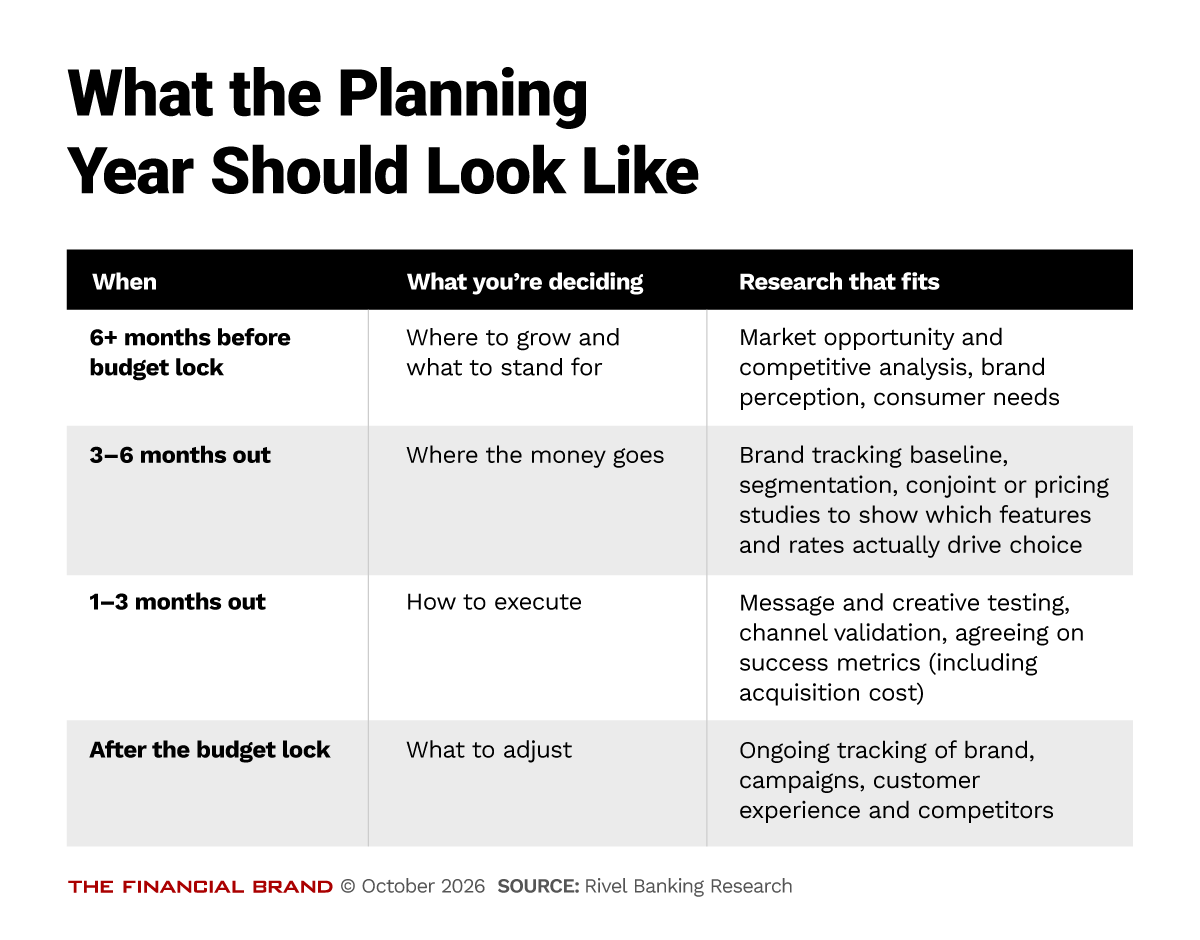
Six or more months out: challenge the strategy. This is when to ask the big questions because there’s still time to act on the answers. If leadership sees a new geography as the next growth market, validate it. If the plan depends on winning younger households, find out what actually drives their consideration. If you’re about to invest heavily behind a brand position, check whether the market already sees you that way. The goal isn’t more data. It’s fewer untested assumptions going into budget season.
Three to six months out: decide where the money goes. The questions get narrower here, and so should the research. If you’re debating a rate special against a fee waiver or a new feature, a conjoint study can show which one prospects will actually trade for, before you fund the wrong choice. Before you commission anything, ask three things:
- What decision will this change?
- Do we already have data that answers it?
- What does it cost us if our current assumption is wrong?
If you can’t name the decision, you probably don’t need the study.
One to three months out: validate execution. The question shifts from “Are we making the right bet?” to “Are we placing it well?” Test the messaging. Confirm the channel mix. Most importantly, agree on what success looks like before the campaign launches. If you don’t, teams tend to pick the metrics that matter after they see the results.
After the budget lock: learn and adjust. A locked budget shouldn’t mean a locked strategy. Keep tracking brand movement, campaign performance and competitive changes. Decide in advance what you’d be willing to change based on what you learn. Measurement with no decision attached is just reporting.
Not Every Question Needs New Research
If campaign data clearly shows one channel outperforming another, you don’t need a study to move the dollars. If a test is cheap, reversible and quick to read, run it in market.
Key insight: Research earns its cost when the decision is expensive, hard to undo or based on something your own data can’t see. That includes entering a new market, repositioning the brand, launching a major product, going after a new audience or trying to understand why prospects keep choosing someone else.
You don’t need to research everything. You need to know where your blind spots are before you spend against them.
What to Do Before Your Next Planning Meeting
Get your team in a room. Write down the three to five biggest assumptions behind next year’s growth plan. Next to each one, write the evidence that supports it. Then label each one:
- Know: We have recent evidence.
- Think: We have some evidence, but we’re filling gaps with judgment.
- Don’t know: We’re making a significant decision without enough information.
Your research agenda is in everything labeled “think” or “don’t know”. Fund those before the budget locks, not after.
If your 2027 budget is already set, run this exercise anyway. Your mid-year reforecast and 2028 planning are closer than they look.
If everything on the page says “know”, ask one more question: When did we last prove it?
Bottom line: The riskiest assumption in a plan usually isn’t a bad one. It’s a good one the market quietly stopped supporting a while ago.


