
A Wave of New Charters is Coming. Meet Your New Competitors
By Steve Cocheo, Senior Executive Editor at The Financial Brand
Simple Subscribe
Subscribe Now!
Executive Summary
- A wave of new banking charters, many involving fintechs, appears to be coming, thanks in part to a friendly administration’s evolving policies.
- Some of the resulting banks will be highly specialized, but a new report says a handful of freshly chartered players could change the look of the industry’s top ranks. Some major fintechs may throw their hats in the ring.
- Among the potential players are foreign providers who want to tackle the U.S. market. Nubank, the Brazilian personal finance powerhouse, is one.
A wave of charter applications for fintech banks of multiple types is coming. Driven in part by a perfect storm of changing political, regulatory policy and economic factors, that wave may have a limited duration, depending on the outcome of future elections. But the wave could influence the shape of the banking industry permanently, much as a storm surge alters a beach.
Applications for national bank charters, including specialized national trust charters, for federal deposit insurance for state-chartered industrial banks, and for specialized state charters are all part of the trend. (Industrial banks are also called industrial loan companies.) So is the shot in the arm that the GENIUS Act gave to the crypto industry, given the desire by some players to tie that in with a charter of some type, such as the national trust charter. (GENIUS stands for Guiding and Establishing National Innovation for U.S. Stablecoins.)
These developments coincide with the maturing of larger fintechs, many that started with narrow concepts but are rapidly expanding their activities.
Others, based in other countries, have been looking to establish beachheads in the U.S., or to build out from moves already made. For example, on Sept. 30, Nubank, the Brazil-based fintech, announced that it had applied for a national bank charter as an entrée to expanding into the United States and beyond that to a global model. The U.S. operation’s chief executive has already moved here.
Other fintechs are considering a charter because of concerns about the future viability of banking-as-a-service, according to a new report.
Organizations besides fintechs are also involved, including four automakers pursuing industrial bank charters.
The report, “Seizing the Bank Charter Moment: Implications for Fintechs and Banks,” was produced by Oliver Wyman and fintech venture capital firm QED Investors. QED’s managing partner and co-founder, and one of the authors of the October report, is Nigel Morris, who co-founded tech-centric Capital One Bank with current CEO Richard Fairbank. The table below comes from the report.
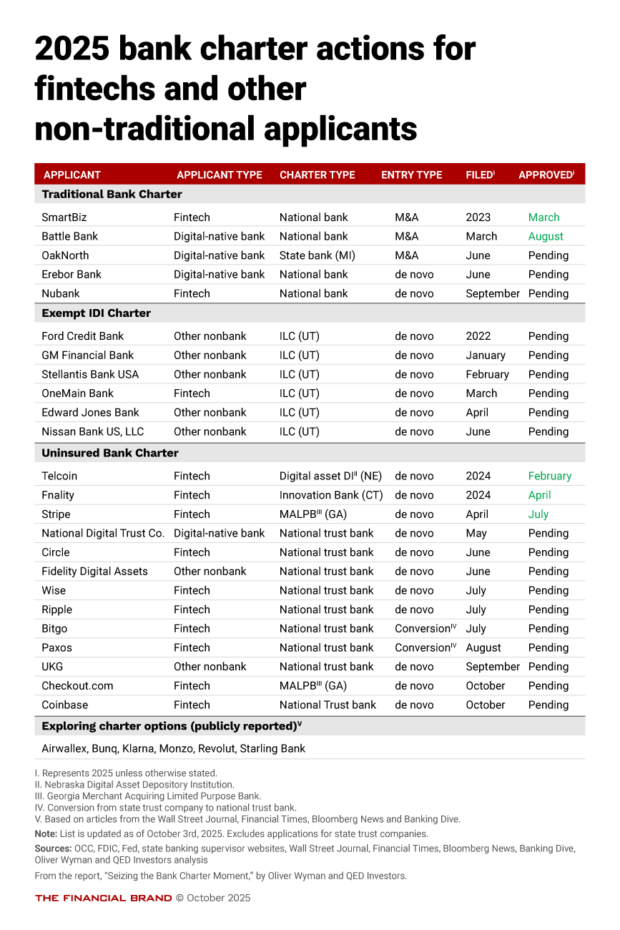
Their report devotes considerable space to arguments against fintechs pursuing a charter, and presents a realistic view of the headwinds they’ll face, including the need for building beyond their original customer bases, which are often people with lower income and lower credit scores. Wyman and QED also point out that a charter and the regulatory oversight that comes with it can hobble the agility that fintechs typically enjoy.
They also present a persuasive case for the benefits some fintechs could obtain via chartering. The report often reads as a playbook for companies considering their charter options, including the need to pay much more attention to compliance and risk management.
Where Will the Charter Wave Leave the Banking Industry?
The seeds for what’s going on were planted back during the Obama administration, when then-Comptroller of the Currency Thomas Curry pushed the concept of a special “fintech charter,” through hearings and rulemaking. That effort fell by the wayside in the first Trump administration, and chartering in general wasn’t favored by the Biden administration, which never successfully nominated a Comptroller of the Currency.
But, for now, the Trump administration, and its top financial regulatory appointees like the idea of more charters, points out the report. Indeed, in September, the Comptroller’s Office, which charters national banks, created a new post of senior deputy comptroller for chartering, organization and structure — elevating the function to a very senior level. (This will include licensing of payment stablecoin issuers.)
Overall, the Trump team also favors crypto and is open to more blending of banking and fintech.
As a consequence of all this, the report says that “charter approval may become a similar milestone to an IPO in the lifecycle of a fintech. The conversion of a subset of nonbank fintechs to banks over the next few years will likely provide the most substantial injection of new top 100 banks in many years.”
The report points out that these new leaders would join SoFi, “which has now surpassed $40 billion in assets and is growing its business at a 30% annual rate.” SoFi stood at 56th place by asset size in the Federal Reserve’s June bank ranking. It was founded in 2011 and became a bank via acquisition only in 2022 — a rapid ascent.
The report says that not every player obtaining a charter will wreak major change. It suggests that most fintech charter approvals will result in niche banking players. But a handful could make a big difference.
“The broader industry competitive impact from new charters will be concentrated in a few scaled fintechs that receive approval for traditional bank charters over the next several years and that have the capability and ambition to scale assets beyond $20 billion,” the report says. Established fintech players that gain traditional charters “are most likely to revolutionize the financial services landscape.”
As highlighted in the table above, many of the pending applications involve digital assets. The report presents this as something of a wildcard.
“One scenario is that stablecoin traction is limited to targeted use cases such as cross-border payments,” the report says. “Another scenario, less likely but more revolutionary, is that stablecoin captures a more central role across U.S. payments systems. In that case, the issuance of new charters to digital asset fintechs will prove to be more transformative.”
Meanwhile, the group of nonbanks seeking national trust charters from the Comptroller’s Office, as listed in the table above, drew a joint comment letter in July from a group of banking and credit union organizations. The associations called on the agency to postpone consideration of the charter applications until more was known about their business plans. A key concern: That the applicants would provide traditional banking services like payments, “presenting material risk to the U.S. banking and financial system.”
Who else is waiting in the wings? This year marks two decades since Walmart tried and failed to enter banking via an industrial bank charter. Before and since it has been trying many other paths into banking and payments, including its fintech effort, One Finance, which provides accounts in partnership with Ribbit Capital, Coastal Community Bank and Lead Bank.
Could this be the time Walmart finally gains its own charter?
Read more: Will a Fintech’s Acquisition of a Chicago Bank Restart the Race for Charters?
‘Act Now! Limited-Time Opportunity to Become a Bank’
How things play out will take time. But time is something that fintechs don’t necessarily have a lot of.
Regulators may be friendlier for now, and they have promised that they will act promptly on applications, points out Michele Alt, a former regulator and now partner at Klaros Group. However, she says, fintechs and other companies interested in pursuing a charter can’t put it off too long because conditions could shift. (Klaros has been involved in multiple charter and acquisition deals involving fintechs. Alt spoke generally.)
“Is the welcome mat really out at the agencies? Yes. How long will that mat be out? Hard to say,” Alt explains.
Alt points out that the no-action attitude of the Biden years could return in the next administration. Even before that, the 2026 mid-term elections could change the environment as well.
“If a potential charter applicant is ready to meet bank regulatory standards — and that’s a big question — now is the time to jump in,” says Alt. “If you want to future-proof your business, you want to obtain at least conditional approval before the mid-terms, and you want to be operating before the next election.”
Conditional approval starts an 18-month clock for meeting certain requirements and opening the bank’s doors, the report points out: “If the fintech can’t stand up the bank in time, the approval expires.”
As the Wyman/QED report points out, this isn’t a matter of interest for fintechs and other nonbanks alone: “Most fintechs have taken the M&A route” — SoFi, LendingClub and SmartBiz among them. This avenue gives incumbent banks a lucrative exit strategy and allows a fintech to avoid the trouble of applying for federal deposit insurance. Still, the more that new charters look feasible, the fewer acquisitions of that sort will happen.
Time for a bit of math: Alt says the Comptroller’s Office has said that it intends to honor the official 120-day review period for charters. So aspirants to a charter need to think of getting their applications in by late summer 2026.
That seems far away, but it’s not, Alt warns. A risk that applicants face is submitting an application that regulators deem to be incomplete. Unlike the public portion of a charter application, the confidential parts fill enough reams of paper to occupy the back of an SUV, she says.
“Because they now have quite a queue to review, the regulators will send you back to start over if the application isn’t complete,” says Alt. “There’s no getting your toe in the door — you’re either all in, or you’re not in.”
Where do the glitches arise? One common problem area is the business plan. Alt says screeners may decide that the plan is vague, or lacks sufficient financial analysis to support projections. Another common problem is incomplete “IBFRs.” This stands for “Interagency Biographical and Financial Report.” Generally, the application must include one of these on every proposed director and senior executive of the bank being organized.
“I tell my clients that these are like financial colonoscopies,” Alt says. Again, miss the mark and you get to do it over again.
Both Alt and the Wyman/QED report stress that the process of seeking a charter is expensive, both in terms of regulatory and legal advisory talent to get the application through and in terms of the systems that must be in place. And that doesn’t include the cost of raising and maintaining the capital that a chartered bank must have in order to open its doors and keep them open.
“You can’t just buy your way in on the cheap,” says Alt. “It’s going to cost you quite a bit to capitalize the bank and stand it up.”
Key Questions: What Fintechs Are and What They Want to Be
Alt points out that creating a successful bank also demands developing both assets and liabilities. Most fintechs have concentrated on one side or the other.
“It’s fairly rare for a fintech to come to me that’s got both sides figured out,” says Alt.
All nonbanks entering the fray also have to decide what type of charter to pursue. The industrial bank charter offers something to nonbanks that a traditional charter doesn’t: exemption from Federal Reserve supervision and restrictions on the parent company under the Bank Holding Company Act. Likewise, specialized state charters noted in the table are exempt, as are national trust bank charters via the Comptroller’s Office.
Alt calls this “the Hamlet question — to be or not to be a bank holding company.” Many would-be owners of an industrial bank charter can’t use a traditional bank charter because their activities, such as automaking, are not considered part of the business of banking. And they’re not about to divest their core businesses.
Question Marks on Industrial Bank Coverage at FDIC
Earlier this year FDIC put out a regulatory “request for information” seeking input about industrial banks and their parent companies. (The comment period ended in September.)
The debate over industrial banks has raged for years, and Alt sees the call for comments as a holding action while Travis Hill, acting FDIC chairman and nominee to the permanent post as chairman, awaits confirmation. (That only became official Sept. 30.) She wonders what could be said that hasn’t been said before.
Indeed, among the lengthy comment letters reviewed, the stances of key groups weren’t surprising.
The Financial Technology Association believes industrial bank charters can help increase the number of de novo charters “to advance competition and promote financial services innovation.” The Independent Community Bankers of America objects to chartering and insuring more industrial banks, in part because of the blurring of the lines between banking and commerce. The Bank Policy Institute continues to maintain that Congress ought to close the loophole that enables industrial banks to be chartered at all.
In a joint comment letter, the Nevada Bankers Association, the Utah Bankers Association — both states charter industrial banks — and the National Association of Industrial Bankers promoted the benefits of industrial banks.
Alt thinks the issue will be in a holding pattern until Hill is confirmed. After that, she says, it will be interesting “to see if FDIC tries to strike a balance among these competing factions.”


