
How Your Bank Can Fight ‘Soft Switching’ — and Steal a Few Accounts of Your Own
By Steve Cocheo, Senior Executive Editor at The Financial Brand
Simple Subscribe
Subscribe Now!
“Soft switching” is picking up as Americans’ financial activity continues to fragment among multiple players, according to new research from JD Power. This trend has implications both for banks and credit unions that want to retain and grow existing relationships, as well as those that would also like to expand by snapping up accounts from other institutions.
Key risk: Once someone establishes a relationship with another provider, their one-time primary financial institution risks slipping into second place — or even losing the relationship entirely.
Need to Know:
- The average checking account customer now has three deposit accounts at different institutions, the study found.
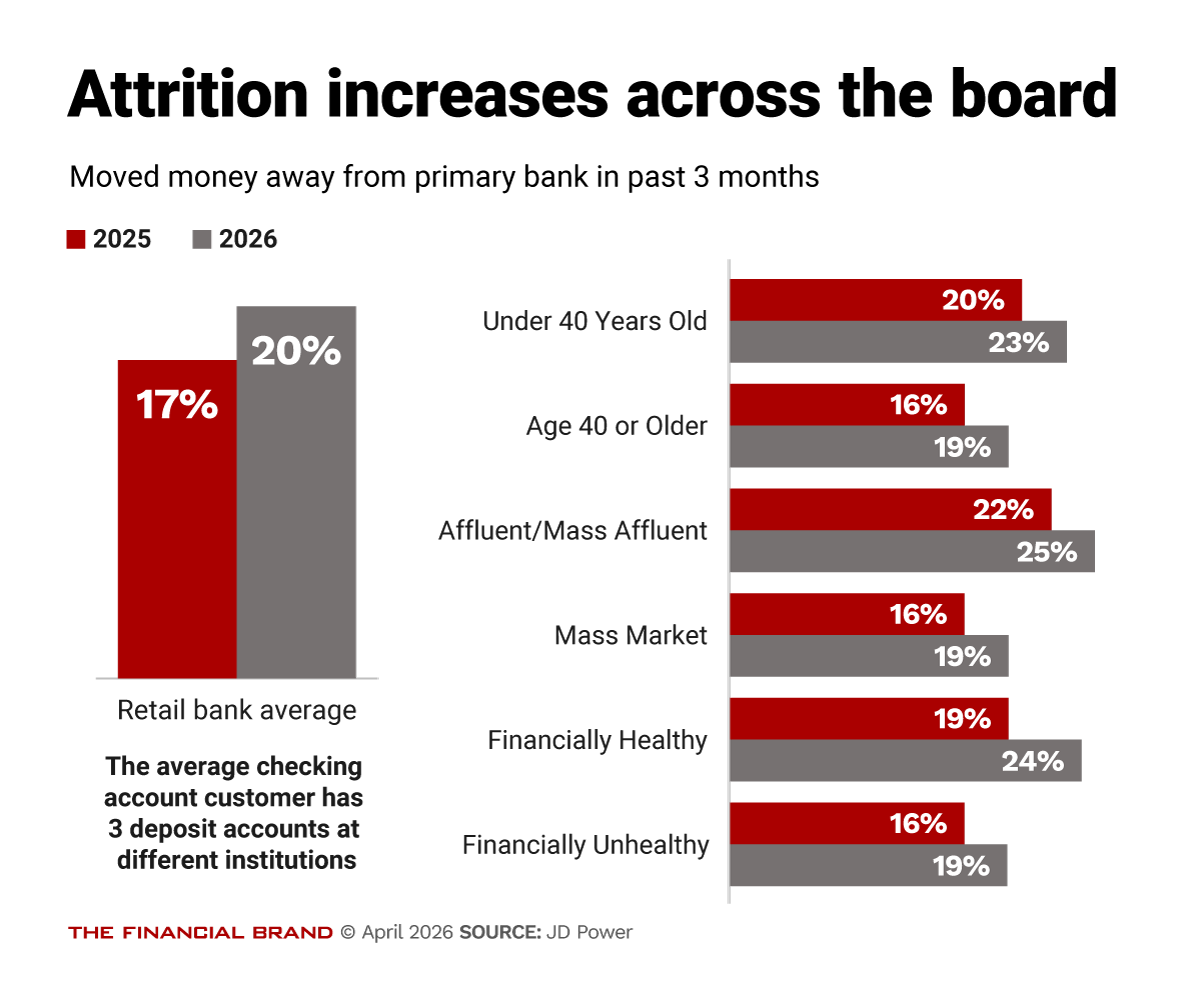
- One out of five consumers moved money away from their primary financial institution in the past three months, according to the study, an increase over the 17% rate seen in the previous edition.
- Departures aren’t sudden and massive, but frequently subtle: “The risk is not immediate attrition — it’s gradual erosion of share of wallet,” according to JD Power.
- This attrition is increasing over multiple demographic categories, the study found, as shown in the chart below.
“Any time money moves, it’s an opportunity for the customer to reassess primacy,” says Jennifer White, senior director of financial services intelligence at JD Power.
She says the firm’s new 2026 U.S. Retail Banking Satisfaction Study confirms a trend seen in multiple studies. When measures of customer satisfaction slide, people quietly open accounts with other institutions or with fintechs, often without shuttering a previous account — they just fade away.
White says there are multiple steps that institutions can take to protect their customer bases — while simultaneously making themselves attractive to someone who is looking to make a move.
AI antidote? The study also digs into the ways that banks are applying AI in ways that touch consumers, yielding insights about what they really find important. The public has become hyper-aware of the growing role AI plays in their lives, and they have opinions about it. This is especially notable because poor communication by institutions was identified as the leading cause of dissatisfaction in the study.
Why Your Customers Begin Looking at Other Providers
The study found that overall satisfaction levels among customers of the major and regional banks studied is actually up slightly — two points on a 1,000-point scale — but that fissures in specific categories of satisfaction are appearing.
Some of the cracks in satisfaction:
- Customer communication. This saw a nine-point drop, the largest among the categories.
- Customer service channels. Satisfaction fell with such channels as interactive voice, live phone, online chat, and social media servicing. A bright spot: satisfaction picked up with assistance provided by email, web forms and in-app messaging.
- Product fees. Another sore point, and getting sorer.
- Problem resolution. Satisfaction fell most severely in this category in the second half of the study period, with a drop of 13 points.
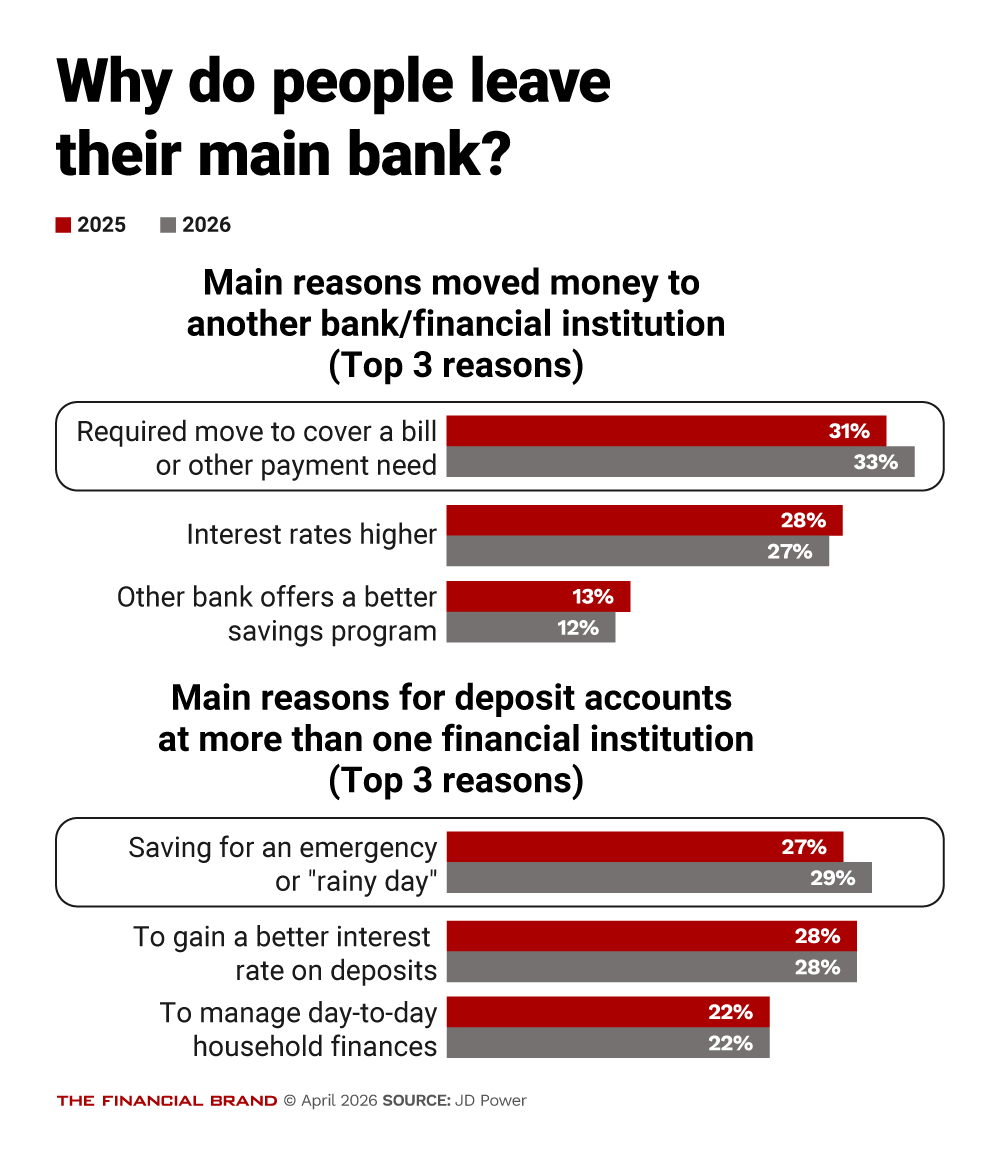
Inertia still plays a part in the likelihood of switching, but certain trigger events, as shown in the chart below, stand out as the factors that actually get consumers to move part of their primary relationship.
Do Consumers Leave Because You Don’t Provide Money Management Tools?
The second part of the chart above points to a key factor in soft-switching, according to White.
Customers may actually want some friction, or, at least, hard lines around savings for emergencies, “rainy days” and special purposes. White says that opening an account with another institution can happen when the consumer’s primary provider doesn’t help them lock down such funds.
“Customers are seeking things like the ability to isolate their savings from their everyday spending, especially when they don’t have the financial literacy to do that with their current tools,” says White.
White adds a dose of reality, based on JD Power research: “Two thirds of the population is financially unhealthy in some way, and more than a third are vulnerable, meaning they struggle to pay their bills month to month.”
They don’t necessarily need to start separate provider relationships, says White, but for some a fintech’s dangling of a good savings program, or a nice set of personal financial management tools, will be enough for them to migrate for that specific need.
How to fight back: Create the capability for customers to visually allocate funds to “buckets” or “vaults” or other nomenclature that establishes categories for planning. White says Ally Bank and SoFi offer particularly attractive options.
Read about Ally’s “buckets and boosters,” which appears extensively on its website.
Two-pronged strategy. “These types of supportive tools are attractive not only to consumers who are struggling,” says White, “but could even be attractive to an affluent customer who is saving for a vacation or a large purchase.”
Another product with appeal in this area is earned wage access, something that’s very attractive to consumers with money issues. This service is offered by many neobanks such as Chime and Dave.
Read more: Consumers Say It’s Not You, It’s Chime
Saving the Day Can Save Your Accounts
Good customer experience is a key defense against losing primacy, according to White.
Case study: The fraud victim. White says there are many examples of how an institution can solve a customer problem and make them a satisfied customer in the end, but cases of fraud are especially strong.
Why? Emotion can run high, White explains, and customers ask themselves:
- Do I feel protected?
- Do I feel safe?
- Do I feel listened to?
“You can get good from a bad experience if it’s handled well,” says White.
Handling a fraud should incorporate several elements, she says:
- An apology, “I’m sorry you are going through this.”
- Active listening, to get a sense of how the customer is being impacted.
- Providing a timeline for resolution.
To these basics, White suggests some value added: Give the customer a listing of any bills or recurring payments that they may have associated with the account, so they can address them during resolution so nothing is disrupted.
Add in some credit monitoring tools or point them to credit bureau tools.
Such effort makes a difference, instead of sending the customer on their way to figure things out on their own, says White.
“If you go that extra mile, you’ve built a loyal customer base that is saying, ‘This bank actually took care of me in my moment of need’,” she explains.
Read more: Four Ways Banks Can Turn Fraud Into a Loyalty Play
Don’t Be Shy About AI
Only one in five respondents think their institution communicates adequately about how they are using AI.
“That means that the industry isn’t controlling the narrative around how AI is being used today to improve customers’ financial lives,” says White. “This is an opportunity that institutions have to explain all the good things they are doing for them with AI.”
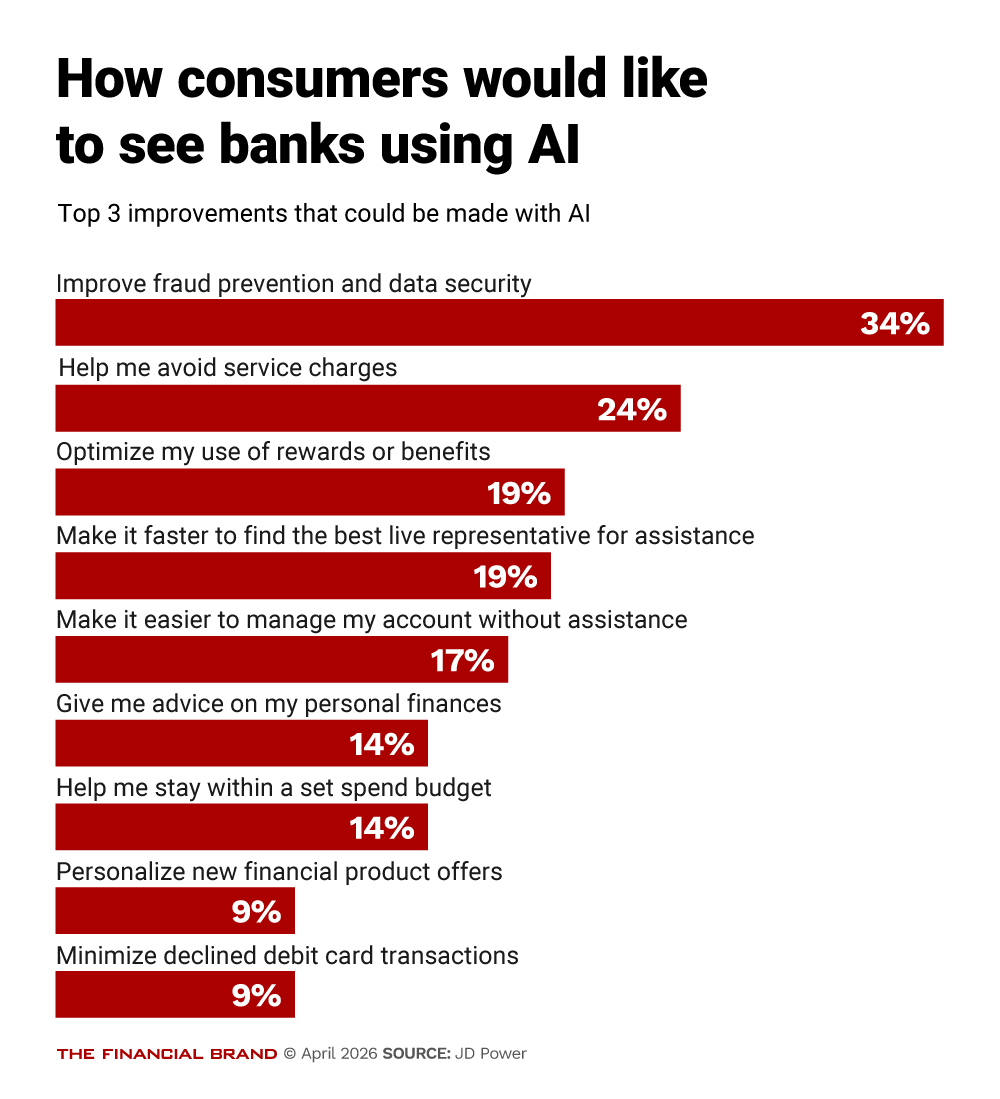
The top two ways that consumers would like to see their banks apply AI — improving fraud prevention and data security and avoiding service charges — tie back to concerns outlined earlier.
White adds that every one of the reasons given have personalization woven into them — how their provider can make their life easier.
Read next: How BECU’s AI Financial Advisor is Moving Beyond Product Answers to Customer Handholding


