
What Bankers Can Learn from an American Living Cashless & Masked in Shanghai
Have you wondered what the post-coronavirus American 'new normal' might look like? Fintech expert Richard Turrin is based in Shanghai and has been living through that city's own return to something like normalcy. QR codes, tracking software and contactless payments make it all possible. Just don't go out without your smartphone.
By Richard Turrin, Consultant and Author.
Simple Subscribe
Subscribe Now!
Shanghai’s recovery from COVID-19 is the stuff of legends, and the “new normal” your city will experience in coming months will probably resemble what we are experiencing here.
Banks, offices, shops and cafés are open. Malls have shoppers. Even my yoga studio is back in business. By my own estimate, the city and its 25 million inhabitants are operating at around 90% of normal. Still, life is far from the old ordinary and has a new set of rhythms that define a “new normal.”
This city was spared heavy coronavirus infection due to the Shanghai government’s fast actions during the outbreak’s early days. Still, the city came to a virtual halt as residents followed the government’s advice to stay at home until it was able to devise a safety net to ensure public safety.
Shanghai’s coronavirus safety net has four critical elements that helped the local government reopen the city for business and allowed life to bounce back. While Shanghai may seem far away, many of the techniques that the city is using to protect public health likely presage what other U.S. and European cities will look like when they return to their own “new normal.”
1. Don’t Forget Your Mask and to Maintain Your Distance
Masks are critical. In fact, wearing a mask is compulsory in China right now. Compliance is high because wearing a mask isn’t considered a big deal here. As with Japan, where wearing a mask when you have a cold is natural, Shanghai residents also wore them, though to a lesser degree than the Japanese.
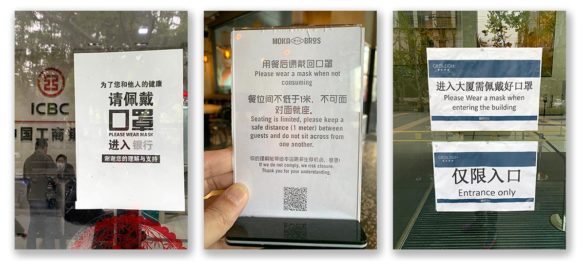
“No Mask, No Entry”: From left to right: a local bank, a coffee shop and at high-rise offices.
Wearing a mask when you are sick, or when air pollution levels got high, a less-frequent event in recent years, just isn’t a big deal here. Wearing a mask during a pandemic isn’t something that strikes people here as odd, or an imposition. Most think of it as quite natural.
Social distancing is also in full swing in China. So while coffee shops and malls are open, everyone in them does their best to keep their distance.
Offices are a bit trickier and vary depending on the size of the office. Banks put this into practice by limiting the number of customers allowed in at any one time. My local branch seems to limit the number of people allowed in by the number of seats in the waiting area and ensuring that everyone has two seats between them. Masks are, of course, mandatory.
2. Watching Your Temperature
One thing that you cannot escape in Shanghai is having your temperature taken. I have it done as many as eight to ten times a day. I have grown used to it and actually grateful.
The most critical temperature check occurs whenever I return to my apartment compound. The security guards or gate attendants manually check every resident who enters. Finding a high temperature puts the entire apartment compound at risk of lockdown.
Access to all apartment complexes is limited to residents only, and no guests are allowed. Delivery people are required to drop off their goods at the front gate and are not allowed in the compound. These measures make tracing and isolation of infected people easier. Malls and other public areas use infrared cameras, so everyone entering high-volume areas like subways and public spaces are checked.
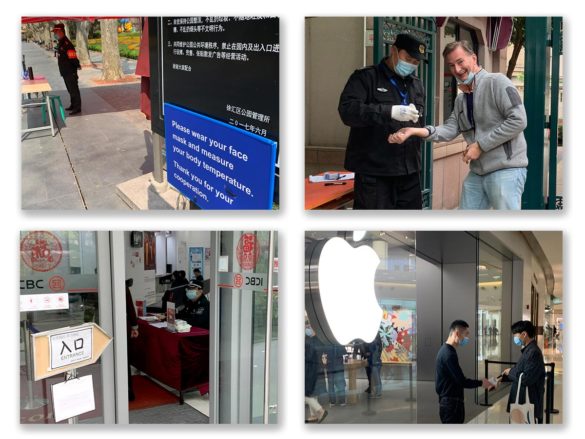
Temperature checks are the norm. Clockwise from top left: 1. Public park with mask and temperature check required. 2. Entering my apartment complex. Non-residents are not allowed inside the gates. 3. Visiting an Apple Store in Shanghai. 4. A trip to the local bank requires a mask, temperature check, your health app and distancing when seated.
3. Your Health App Is a Public Record
Most of us here don’t have a single app for tracking health but several. The most important is Suishenma, the health tracking app that all Chinese must use.
The app was built by Ant Financial. It assigns users a health QR code depending on where you’ve been and whom you’ve come into contact with. The codes are:
- Red, 14-day quarantine required.
- Yellow, 7-day quarantine required.
- Green, free to travel.
Your color can change depending on whether you’ve come into contact with an infected person or a person who has disobeyed quarantine procedures.
So just because you are green today doesn’t mean you will be green tomorrow.
It is mandatory to show your app color code whenever you enter into an office building. Likewise for stores which offer personal services like hair cutting or my yoga studio. Most coffee shops and malls had required you to show the code, though about two weeks ago, this requirement was relaxed.
The Metro also requires use of Suishenma, which is tied to a QR code in each subway car for the purpose of tracing your car and fellow travelers.
This system was used meticulously when the Metro reopened, but passengers do not appear to use it as much recently.
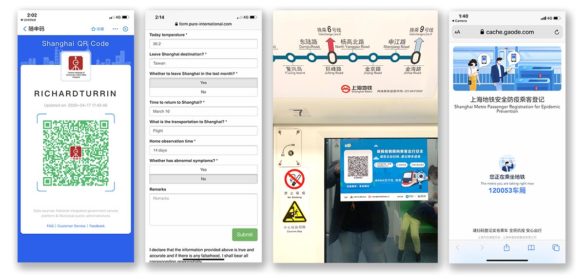
Apps help prevent the transmission of coronavirus. From left to right: 1. Suishenma app developed by Ant Financial and used throughout China. 2. Temperature recording app similar to those used in many office buildings. 3. QR code to scan on Metro — each car has one. 4. QR code links to a central registry to trace infection.
Suishenma is not the only app required. Many office buildings and companies maintain their own apps that you must use before you can gain entrance. These are not necessarily government-mandated but have been put in place by buildings or business owners. Typically, you have to scan a QR code at the front desk, fill out the online form, and submit it for approval.
Such apps aren’t unique to China and are coming to the West. Apple and Google are now working on a Bluetooth-based “tracing” app for global rollout that tracks who you’ve been near during the day. These apps will offer users a form of digital protection, much like China’s, and can alert you if a person you’ve been near tests positive.
Unlike China’s apps that both “track and trace,” the Apple-Google app will reportedly only “trace” who you’ve come into contact with, for greater privacy. These apps work wonders in helping China control the spread of coronavirus. However, the debate over their efficacy and privacy in the U.S. and E.U. is just now starting, and many steadfastly oppose their use.
Read More: Digital CX Now The Ultimate Factor In The Fate of Banking Brands
4. Cashless Payment and Delivery Become Standard
The West can’t quite duplicate China’s cashless payment experience. China went “mostly” cashless roughly four years ago when mobile payment apps Alipay and WeChat Pay caught on. While cash is still accepted at most stores, nearly everyone uses mobile payment and now, with coronavirus, what little cash use left has disappeared. So closing bank branches in China wasn’t much of an issue when roughly 85% of all payments in China are made with mobile.
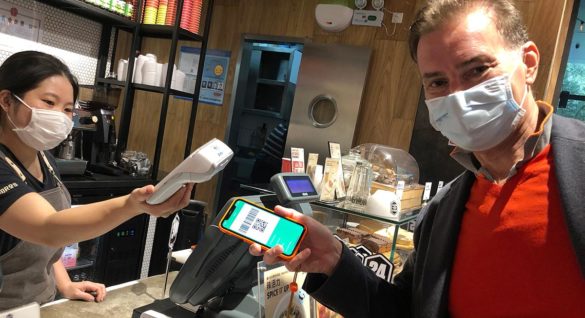
A trip to the coffee shop in the “new normal” showing cashless payments, masks and distancing.
What makes cashless payment in China unique is that it uses a QR code-based system. The best feature of this system is that there is no card tapping, mobile phone touching against a reader nor PIN codes, a significant advantage. It would be easy to ignore cashless payment as “no big deal” because your touchless payment credit card in the West is close enough. That would be a critical error.
QR code payment systems at typical cash tills in China work at a range of around 30-40 centimeters. No tapping, no PIN, no resting on an NFC reader.
Mobile payment didn’t just make life easy at the cash till — it gave rise to a new mobile-payment-based service economy. This economy includes digital logistics and delivery networks that are of strategic importance to every country in lockdown. In Shanghai, everyone is using these services to avoid going to the market or main street to buy things or to obtain services like a doctor’s consultation.
One thing that has changed in Shanghai’s new normal is that my local supermarket is nearly empty. People simply don’t want to go and are buying online instead.
China’s early adoption of cashless payment gave it a significant leg up in building out these delivery systems compared to the West. When Wuhan went into lockdown on Jan. 23, 2020, western journalists asked how long the city could survive. It was inconceivable to them that Wuhan could be supplied. Digital distribution systems sprang into action and kept Wuhan’s 11 million fed and supplied throughout the crisis.
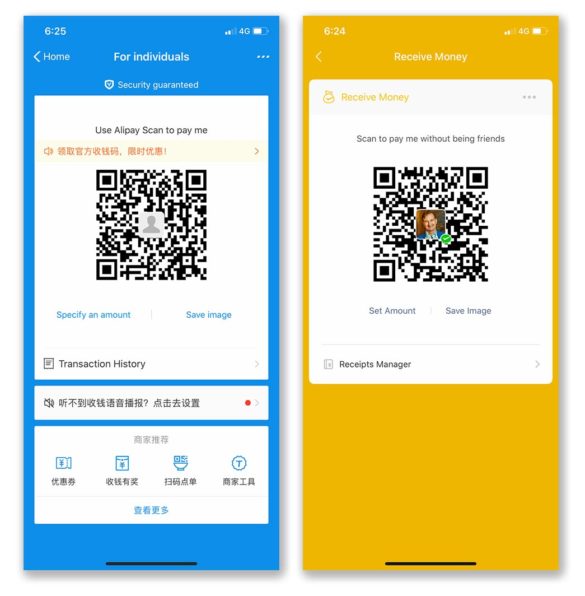
QR code payment systems at typical cash tills in China work at a range of around 30-40 centimeters. No tapping, no PIN, no resting on an NFC reader. Note that the QR codes generated are one-time codes.
An American’s Perspective on the ‘New Normal’
These four critical elements are what allowed Shanghai to return to its “new normal.”
What is interesting is that two of these elements are decidedly low tech. They can be reproduced just about anywhere if cities put their mind to it. Implementing temperature checks, mask requirements and social distancing as a policy in a city, office or store is common sense. They are low-cost and non-invasive solutions that protect everyone.
The other two elements are decidedly high tech and will have varying degrees of success being implemented in the West. Mobile payment systems and the digital logistic systems the Chinese built are simply not going to be built overnight.
Sure, Amazon is a wonder. And your swipe to pay credit card is, I’m sorry to say, at best, “neat.” But neither of these comes close to the fully digital commerce and service industry found in China. This simply means you will have to go out more to get what you need to live, which will work fine — if you wear a mask and the stores check patrons’ temperature.
It’s clear that Western governments aren’t going to make “tracing” apps mandatory as China did — but your employer, office building or airline just might. I leave the legal ramifications to others, but imagine flying on an airplane without it. While these apps don’t perform miracles in preventing disease, they just might keep infected people off a plane and out of the airport if their app flashes red in the morning.
The “new normal” is coming and will probably be around for quite a few months. I’m living it and can tell you that it’s something to look forward to. We can get back to something that resembles normal, but it requires planning and the construction of a safety net. I’m confident that your city can do this and that it will come with some hard work, a bit of personal sacrifice, and an acknowledgment that we’re all in this together.


