
Are Online Gambling and Prediction Markets Draining Your Deposits?
By Steve Cocheo, Senior Executive Editor at The Financial Brand
Simple Subscribe
Subscribe Now!
America’s banks and credit unions have a gambling problem, one that could potentially lead to deposit erosion and credit issues, especially among younger people who increasingly represent the core of their customer and member bases.
A growing body of research indicates that the ready accessibility of online gambling and prediction market sites is contributing to financial stress for many Americans. While many demographics are betting online, it’s especially worrisome that younger people are especially active at a point in their lives where they are still establishing their finances.
Beyond that, research suggests that online computer gaming that involves in-game currency or in-game purchases with real money — could be warming up even younger audiences for later participation on betting sites and prediction markets.
Why this matters: Banks and credit unions continue to stress financial literacy for customers and members, but how they do that and what they talk about may have to evolve from general education to more specific guidance on how to safeguard their futures.
“You see a perfect storm coming together, from a societal standpoint,” says Mark Meyer, CEO of the Filene Research Institute. “If folks think they’re more likely able to strike it rich by games of chance, whether it’s lotteries or online sports betting or chance markets versus good old-fashioned savings, that’s a yellow flag.”
Need to Know:
- One out of 10 Gen Z members at credit unions gamble, and heavier gambling correlates with lower deposit levels, per a study by the Filene Research Institute.
- Gambling isn’t simply entertainment with juice. More than half of sports bettors admit that they bet in hopes of paying their bills, per a U.S. News study.
- Many people are borrowing to pay for their bets, including seeking personal loans and payday financing.
- Sports betting is increasingly woven into the sports themselves, with professional leagues selling rich data streams to prediction market platforms and others.
Meyer adds that for his member credit unions’ deposits, easy access to gambling is “a leaky hole.”
“It’s not good for individuals, communities and society as a whole if this plays out,” Meyer says.
Earlier this year, in a short space of time, Meyer began hearing concerns about online gambling from some of his group’s member credit unions. They had only vague glimmerings at that point. In a couple of cases, the concerns arose because of habits they saw forming among their own family members.
That led to research — “The ‘Vice Economy'” — and a blog — “Are Your Members Betting More Than You Think?” — published this summer, which are among the sources tapped for this article.
Velera, the payments credit union service organization, took a deep dive on gambling in its September credit union payments report. In a foreword, Karen Postma, SVP-risk solutions, said that “Online gambling and prediction markets are a small share of overall card activity, but they’re moving into the mainstream faster than many financial institutions expected, particularly among younger consumers.” (The report concentrated on debit cards in this context. Major gambling sites have been moving away from accepting credit cards.)
During congressional testimony earlier this year, the Public Health Advocacy Institute decried the victimization of children and young adults “by the unrelenting power of technology and the normalization of sports gambling.” It also criticized platforms that are capable of literally turning every play in a sport into a bettable event.
Read more: The K-Shaped Consumer Is Giving Way to Something More Complicated
What Research Says About Americans’ Online Gambling Practices
The latest edition of an annual U.S. News survey published in mid-September contained data points that undermined the position that for many people gambling is only entertainment. The study, which specifically concerned sports gambling, found the following:
- 51% of respondents admitted that they’d made sports bets in an attempt to pay bills. One out of five have made bets in order to pay their rent or mortgage installment.
- 57% of sports bettors say they bet at least weekly, and 17% bet daily.
- 45% of the sample have borrowed to be able to bet on sports.
- 13% have taken a personal loan in order to bet and 11% have had to use a high-interest payday loan.
- 19% of the sample have outstanding sports betting debts. This is actually down from the 30% cited in the previous study.
- 22% of sports bettors worry that they can’t control their betting, and nearly half of that group have incurred debt from sports betting.
- While about half of the sports bettors don’t think sports betting affects their finances at all, 17% felt it impacts their financial health. Meanwhile, 34% — apparently good bettors — say wagering helps their finances.
- 41% of sports bettors also use prediction markets, with 55% saying that they consider that activity to be betting.
Key insight: Recent research by Spinwheel found that 7% of consumers surveyed have borrowed money in order to take part in prediction markets. The study also found that 7% have borrowed for sports betting and other gambling.
Read more: How to Navigate a Credit Card Market Polarized Between the Affluent and the Stressed
What Credit Union Industry Research Says About Member Behavior
The signals that Filene’s Mark Meyer had been hearing turned into a research project by the organization and Vertice AI using a membership database called Member Pulse. Participating credit unions provide anonymized member information. For this study, analysis was restricted to the checking accounts of members of an industry cross section of 31 institutions in states where gambling is permitted. The behavior of approximately 910,000 members over about a year was analyzed. About 3 million records were pulled based on gambling keywords or merchant codes.
Key insight: The study found evidence of gambling activity among over 9% of the overall sample. However, Generation Z members turned out to be more likely to gamble. One out of ten do so. Among other generations:
- Millennials 8.5%
- Gen X 5.8%
- Boomers 2.4%
- Silents 0.5%
Millennials represent the largest group of gamblers among members, by generation, at 36.3% of all members studied. Gen Z comes in second, at 30.3%.
More specifically, the Filene research found that while Gen Z and Millennials comprise 44% of credit union members, they represent 66% of members who gamble.
“Younger members are the ones moving money to online gambling and prediction markets, and they are doing it at significant scale,” wrote Filene’s Stephen Arnold, chief strategy and enterprise development officer, and Cole Ritchey, analyst at Vertice AI, in the group’s blog.
Why this matters: “As gambling activity rises, deposit balances fall,” according to the study. “The most active bettors hold roughly half the median balance of casual ones — a clear signal worth watching for financial-wellness programs.”
This trend doesn’t come through in checking balances, which are about the same among bettors and those who don’t. Instead, bettors lag in savings, money market and CD balances.
At present a small portion of the population analyzed — about 4% — accounts for half of the funds bet. But indications are that the potential for that group growing is strong.
What to watch: “This is going to become a very well-known problem in our society in the not-so-distant future. It may not be an epidemic yet, but I project we’re on the threshold of something we haven’t seen before with regard to gambling,” says Mark Meyer. He worries especially about under-30s who gamble starting life underwater.
Action item: The research gives a wide-angle view, but Mitch Rutledge, CEO at Vertice AI, says individual institutions need to analyze their own bases to see how heavily gambling spending weighs. He says this is important enough to warrant board-level attention.
Read more: Personal Loan Levels Set a Record, But Fintechs Dominate the Race
Looking at Gambling-Related Debit Card Transactions
Velera’s analysis is based on billions of transactions processed for over 4,000 financial institutions.
The CUSO’s report found that in the year to date, through August, gambling-related debit card transactions increased in two ways. First, the number of transactions increased by 21.8%. Second, the actual dollar volume, called “purchases,” rose by 25.4%. Both are slightly lower than comparative growth figures for 2025 versus 2024, but the rate of increase is breathtaking.
“While these transactions still account for a small share of overall card volume, growth rates significantly exceed broader consumer spending trends — particularly among younger consumers,” according to Velera’s report.
Betting activity varies with sports season, to a degree, but observers point out that football season is a heavy draw for gamblers. This year saw the major betting season last longer, into July, trending down in August after the World Cup wrapped up. The American Gaming Association predicts that by the next Super Bowl, Americans will have wagered $29.5 billion on NFL football alone in physical and online sports betting books.
The table below gives the trends Velera traced among generations, in terms of the actual activity seen in transactions and purchases. Not surprisingly, the older the bettor, the higher the average bet.
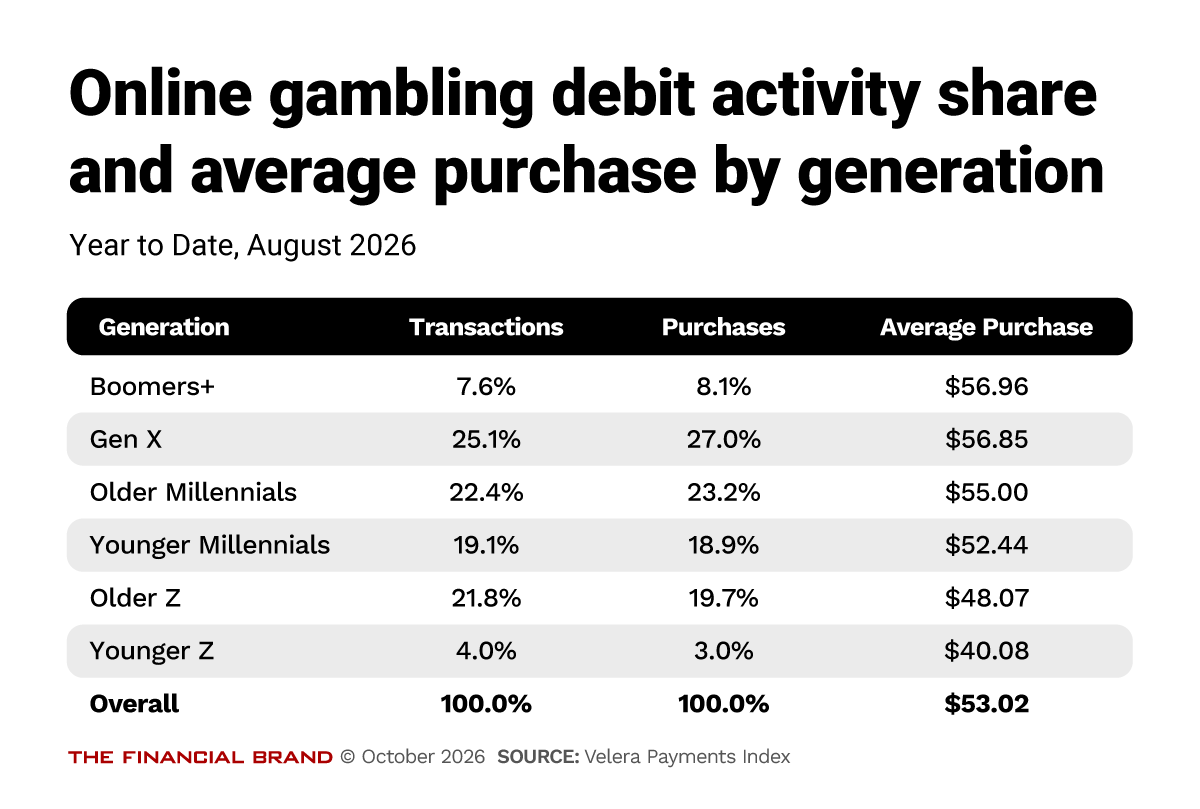
Key fact: But the level seen among the younger Gen Zers is a yellow light: They average $40.08 per bet.
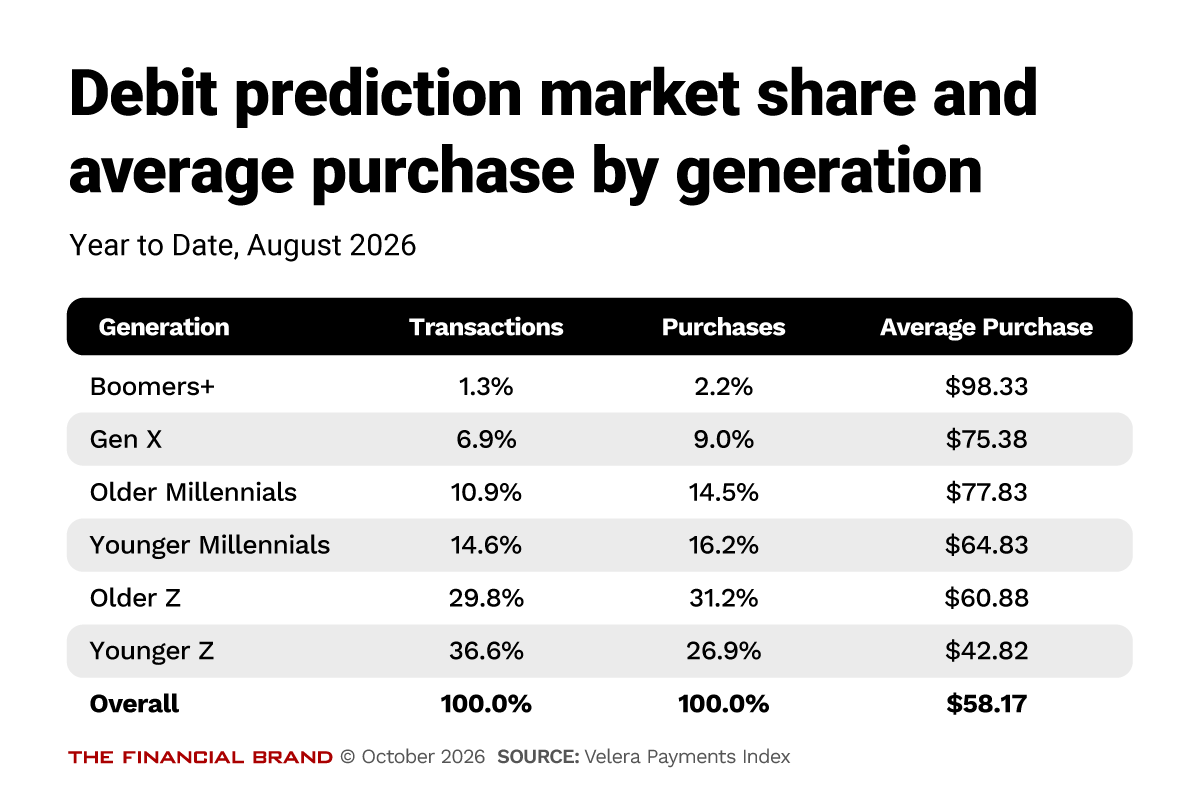
And Gen Zers both older and younger accounted for almost two-thirds of the prediction market betting tracked by Velera. And the younger Zers’ average “investment” in prediction markets is $42.82. (Prediction market companies press the viewpoint that what they offer isn’t gambling, but investments.)
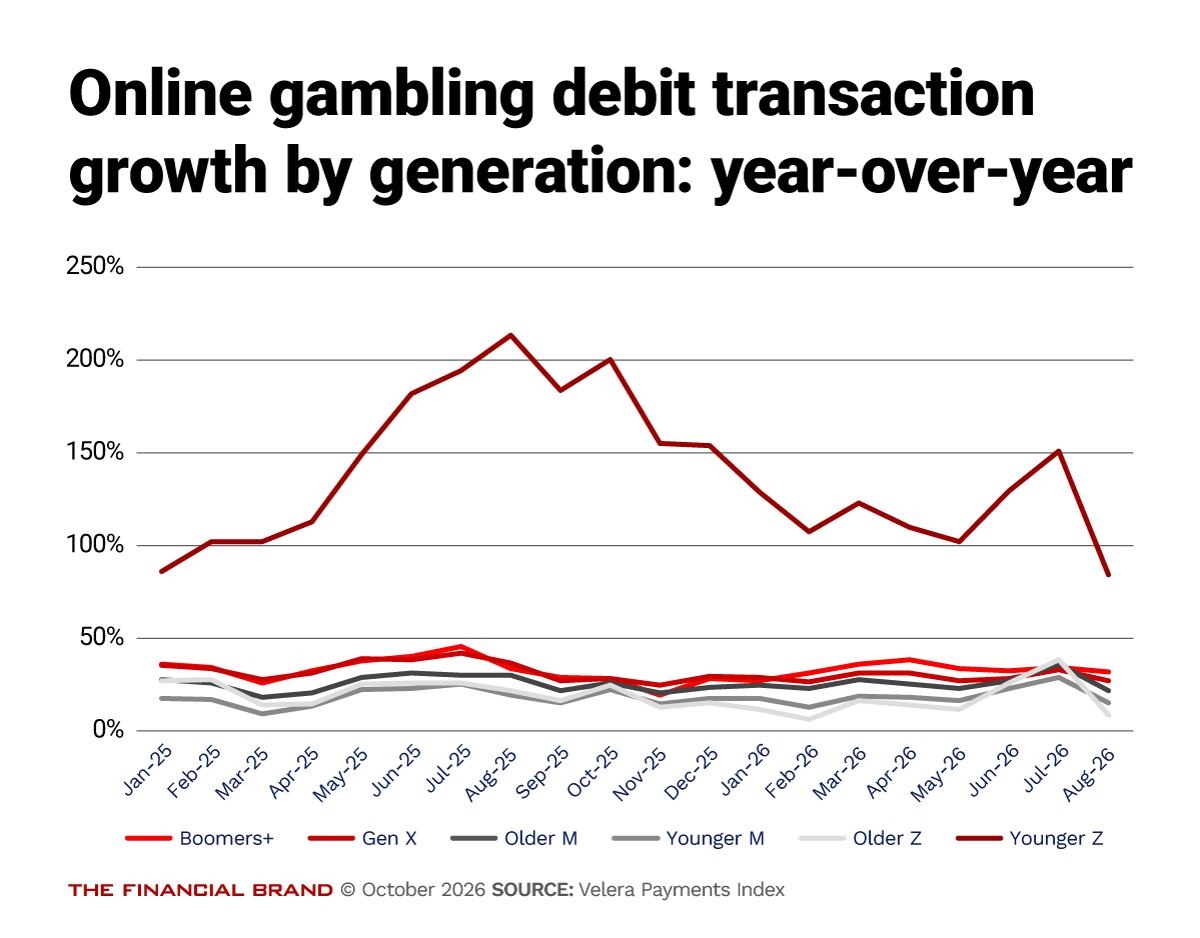
In addition, as shown by the chart below, growth in online betting via debit cards by younger Gen Z is significantly higher than the growth rate shown among all other age groups tracked.
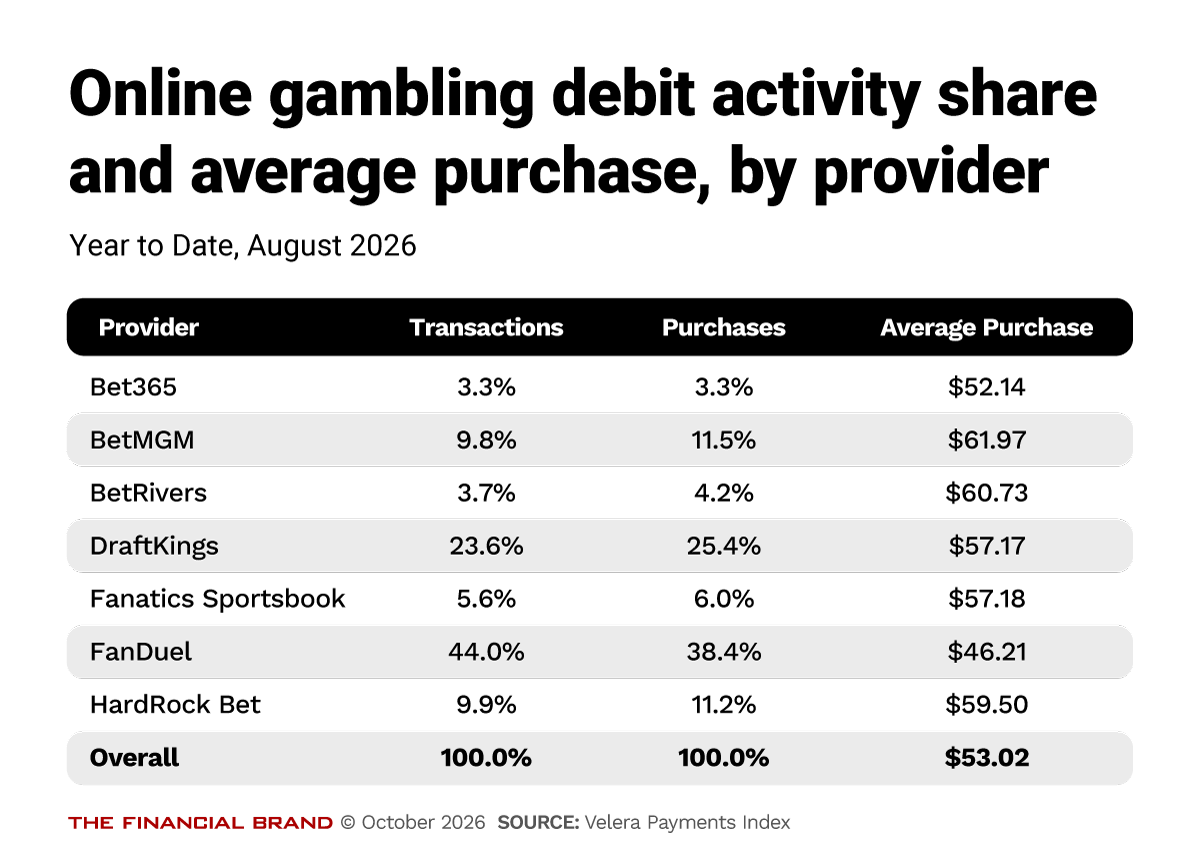
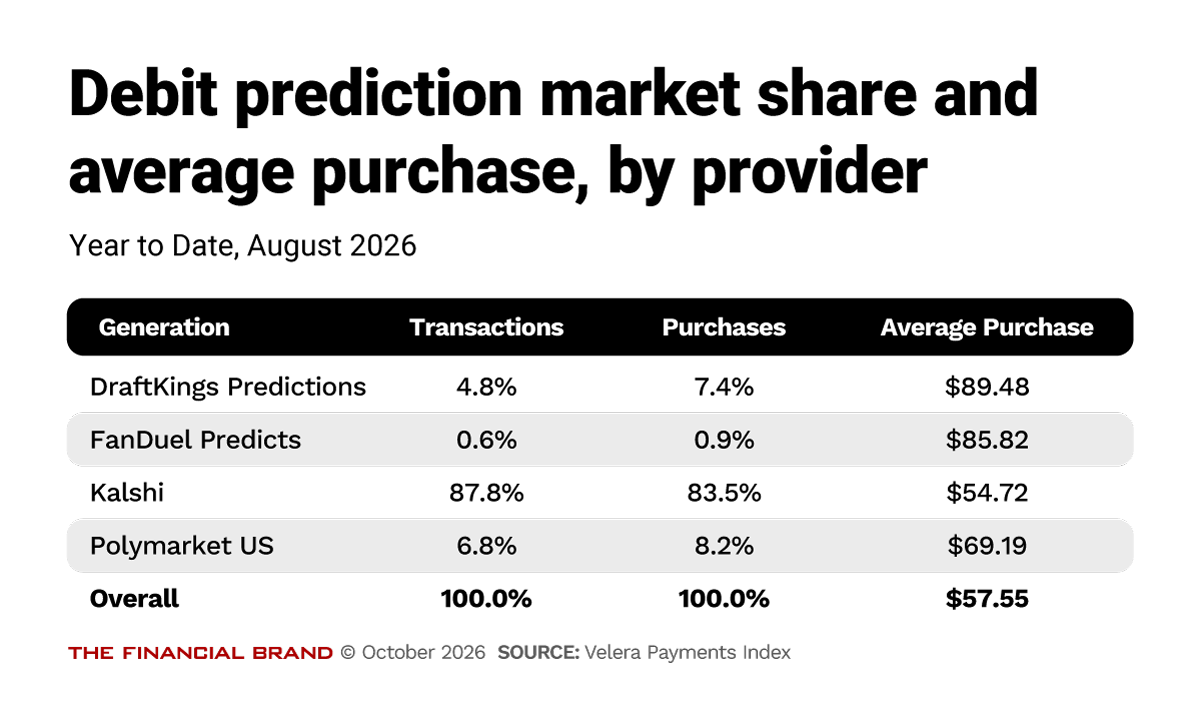
Velera also broke out the platforms that are pulling in the bets, including tallies of online gambling as well as prediction markets.
Other research underscores the potential risks that are brewing.
A recent study by Common Sense Media found that “more than a third of boys are gambling before they’re even old enough to vote.”
The report, “Betting on Boys: Understanding Gambling Among Adolescent Boys,” found that their exposure and involvement in gambling goes beyond the multitude of digital ads for betting and prediction platforms. The group said that many online computer games include transaction and reward systems that are a gateway to online gambling. More than half of the boys age 11 to 17 surveyed have spent real money on these quasi forms of wagering. Of the 36% who acknowledged gambling, 64% did so within online game environments. In addition, 34% engaged in some form of traditional gambling and 34% participated in some way in sports gambling.
The study found that 23% of boys who gamble in some form do so with permission to use parents’ or other adults’ credit or debit cards. But 8% use others’ cards without permission.
Read more: Don’t Mistake Gen Z’s Financial Stress for Financial Apathy
Early Thoughts on What Institutions Can Do
Though some of the data comes from credit union activity, both banks and credit unions face, and will face, the implications of online gambling. Gambling has always been around, from friendly poker games to office football pools to the horses, but now potential losing wagers are as close as one’s smartphone.
What can institutions do about this?
1. See who appears to be having issues and tailor content or conversation to them. Filene Institute notes that many bettors are “Helpful Help-Seekers” — financially stressed people who would accept guidance from their credit union.
2. Position banking products against gambling. Velera’s report points out that prediction market companies promote themselves as a form of investing and wealth building. This is an opportunity to talk about realistic achievement of long-term goals via savings and real investing. The company suggests that financial literacy training be re-oriented towards wealth building, instead of concentrating on traditional themes.
3. Take your messages to where younger consumers live. Social media and influencers beat the drum for gambling. Consider putting a more sober message in the same channels, but speaking at Gen Z’s level.
4. Play into the quest for dopamine, but in a positive way. Filene’s Mark Meyer sees a parallel between today’s situation and a point decades ago when lotteries were siphoning off potential deposits. This resulted in introduction of prize-based savings, programs some institutions offer where each deposit of a given size gives a consumer an entry in a prize drawing. The more you deposit, the better your odds.
Gambling sites often promote themselves with bonuses to players, such as FanDuel’s current offer of $250 for players who bet $5 a day for five days. Prize-based savings is one potential alternative, in states where the practice is legal.
“Sometimes what’s old is new again,” says Meyer.
Read more: Why the ‘K-Curve’ Demands Proactive Strategies from Banks Right Now


