
Is Your Bank Giving Consumers the Control Over Online Privacy that They Crave?
By Steve Cocheo, Senior Executive Editor at The Financial Brand
Simple Subscribe
Subscribe Now!
As concerns about fraud, identity theft and cybercrime continue to rise, many consumers seek ways to get themselves at least a little “off the grid” — or at least avoid going further onto it.
Yet only about half of major retail bank brands studied by Keynova Group give their customers the ability to set privacy preferences in the authenticated online banking area when applying online for a checking account. And only 30% of the institutions allow customers to set the type and frequency of promotional messages to the email address or phone number they provide.
“Banks have an important opportunity to strengthen customer trust through transparent privacy practices and greater control over marketing communications and data-sharing preferences,” says Susan Foulds, managing director at the firm.
Here’s why this is critical: Foulds says that banks still enjoy a leg-up over other financial services firms, in terms of consumers’ perception of them as trusted providers. It’s an edge they shouldn’t take lightly.
In the course of her firm’s research, which relies on opening actual accounts to monitor the user experience, she gives out significant contact information. In her experience banks tend to be less “grabby” with customer contact data than fintechs tend to be. This is a perception that she believes traditional institutions can play into by improving the privacy and marketing controls provided to digital customers.
Need to Know:
- Keynova’s Online Banker Scorecard for the first half of 2026 found that the 17 major institutions studied have, as a group, improved privacy controls, making online banking account enrollment easier to handle, and streamlining the ability to switch channels in the course of opening accounts.
- Improvements have been made in allowing online banking customers to ask questions during enrollment. But some banks still have to stop sending enrollees to numbers backed by interactive voice response systems that ask for account numbers — which, obviously, they don’t yet have.
- Features that online banking customers lost as mobile banking dominated product design have been creeping back, as the online and mobile experiences have increasingly merged.
- In a custom analysis for The Financial Brand, Keynova compared the typical bank digital enrollment with two leading digital-only brands, SoFi and Chime.
Refining Consumers’ Privacy Experience in Online Banking
There are two aspects of privacy — disclosures regarding privacy policies and data usage and consumer controls over the actual options.
On the disclosure front, improvement is still needed. Take online checking account applications. Every institution studied provides a link to its privacy policy when asking for personal information. However, only two out of five fully explain how they will actually use email addresses. On the other hand, almost two thirds of the group explain how they will use phone numbers.
Key point: Signing up for some “free” services can open a flood gate of email and text marketing messages. something consumers increasingly resent.
Foulds says that demonstrating to consumers that they can have some control on how their contact data will show institutions’ interest in customers’ preferences.
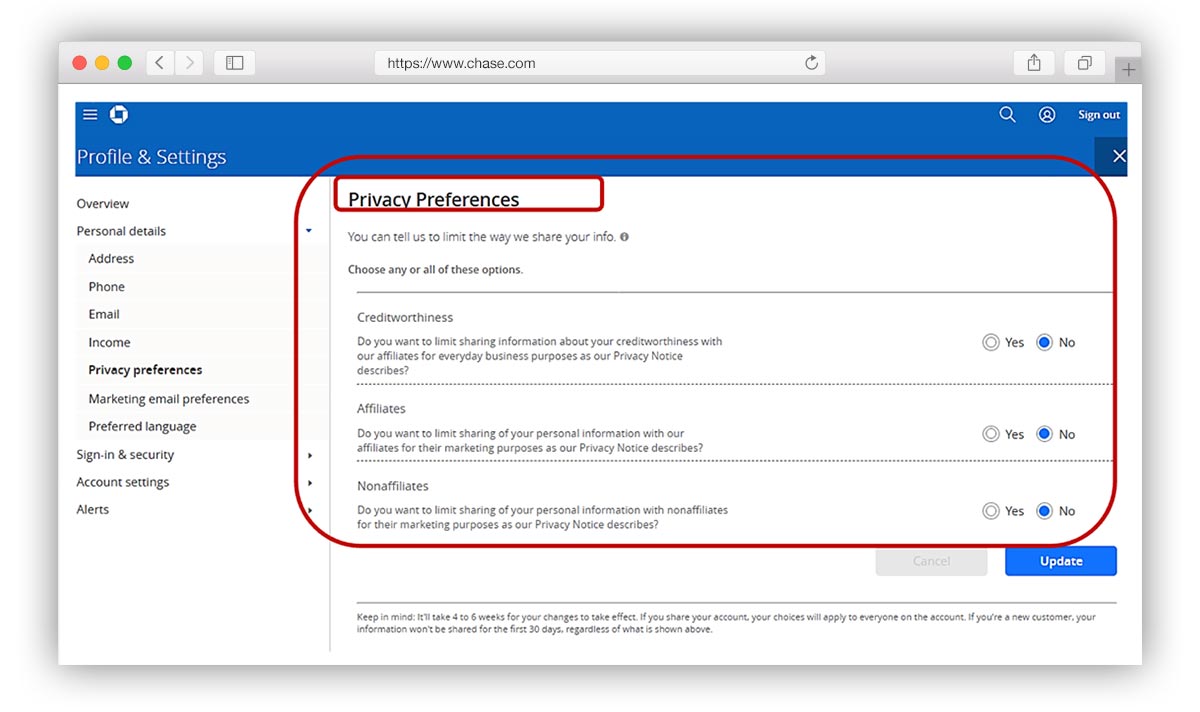
Foulds cites JPMorgan Chase as best-in-class in this regard, as illustrated in the pair of screens below.
Graphics courtesy Keynova Group
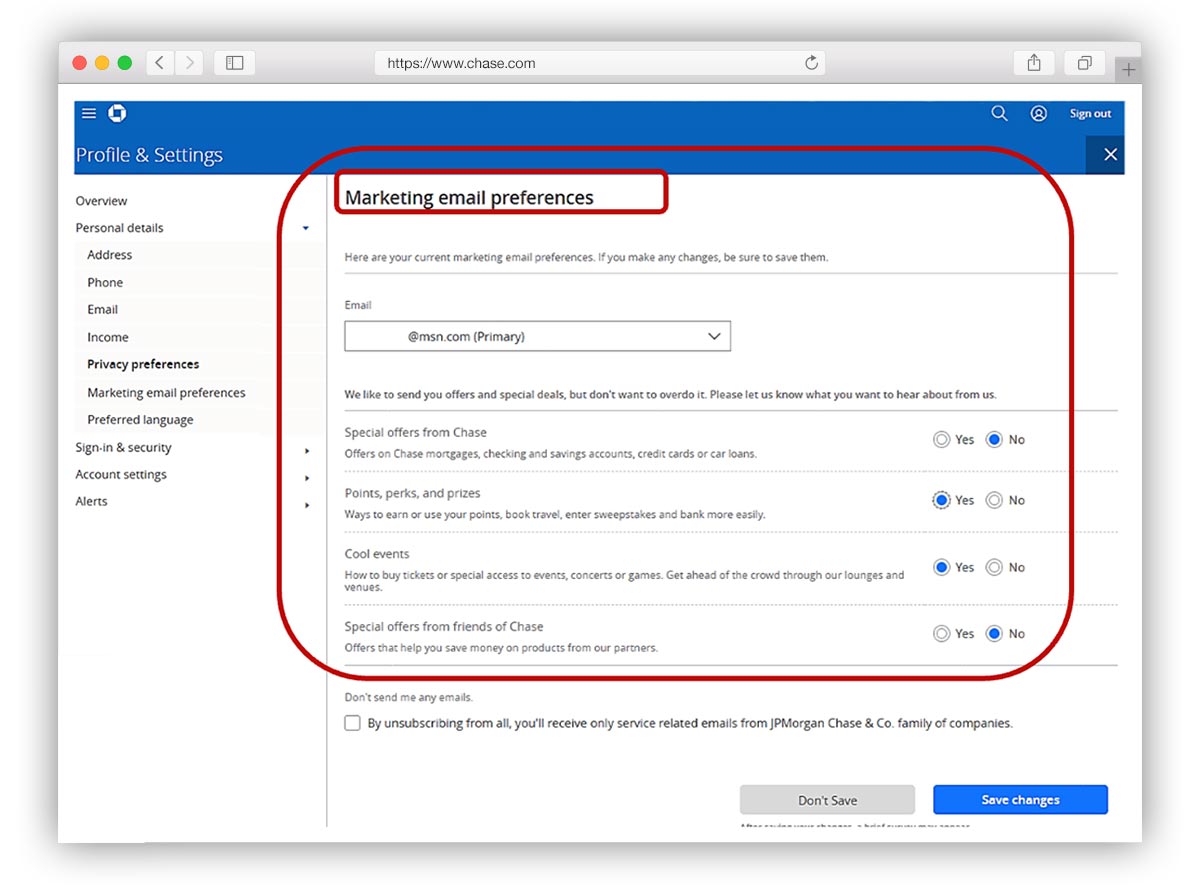
The Chase process takes things to a granular level, permitting four types of marketing messages to be toggled on or off. In addition, multiple privacy settings can be adjusted concerning data provided to affiliates and nonaffiliates.
“These are good, very clear screens,” says Foulds. She says Chase is smart to provide separate screens for privacy and marketing. Institutions that provide only an all-in or all-out option risk losing everything if a consumer actually has only one or two concerns.
Keep it all in one place. Keynova considers the ability to control access via the online channel to be a best practice, rather than forcing customers to request opt-outs through a separate channel.
Foulds also praises institutions that enable online customers to selectively hide accounts on screen so they can limit what may be seen if they are accessing their bank accounts in a public area or another situation where someone may see their screen.
Read more: How Many of These Mobile App Best Practices Is Your Bank Following?
Banks Can Avoid Abandonment by Making Requirements Clear Upfront
Would-be checking account customers bail out during the application process for any number of reasons. But Foulds says a common one is not making it clear what information the applicant has to have on hand to complete the application process.
“The best ones tell you everything you need in the introduction — social security card, driver’s license, and a debit card or check number to enable you to fund the account online,” Foulds explains. Not knowing about any one ingredient up front takes the customer away from the screen and potentially leads to abandonment.
Citizens Bank is among the institutions that do well with its introductory page, according to Foulds. One feature of its account flow that appeals to her is a series of questions to help narrow down the type of account best matching the person’s needs.
Other best practices that Foulds says can decrease slippage include:
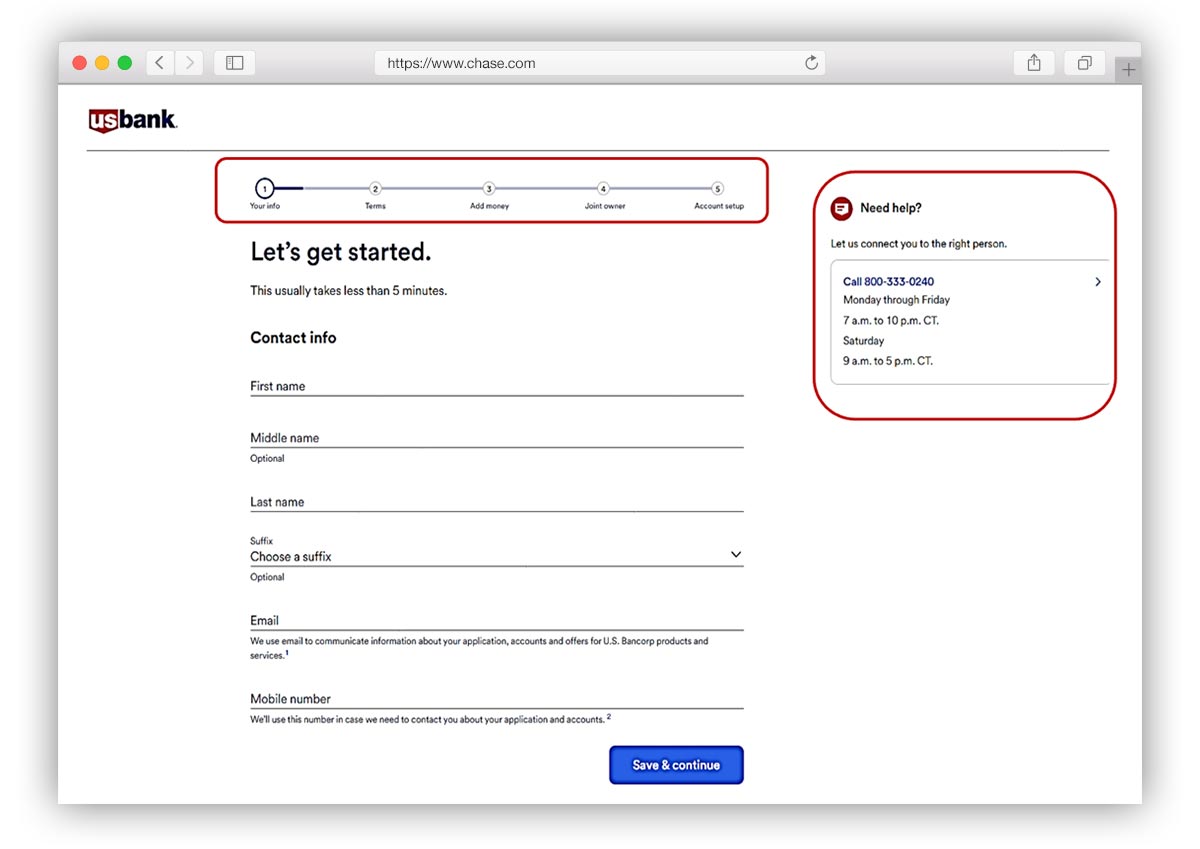
• Progress bars or other indicators of how far into the process an application is. 76% of banks studied offer that.
• Customer service contact numbers accessible within two clicks, with hours of availability. Keynova research found that live help is available within the account opening sites of 59% of institutions. Live chat is only available at 35% of sites.
Graphics courtesy Keynova Group
Read more: Can Traditional Financial Institutions Close the Mobile Gap?
Looking at Fintech-Style Account Flows
While SoFi, a fintech turned chartered bank, and Chime are not part of the study’s database, Foulds has been looking at the enrollment process used by companies like these that tend to compete for checking accounts, especially in targeted demographics.
Both companies’ enrollment processes fail to provide that upfront prep list, a curious gap for providers who put a lot of emphasis on digital convenience.
Foulds also found that both companies’ flows have a multitude of screens compared to traditional banks. Chime, for example, puts applicants through more than 16 screens and steps in the application and onboarding process.
Some of this reflects differing philosophies on customer experience, according to Foulds. Banks tend to try to cram more into fewer screens, in an attempt at streamlining. Players with fintech roots lean into more but simpler screens, to make the account-opening process look easier and friendlier.
Read next: How Banks Can Block Financial Scams Targeting Older Customers


