
How Truist Delivers Proactive Insights to Its App and Online Users
By Steve Cocheo, Senior Executive Editor at The Financial Brand
Simple Subscribe
Subscribe Now!
Traditional bank communication with their customers tends to be a rear-view mirror. Customers find out what happened, good or bad, rather than what’s happening or what could happen, especially when it comes to bad news, like overdrafts.
That’s like having a speed bump warning appear after the speed bump. With today’s technology, the relationship doesn’t have to stay that way.
Truist introduced an AI-driven service, Truist Insights, in 2023 to give consumer, small business and wealth management customers more timely updates, warnings and suggestions via the bank’s digital channels. Insights serves as a companion to Truist Assist, a virtual assistant introduced in 2022 that guides mobile app and online banking users through digital interactions.
Key insight: To Dontá Wilson, chief consumer and small business banking officer, Insights represents a very practical application of the concept of personalization based on customer data. AI delivers very specific input based on past behavior and financial trends.
The bank has seen a high degree of customer click-through, and recently surpassed two billion proactive messages sent via Truist Insights. Messages can be push notices and can also appear as in-context in the bank’s digital channels and in customers’ dashboards.
For Wilson, the bank’s use of AI illustrates where financial innovation needs to happen: “Let’s all stay grounded on solving problems and creating opportunities for clients,” says Wilson.
Need to Know:
- Truist sees over four million client sign-ins daily, overwhelmingly consumer banking accounts.
- Truist Insights delivers over 500 insights to the average customer annually.
- The bank’s consumer banking interactions lean heavily towards digital, with 70% chiefly using digital channels while 30% favor the company’s branch network. Two out of five new-to-bank customers comes to Truist digitally.
- Reflecting this split, Truist execs tend to speak in terms of “digital first, but not digital only.”
- Truist Insights, a wholly digital product, dovetails with related technology used in Truist’s evolving branch network, “Connection Tiles,” which prompts staff on the five best next steps to suggest to customers, based on AI analysis of their financial status and behavior.
How Truist Insights Adds Value to Customers’ Interactions
A good deal of financial management comes down to awareness, something that can escape many busy consumers. A key aspect of Truist Insights’ utility is what the bank learns about each customer over time, and how it can use AI to tailor alerts and suggestions to flag what they aren’t paying attention to.
Key insight: Predictive cash flow management is one of Insights’ most important facets, according to Wilson.
“We have the history of how much you tend to bring in, in income, every month, and we’re tracking your expense pattern over the month,” says Wilson. “We can tell, for instance, if by mid-month you’re likely going to overspend if you keep up that rate of activity.”
That drives a proactive alert. Wilson says many arise from mismatches of income and expenses.
What comes next is up to the consumer. Wilson says they might simply choose to throttle back their spending a bit, in optional categories like entertainment, for example.
“Or we might offer them an opportunity to make a transfer from their savings account to their checking account to help supplement their spending.”
Many other types of alerts are possible. One queries the customer when it looks like a merchant has put through the same transaction on their credit or debit card twice.
“Back in the day, you wouldn’t reconcile that until the end of the month, when you saw it on your statement,” says Wilson. “But now we can present it to you and ask if you meant to make two purchases for the same amount. That way if you didn’t, you can catch it and stop it.”
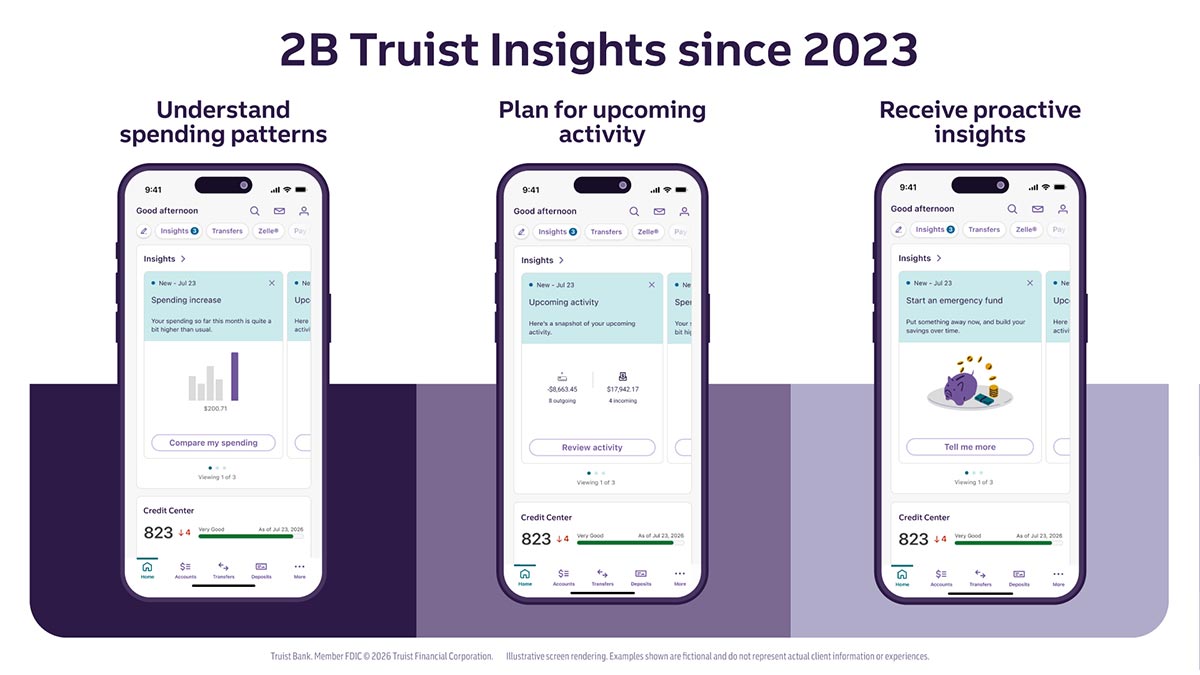
Advisories can also come through if the bank detects that the customer has excess cash in checking that could be earning something in a savings deposit. Another common alert category concerns subscriptions.
Avoiding Being the Annoying App
In today’s world, many of us get a plethora of messages that we frankly could do mostly without. Sign up for text alerts about prescriptions from a large national pharmacy chain, for example, and you will not only receive multiple reminders and queries about prescriptions, but a host of marketing messages, such as frequent reminders about in-pharmacy flu shots and other inoculations.
Reality check: Wilson says it’s critical for Truist to strike the right balance between timely insights and nagging.
“A major focus for us is using AI to be there at the right moment with the right information,” says Wilson. Thus, the frequency of alerts hinges on the depth and breadth of the customer’s relationship with Truist, and how much they do with their accounts — and how they manage them.
Wilson explains that one simple factor is whether the information is something that the customer can actually do something with?
While Insights may suggest opening a particular type of account, or moving to a different tier among the bank’s offerings, this channel is not used for indiscriminate marketing blasts that go to everyone. Such promos would defeat the purpose of Insights, according to Wilson.
Why this matters: “We’re looking for very tailored opportunities to help improve their financial lives,” says Wilson. “This is for real insights that can help them change and lead to better behavior.”
Read more: BofA Augments Internal EricaAssist with GenAI, Eyes Erica Virtual Assistant Next
Meanwhile, Over in the Branches…
Truist has been shifting its branches to a more consultative model. The bank is renovating many locations and has plans for adding 100 new locations to its network. Those will be sited in mass affluent markets, according to Wilson.
A key change, as part of the consultative approach, is what the bank calls “insight-driven” branches. The idea is to avoid generic conversations and bring out real-time aspects of the customer’s financial life that the bank can serve.
Beyond increased training for branch staff, the bank has added a new tool that uses AI-based analysis that’s similar to Truist Insights.
How this works: This tool is called “Connection Tiles,” introduced 18 months ago. When the banker sits down with a customer, the system analyzes the customer’s circumstances and sets up five products or actions on screen that respond to holes the AI sees in the relationship. For example, a large recent deposit sitting idly in checking could generate a query about opening a money market deposit account.
Not every Connection Tiles interaction represents a potential sale, says Wilson. Sometimes the banker may be prompted to do some anti-fraud education, for example. Or a product shift may be suggested, such as switching a deposit balance to a higher-earning opportunity.
Wilson says this takes the guesswork out of the appointment for the banker and provides aids to conducting the conversation. He sees this as consistent with the bank’s approach to virtual assistants. Truist Assist is designed to connect the customer with a human should the AI not be sufficient to execute what they need done.
“Some of our competitors don’t offer that ability,” says Wilson. “They want people to stay in their digital experience. We want to give customers the best of both.”
Read next: Resistance Is Futile: Don’t Let Apple’s Siri AI Push Your Bank Behind The Glass


