
What Really Is a Core Deposit Now? Customer Behavior Is Your Best Guide
By Justin Bakst, Darling Consulting Group
Simple Subscribe
Subscribe Now!
As the banking industry evolves through technology innovation including artificial intelligence, fintech, stablecoins and tokenized deposits, and the pending largest generational wealth transfer in U.S. history, financial institution liquidity, and specifically deposit relationship behavior, becomes a more-urgent industry issue — and something of a conundrum.
Customers — including households, businesses and municipalities — have more choices, information and options to move money than ever before. For the industry, that means a funding base that over the long term is more expensive, rate sensitive and less predictable.
Yet the industry still lacks a consistent answer to a basic question: What, really, is a core deposit today?
Why this matters: How each institution answers that question will increasingly influence pricing, liquidity planning, growth strategy, and competitive positioning.
Need to Know:
- There is no single industry definition of a core deposit, and how an institution defines “core” can directly influence strategy, pricing, and funding decisions.
- In the current environment, replacing lost deposits can cost roughly 25–40 basis points more than retaining existing relationships.
- Total deposit growth can hide meaningful churn. Two institutions with the same growth can have very different stories underneath the surface.
- Traditional factors such as product type, cost, account size and deposit insurance status are helpful, but they do not specifically tell you how stable or valuable the relationship is.
Revising the Definition of a Core Deposit
In a recent Darling Consulting Group poll, roughly 70% of financial institutions identified growing and retaining core deposits as their biggest deposit challenge for 2026 and beyond.
What is less clear is what the industry actually means by a “core deposit.”
Ask five bankers to define the term and you will likely get five different answers. Product type, cost, account size, and deposit insurance status are all useful, but they often miss the question that matters most: How stable is the relationship?
Key insight: A low-cost checking account that leaves tomorrow may be far less valuable than a higher-cost relationship that stays through multiple rate cycles. A low-cost relationship that is highly rate sensitive may ultimately be more expensive to replace than a higher-cost relationship that remains stable. Conversely, paying up for deposits does not automatically make a relationship valuable if it is “hot” money.
The ultimate goal: To understand how stable each relationship is, what it is worth, and what it would cost to replace.
Why it matters: The deposit environment has changed. How an institution defines core deposits influences where it competes, how it prices, which relationships it values, and where it invests resources.
Read more: How BMO is Leaning into Fundamentals to Drive More U.S. Deposits
The Deposit Environment Keeps Changing
Competition for deposits continues to expand across online banks, fintech platforms, high-yield savings accounts, brokerage accounts, money market funds, and emerging alternatives such as stablecoins and tokenized deposits.
Customers are also paying attention in the wake of a historic increase in rates, bank failures and intense competition for deposits. In many ways, customers are managing deposits more like portfolio managers.
DCG’s cross-institution data also shows how unusual the last several years have been.
Deposit relationship stability, as measured by DCG’s Deposits360°® Deposit Retention IndexTM (in the chart below) was relatively consistent for much of the period before the pandemic. During 2020 and 2021, government stimulus, excess liquidity, lower consumer spending and near-zero interest rates drove significant growth within existing relationships.
Then the environment changed quickly.
As rates increased, customers had reason to pay attention and alternatives available. Retention fell sharply in 2023 and has since improved, but it remains below its longer-term average.
Key point: The strategic question is whether the industry is simply working through the effects of an unusual rate cycle or whether something more permanent has changed in how customers manage liquidity.
If customer behavior has structurally changed, institutions cannot simply wait for deposit behavior to return to the way it was before 2020. Pricing, growth expectations and liquidity strategy may also need to adjust.
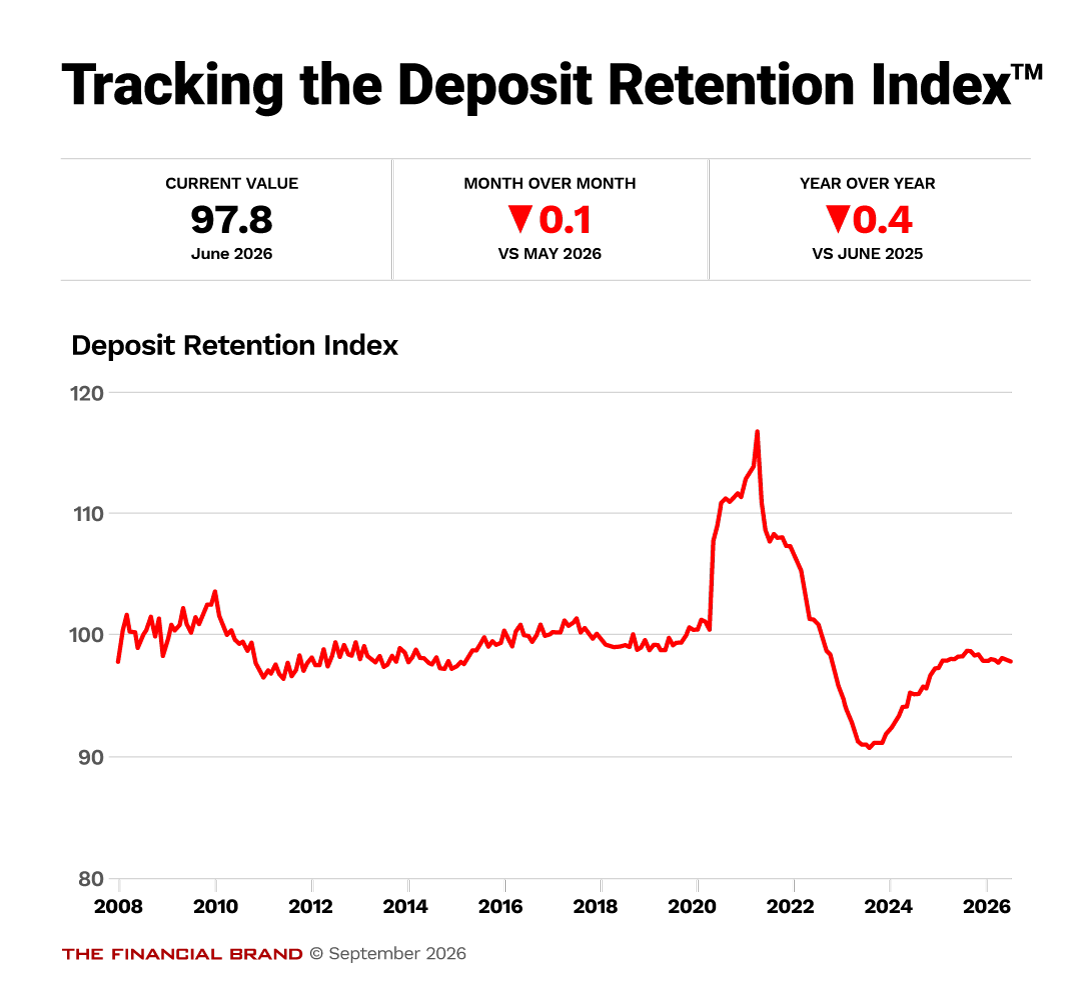
DCG’s Deposits360°® monthly Deposit Retention Index™ measures the percentage of deposit relationship dollars retained compared with the same point one year earlier. Because the Index focuses only on relationships that existed a year before, growth from new relationships does not affect it. The current reading of 97.8% means existing deposit relationships, in aggregate, hold 97.8% of the dollars they held one year ago.
Why it matters: The industry has moved beyond the unusual conditions of 2020 and 2021, but conditions have not fully returned to the pre-pandemic deposit environment.
Actions to take now:
- Understand how your customer base behaved through the last rate cycle and project how they may react given the most recent Federal Open Market Committee rate hike.
- Identify which relationships proved most resilient as competition increased.
- Look for customer segments where behavior changed most significantly.
- Create early warning indicators to identify meaningful changes in customer behavior before they materially affect funding.
Monitor factors such as relationship type, activity levels, relationship size, and the depth and breadth of the overall relationship. Use predictive models to develop a forward view of various “what if” scenarios and compare potential outcomes against the broader portfolio and industry trends.
Read more: Personalization Didn’t Save Bank Deposits, But Product Customization Can
Total Deposit Growth Can Mask Differing Behavior Patterns
Most institutions track total balances, new accounts, product mix and cost of funds. Those classic measures matter, but they do not always reveal what is happening within existing relationships.
Here’s a working example:
• Consider an institution that starts the year with $1 billion in deposits. It gathers $100 million from new relationships but loses $100 million from existing customers.
Total deposits remain $1 billion, but the institution replaced 10% of its deposit base just to stay in the same place.
• Now consider another institution that also ends the year with $1 billion in deposits but retained nearly all of its existing relationships.
• The headline number is the same, but what is happening underneath it is very different.
The first institution may be paying up to replace balances that continue to leave. The second may have a stable funding base but needs to generate new relationships to support growth.
Key insight: And there is a real cost difference between retaining and replacing funding.
In the current environment, DCG’s Deposits360°® analysis suggests that replacing lost deposit relationships with new relationships can cost roughly 25–40 basis points in interest expense. On $100 million of deposits, that can represent $250,000 to $400,000 of annual interest expense.
These two institutions should not have the same funding strategy moving forward. One may need to focus on retention, pricing, and relationship management. The other may need to invest heavily in acquisition, new markets, or product development.
Key insight: Two institutions can report identical deposit growth and still have very different competitive positions, funding economics, and strategic priorities.
Actions to take:
- Separate growth from new relationships and growth within existing relationships.
- Identify which customer segments are adding balances, and which are contracting.
- Determine the relationship and strategic dynamics between acquisition, retention, pricing or relationship expansion.
Read more: Want Lower CD Expense? Fix Your DDAs First
A Practical Way to Think About Core Deposits
There will never be a perfect definition of a core deposit.
A practical approach is to understand how the relationship behaves and what that means economically and strategically.
Six key questions executives should consider:
- Does the relationship remain through rate cycles?
- Does the customer maintain balances when attractive alternatives emerge?
- How rate sensitive is the relationship?
- How broad and valuable is the overall relationship?
- How difficult and expensive would those deposits be to replace?
- Is new growth expanding the franchise, or simply replacing money that continues to leave?
How this changes things: These questions move the discussion away from a static product definition and toward dynamic analysis.
Cost and stability are different but related attributes. Low-cost, unstable relationships require different game plans than a higher-cost relationship with proven stability and broader value. If two deposit relationships have the same balance but very different stability, rate sensitivity, and replacement risk, they should not be managed the same way.
This analysis should help determine where to price, where to spend time, and where the best opportunities exist.
Key insight: The goal is to build and retain relationships that are valuable, stable and help build long-term franchise value.
Some steps to take:
- Define what a valuable, stable relationship looks like for your institution.
- Identify the customer segments that matter most to long-term funding strategy.
- Evaluate relationships across cost, stability, rate sensitivity, and overall value.
- Use those differences to guide pricing, sales, retention, and growth strategies.
Read more: Why Deposit Profitability, Not Deposit Volume, Should Be Your Goal
So, What Is a Core Deposit?
As recounted, the old definitions no longer work. We like to think about a core deposit as a relationship-based deposit that an institution can expect to retain at a reasonable cost across changing interest rate, economic and liquidity environments.
Key insight: Your institution needs to go a level deeper than this definition to understand what it means for your own idiosyncratic deposit base.
The deposit environment is competitive, customers have options, and money can move faster than in prior cycles. Institutions need to understand the characteristics of those relationships: how they behave today and how they are likely to behave moving forward.
That insight can and will change strategy and competitive positioning.
The question going forward should be: What does a core relationship look like at my institution?
And what are we going to do differently today based on that definition?
Read next: To Compete for Today’s Deposits, Banks Need to Redesign Their Account Offerings


