
Personal Loan Levels Set a Record, But Fintechs Dominate the Race
By Steve Cocheo, Senior Executive Editor at The Financial Brand
Simple Subscribe
Subscribe Now!
Total outstanding U.S. consumer debt balances hit $18.6 trillion in the second quarter, according to a quarterly report from TransUnion. That’s a year-over-year increase of 2.8% and a three-year compound annual growth rate of 3%.
According to TransUnion’s calculations, nearly one in 10 Americans over 18 years old carry at least one unsecured personal loan, as of the end of the second quarter of 2026 — reflecting a steady uptick over the last few years.
At the same time, originations rose by 19.5% in the first quarter, according to TransUnion’s report, and indications are that demand will continue to grow as rising consumer debt levels lead more people to seek out consolidation loans for liquidity and rate relief.
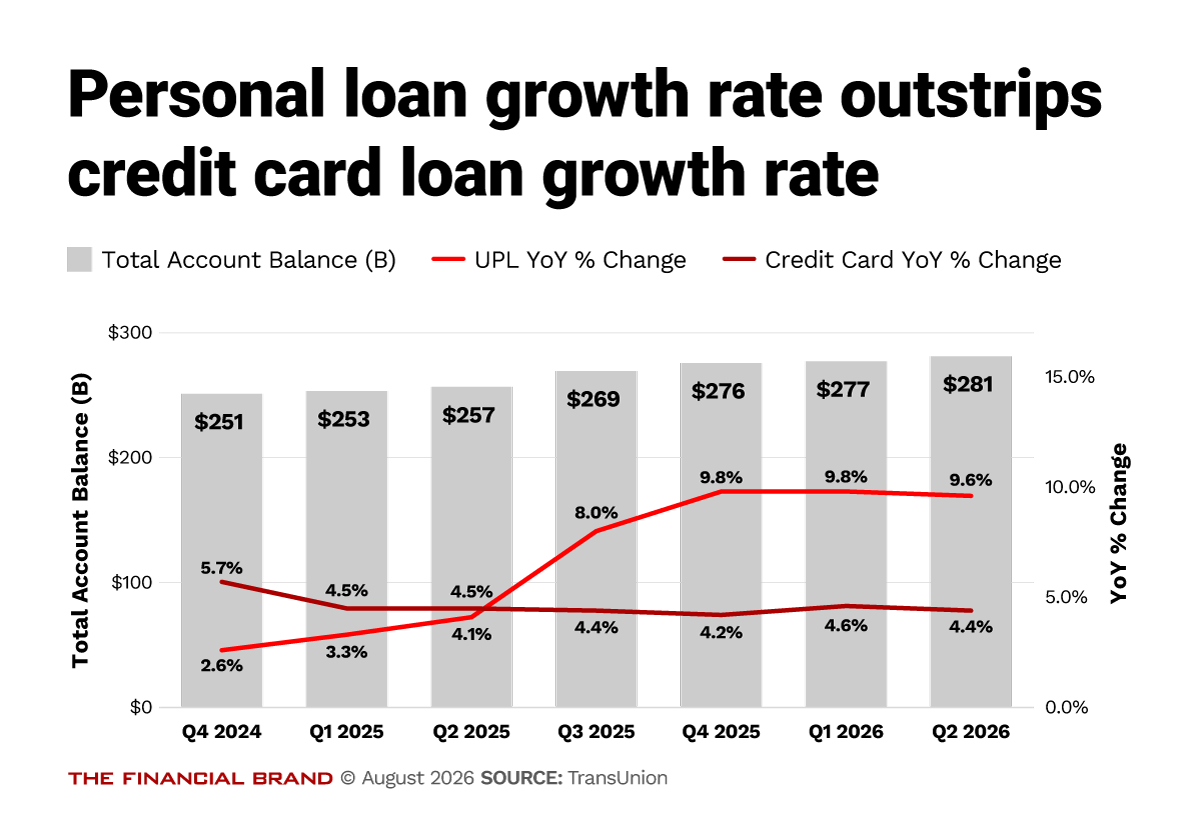
Competitive insight: While the pie keeps growing — up 9.6% year over year to a record $281 billion in outstandings, the slice for banks and credit unions has gotten smaller. Fintechs now have a much larger slice, reaching record levels.
At the end of the first quarter, 45% of originations came from fintechs, up 5.2 percentage points over the first quarter of 2025, per TransUnion. (The company reports originations one quarter in arrears.)
By contrast, banks’ share fell to 10.8% over the same period, down 2.3 percentage points. Credit unions’ share fell to 14.3%, down 2.2 points. Traditional finance companies have also lost share, at 26.9%, down 2.4 points, although they remain ahead of bank and credit union shares combined.
“Fintech lenders are helping to scale participation across the credit spectrum, making unsecured personal loans a more mainstream tool for both liquidity management and debt restructuring,” the credit bureau observed during a recent webinar.
Need to Know:
- TransUnion analysis indicates unsecured personal loan balances are growing at more than double the rate of credit card balances.
- Record growth for unsecured personal loans reflects larger loans for prime and superior risk borrowers, but also more loans granted. However, the average size of new loans to subprime borrowers shrank by 6.8%.
- The average unsecured personal loan debt balance per borrower hit $11,694 in the second quarter of 2026.
- While originations increased by 19.5% overall, the highest increases were seen at the extremes of the credit hierarchy. Subprime originations jumped by 29% year over year and super prime originations rose by 9%.
- Credit cards aren’t going away. In fact, some card companies allow cards to be used as means to obtain unsecured personal loans. TransUnion calculates that 78.9% of Americans over 18 years old hold at least one credit card now while 65.5% carry a balance.
Managing Rising Debt Levels
As credit balances continue to rise and many Americans face affordability issues, lenders turn to tactics like granting smaller credit lines to manage their portfolios. TransUnion says this reflects an effort to keep making increased credit available while maintaining control over exposures to individual borrowers, especially subprime borrowers.
Why this matters: “While consumers may be stretched right now with inflation, this gives them a bridge if they have a problem,” says Michele Raneri, vice president and head of U.S. research and consulting at TransUnion, in an interview.
The company says that the continuing expansion of credit does not seem to have resulted in significantly higher portfolio risk to lenders. “While borrower-level credit card delinquency rates increase year over year, balance-level delinquency rates are relatively flat,” according to TransUnion.
“Right now, it looks like their strategy of having lower credit limit increases for near-prime and subprime is looking good because the balance-level delinquency of most of the measurements is either flat or going down,” says Raneri. She believes this is giving them some leeway to conservatively push further into nonprime credit tiers.
“A lot of them have pretty solid portfolios,” she adds. “They’ve got a lot of revenue they can use for support if they have some shorter-term losses as they test their way into this space.”
Read more: Affordability Is Driving Consumers to Auto Loan Refis — and Opening a Growth Route for Lenders
Key Credit Areas Press on Consumer Budgets
The American way of debt hinges on multiple kinds of borrowing, all contributing towards the growth in unsecured personal loans.
Bank card originations increased for the sixth consecutive quarter in the first quarter, rising 11.8% year over year. The greatest growth was seen among subprime and super prime card holders. The average card debt per borrower in the second quarter came to $6,610, up 2.1% year over year.
Total bank card balances grew 4.4% year over year to $1.14 trillion. Consumer-level delinquencies also ticked up in the second quarter, with TransUnion attributing much of that to lenders adding more subprime card borrowers to their mixes.
Auto credit is a sticky spot. Rising new car prices have caused more people to explore used cars, but the pressure on borrowers still continues to increase.
“Payment growth continues to outpace both inflation and wage gains, even as interest rates have moderated and loan terms have lengthened,” according to TransUnion.
Since 2019, monthly payments have increased by 38.7% for new vehicles and 39.6% for used vehicles.
“The affordability challenge is a challenge for everybody, because new or used, it’s a pretty high payment,” says Raneri.
Today, the average monthly payment for new vehicles was $785 in the second quarter while the average for used vehicles was $544.
A new car loan averages a total price of $44,421 compared to $27,633 for the average used car loan. Overall, the average car loan balance was $25,219 in the second quarter.
Mortgage and home equity line originations grew in the first quarter. Total mortgage originations increased by 26% year over year, predominantly boosted by refinancing. Purchase mortgages were up by 5.8% year over year. Home equity line of credit originations increased by 16.8%.
The average balance per mortgage borrower was $272,628 — up 2.6% year over year.
Read more: Why Card-Based BNPL Is Poised to Become the Mainstream Pay-Later Channel
What’s Driving Personal Loan Growth
While multiple borrower groups contributed to the rise in unsecured personal loans, a key source of growth was subprime consumers. Subprime originations represented 38% of new loans, growing year over year in the first quarter of 2026.
This growing share for subprime has had an impact on credit performance. TransUnion found that borrower-level delinquencies of more than 60+ days past due increased to 3.81%, up 44 basis points year over year. Account-level delinquency increase to 3.33%, up by 30 basis points.
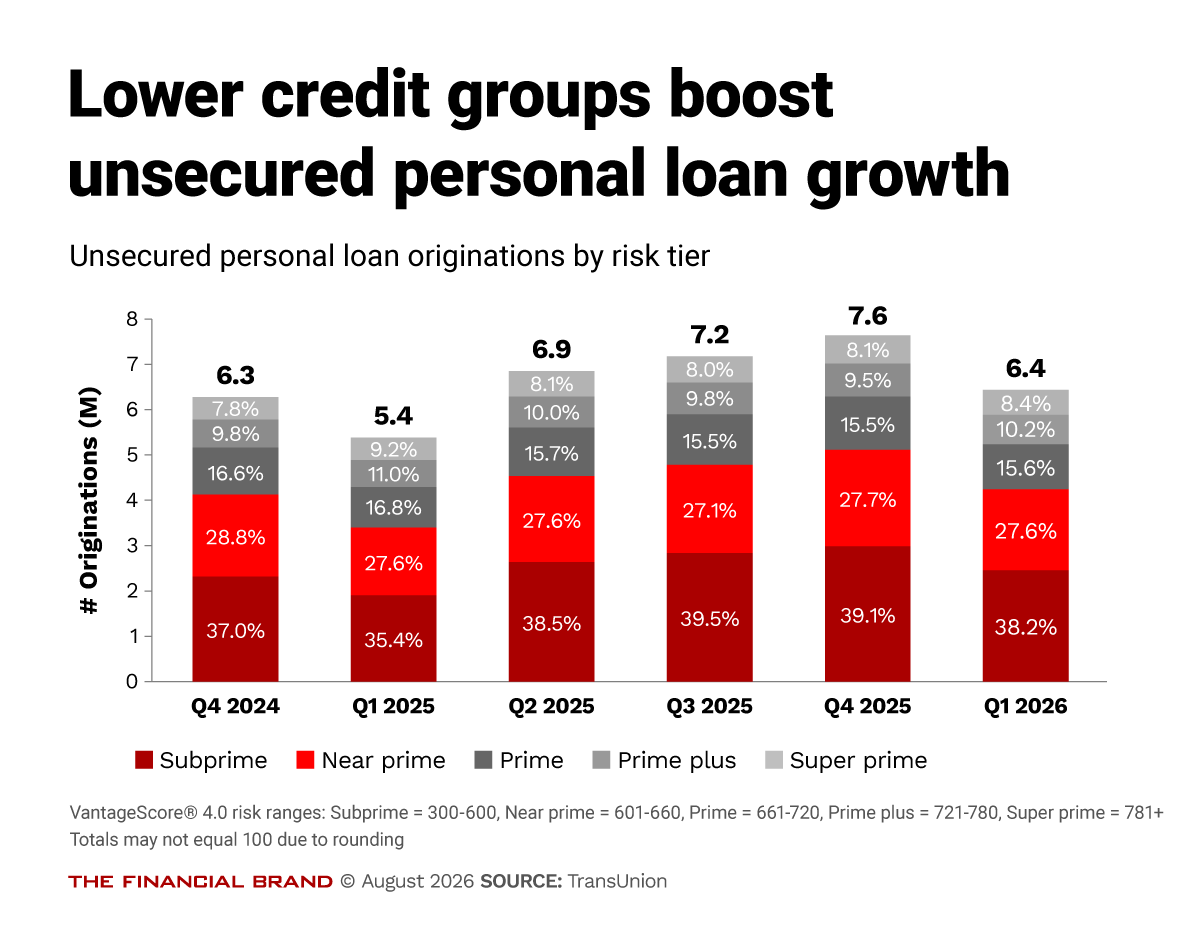
Despite this, newer subprime unsecured personal loans are now outperforming older ones. This reflects lenders’ current discipline, according to TransUnion.
Read more: How SoFi Powers Its Relentless Loan Origination Machine
Competing for Unsecured Personal Lending Business
During its webinar, TransUnion recommended steps to better compete for unsecured loans:
• Target prospects through prequalification and prescreening to identify better risks up front.
• Lean into new credit data formats. Using trended data and alternative data, rather than just a snapshot based on traditional credit measures, can help sift out better risks among non-prime tiers.
• Learn from fintechs. Part of what they sell is speedy evaluation and answers. Consumers are in a hurry.
A recent analysis of the market by JD Power for The Financial Brand presents a deep dive on how to compete with fintechs. A notable point is that while they are winning, customer satisfaction levels with fintech personal loans are lower.
Read next: How Privatization of Student Lending Creates Opportunity — and Risk


