
To Compete for Today’s Deposits, Banks Need to Redesign Their Account Offerings
By Steve Cocheo, Senior Executive Editor at The Financial Brand
Simple Subscribe
Subscribe Now!
As more banks seek to build deposits, fintechs enjoy advantages in the battle for consumers’ savings and checking accounts. The key to turning the tide for many banking institutions will be to adopt more of the policies and strategies that work well for fintechs and fintechs-turned-banks.
Key insight: This is especially important for institutions that seek deposits in the mass market, according to Jennifer White, senior director, financial services intelligence, at JD Power.
The firm defines mass market as having income under $150,000 and investable assets under $100,000.
Need to Know:
- It’s easier than ever for depositors to open accounts with competitors and fragmented financial relationships are common.
- JD Power data indicate that more “soft churn” is going on than “hard churn.” That is, people are opening additional accounts more than shifting primary providers outright.
- More specifically, for checking accounts, JD Power found that 49% of openings were soft churn, and only 25% hard churn. In the savings account category, similarly, 46% of openings were soft churn, while 19% were hard churn.
Who’s Winning the Race for New Checking and Savings Accounts?
In JD Power’s first quarter 2026 edition of its Financial Services Churn Data and Analytics report, Chime continues to be in the top three places in acquisition of checking (#1) and savings (#2) accounts overall. Chime’s greatest strength is in the mass market segment.
Chime achieved the highest share of new checking accounts in the first quarter, according to the research, at 12.4%, repeating its win from the fourth quarter of last year. It outdistanced Chase, Wells Fargo, Bank of America and SoFi, among others.
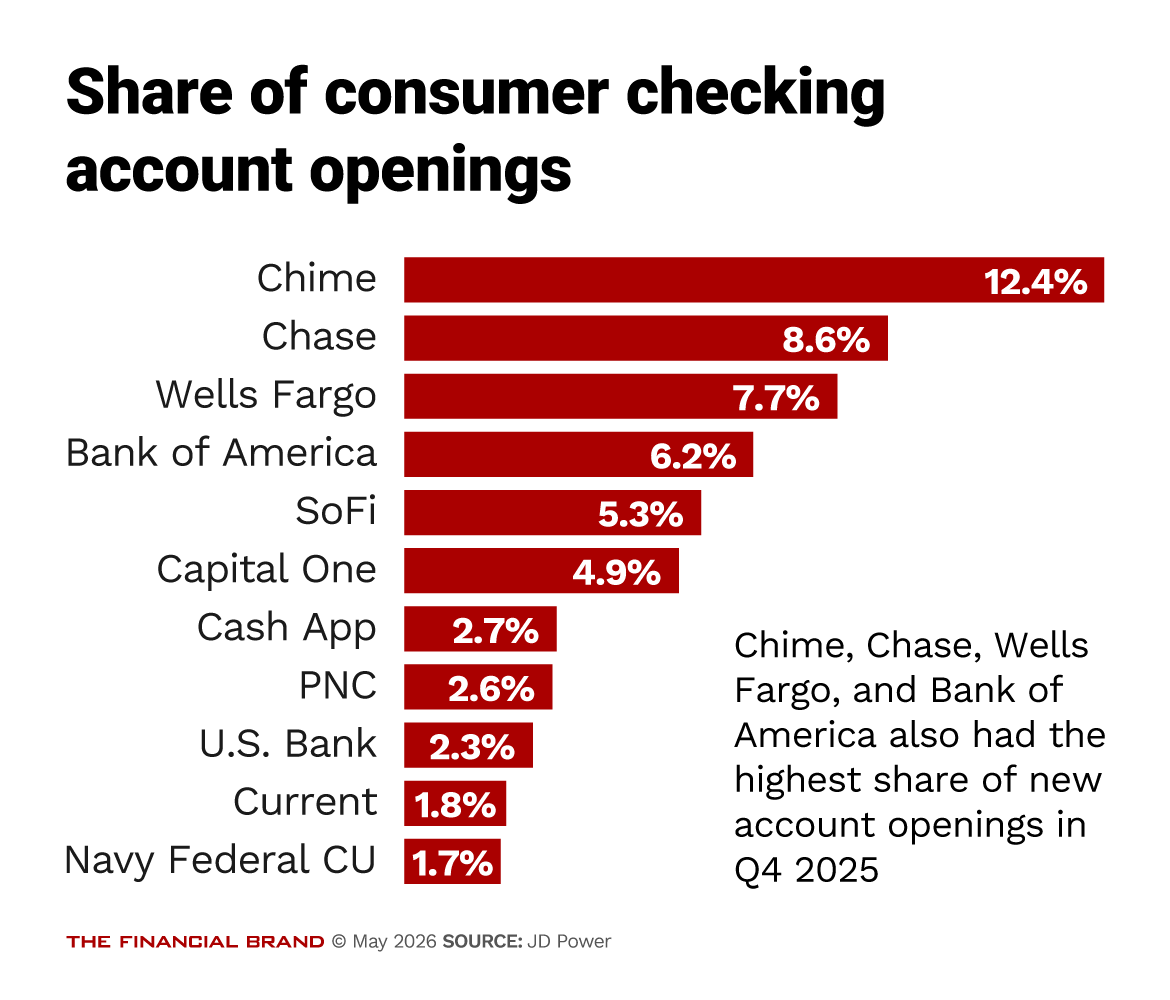
In terms of conversion rates, fintechs and SoFi, now a bank, dominated:
Current 76%
Chime 76%
SoFi 72%
Cash App 65%
Navy Federal Credit Union 62%
Capital One 60%
PNC 53%
U.S. Bank 49%
Chase 45%
Wells Fargo 45%
Bank of America 42%
JPMorgan Chase topped the ranking for savings account acquisition, at 8.4% of openings, with Chime just behind at 7.1%.
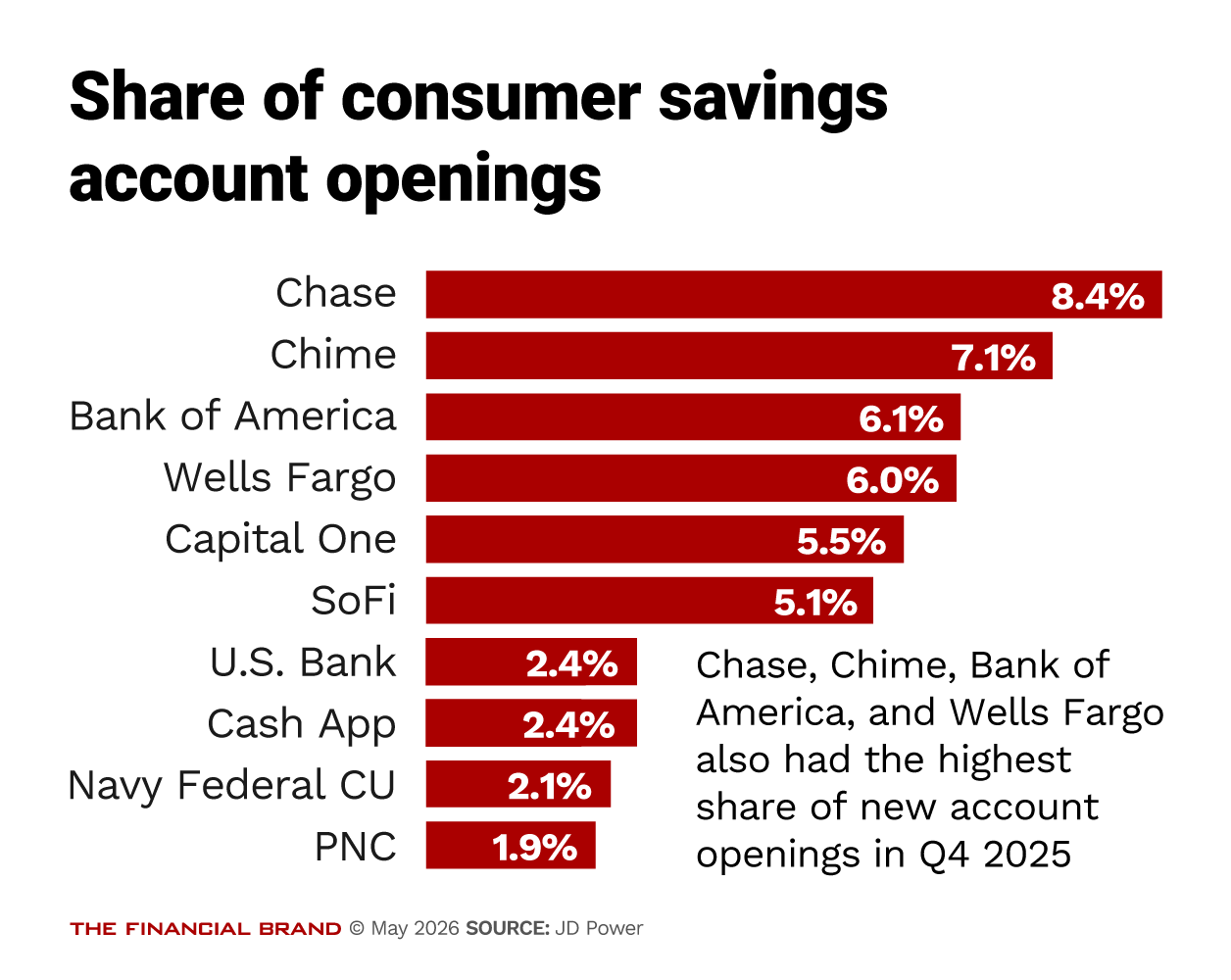
In terms of conversion rates, fintechs dominated the top five positions:
Chime 82%
Cash App 76%
Navy Federal CU 75%
SoFi 74%
Capital One 71%
U.S. Bank 71%
PNC 63%
Chase 61%
Wells Fargo 57%
Bank of America 55%
Read more: How LendingClub Is Wielding Its Bank Charter to Steal Your Customers
Why Are Chime and SoFi Winning? Affordability
White says that while Chime and other fintechs are encroaching on banks’ turf, their strength, overall, is among the mass market customers.
“When we look at affluency, their ability to capture new account openings is lower, notably with Chime,” says White.
• In mass market checking, Chime has a 14.2% share, first place, but drops to 7% and fourth place for mass affluent and falls to 2.8% and ninth place in the affluent category.
• In mass market savings, Chime has a 9.4% share, first place, but falls to 3.3% and sixth place, for mass affluent and doesn’t place in the top ten ranks for the affluent category.
(The company defines mass affluent as people with income of $150,000 or more, and investable assets of under $250,000, or, alternatively, as income under $150,000 and investable assets of $150,000 or more. Affluent customers are defined as people with income of $150,000 or more and investable assets of $250,000 or more.)
She adds that SoFi presently skews towards more affluent customers than Chime. In the checking area, SoFi has a 5.4% share in the mass market, fourth place, 7% in mass affluent, fourth place, and 5%, fifth place, among the affluent.
Chime’s acquisition pattern among the wealth categories could change. Going back to its much-awaited initial public offering, last June, Chime was talking about reaching further up in income level in its promotions. Then, in early April, Chime unveiled a new customer tier, Chime Prime, featuring 5% cash back in their chosen category, 3.75% APY on savings accounts, and premium rewards and perks. To qualify for the new level, Chime customers must receive at least $3,000 in monthly direct deposits.
Read more: The Classic Checking Account Doesn’t Meet the Needs of Today’s Consumers. Here’s How to Fix It
How Savings ‘Buckets’ in Accounts Can Counter a Key Fintech Strategy
White says part of the appeal of fintechs is that they tend to be very tied into consumer pain points — it’s part of what got them off the ground. One of them is the desire to be able to isolate savings towards a specific goals, or even multiple goals.
She explains that in the past this has caused many consumers to open separate accounts dedicated to those goals. They may even open them at an institution besides their primary provider, to mentally seal off the money. Fintechs, often offering fee-free accounts, are an attractive place to open such relationships. Such accounts can be smaller in the beginning, as balances build towards the goal, and could be subject to fees at a bank.
Key strategy: As White describes this trend, it can be an affordability play, and there’s no reason banks can’t participate in the same game. Beyond the price attraction, fintechs often offer the ability to set up multiple “buckets” within a single account that depositors can use for their goals.
• Chime, for example, has its Savings Goals service, accessed via its app, which includes progress bars and a celebratory message when the saver hits the goal.
• SoFi offers SoFi Savings Vaults, which not only provide segregation, but options to help meet goals, such as rounding up debit card transactions to add the spare change to the chosen bucket.
• Current offers Savings Pods — up to three can be open at a time and they receive an annual bonus rate, subject to requirements.
Key insight: White recommends that more banks rethink their deposit product lineups to include these key features:
• The ability to segregate deposits for different purposes within the same accounts, to help people budget and save towards goals.
• Access to real-time balances, so consumers know exactly what their actual balance is at all times.
• Clearer information regarding availability of funds when money is transferred into accounts and when it is transferred to others’ accounts.
White points out that Ally has been offering its own buckets for years and that Capital One is piloting such an arrangement.
Beyond the mass market: While this setup has appeal to people on tight budgets — it’s a digital equivalent of the old “envelope system” — White says it has appeal to mass affluent and affluent customers as well.
“They’re the ones who are going to be most likely to be setting aside money for a vacation or a large purchase and still actively funding that” in this economy, she says.
Read more: Banks Lost $3 Trillion to Fintechs in the Last Five Years. Blame the Primacy Myth
Banks Have to Synch Up with Gen Z’s Views on Money
Younger consumers gravitate towards fintech accounts and White says banks have an opportunity if they begin to change their mindset in terms of checking and savings. The bucket approach can help.
“One of the challenges about Gen Z is that they don’t think in terms of traditional checking versus savings,” says White. “They think about money in different ways. For them, there’s everyday spending versus savings accounts.”
She adds that banks shouldn’t be surprised when Gen Zers open up multiple accounts in order to manage their money based on that mindset. Fintechs will continue to draw these customers’ funds if banks don’t accommodate them.
Another insight: Gen Zers doesn’t understand why they can’t draw on their funds right away or know to the penny what their balance really is.
White says the nuances about account balances that older generations may have grown to accept are lost on young customers. She had a conversation with a younger reporter recently who expressed disbelief that some banks don’t provide real-time balances. The reporter found the idea of batched processing, which holds up real-time balances, to be inconceivable.
Yet White says JD Power data from other research indicates that one in five banking customers today don’t have access to real-time balances.
“As our technological world spins faster,” says White, “tolerance for lack of up-to-date information will become lower and lower.”
Fintechs frequently offer early wage access or small, interest-free loans to tide depositors over. This ties into the availability of real-time balances. Many younger customers live financially closer to the line than do bankers from Gen X or Gen Y.
“I’m Gen X and privileged enough to not need to know that I could overdraw in a moment,” says White. The younger customers of fintechs place a value on helpful services that bankers must take note of.
Read next: Gen Z Is Redefining Primary Banking Relationships Faster Than Banks Realize


