
Surging Home Equity Credit Demand Blurs the Lines Between Banks and Fintechs
By Steve Cocheo, Senior Executive Editor at The Financial Brand
Simple Subscribe
Subscribe Now!
Executive Summary
- Rising consumer debt, homeowners housebound by rates and next-home prices, and the pressure for upgrades all feed the need for still more credit.
- Massive amounts of tappable equity, driven in part by the rise in home prices, make borrowing on the house attractive again. Home equity options, rather than cash-out refis, pencil out better, and will continue to do so.
- After nearly five years out of the home equity business, Chase is back, but with a very different approach that straddles the bank-fintech line. Other banking players are watching closely.
Home equity credit is booming and a growing number of players want a piece of that pie.
Take SoFi, a blend of bank and fintech. During a second quarter earnings briefing Anthony Noto, CEO, reported that the company’s home lending originations had hit nearly $800 million in the quarter, a 90% year-over-year increase in spite of a higher-rate environment that has slowed mortgage growth.
How did SoFi do it? The company launched a home equity credit operation in 2024, and, less than a year later, home equity lending accounts for nearly a third of SoFi’s home lending volume. And that’s just for starters. Noto told analysts that the bank has nearly 3 million customers — which SoFi calls members — who have home loans with other institutions.
Courtesy of Comperemedia, a Mintel company
“We believe we are well-positioned to capture a significant portion of the refinance volume as the rate environment improves,” Noto said.
SoFi’s numbers impress, but when the nation’s largest bank returns to the home equity arena after an absence of almost five years, that makes a huge splash. JPMorgan Chase may have slow-rolled its return over the course of 2025, but make no mistake: It is changing things up.
Typically, bank home equity credit lines haven’t been issued with a mandatory draw-down on the line, leading many borrowers to treat them as convenience credit. Fintech lenders, on the other hand, have entered the fray in recent years with the requirement that borrowers draw down substantially or completely. The reason: Fintechs generally sell the credits that they originate. Investors want to buy actual assets, not baskets of “ifs” and “somedays” that haven’t actually turned into profitable credit.
One example is Figure Lending, a major fintech presence in HELOCs both directly and through partner financial institutions. Figure, a subsidiary of Figure Technology Solutions, went public in September.
With its new product, Chase is requiring a drawdown at the outset of at least 85% of the credit line — effectively putting one foot in banking tradition and one in fintech territory.
Meanwhile, as fintechs and independent mortgage banks build volume in home equity credit, other longstanding players also keep at it. For example, Citizens Bank remained the top home equity lender of all kinds — by dollars of originations — in the quarterly rankings compiled by Inside Mortgage Finance.
As demand for home equity credit has heated up, both banks and credit unions have been even more aggressive in the wake of the Federal Reserve’s mid-September rate cut, according to Marisa Frys, analyst at Comperemedia, a Mintel company.
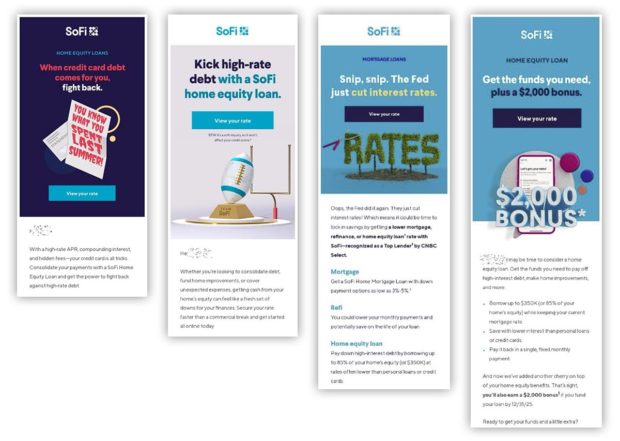
Right before the rate drop, Chase launched Facebook advertising to familiarize people with the idea of HELOCs. Since the rate cut, Frys says, SoFi has been pouring it on with email promotions for home equity credit. Frys says that others have also been actively pushing home equity credit, some lenders leaning into home equity loans — closed-end second liens — and others into HELOCs, open-end secured lines.
Chase hasn’t been alone in bringing new approaches to an area that’s been cut and dried. Beth Robertson, managing director at Keynova Group, recently studied home equity product trends as part of a broader home lending project and found that other lenders, both banks and nonbanks, have been shaking things up.
For instance, some lenders are offering fixed-rate conversions for HELOC draws. And Keynova research found that a growing number of lenders, notably Citibank, offer qualifying HELOC borrowers the choice of making interest and principal or interest-only payments during the draw period – an option that improves affordability, according to Robertson. She points out that for people who hope to move up to a bigger home, who are making interim improvements, never paying principal, that’s an attractive option. (Note that Citi’s interest-only offer has a qualification: Post-closing the borrower must have $200,000 or more in post-close traditional bank products with Citi, or $1 million or more in total investable assets.)
Let’s look at some figures.
Read the companion article: Success in Home Equity Hinges on Quality (and Fast) Customer Experience
Home Equity Credit By the Numbers
Originations of home equity credit — both home equity loans and HELOCs — are on pace to top originations in 2022, which had been the post-2008 peak, according to the second quarter report from Inside Mortgage Finance. At the six-month mark, originations in dollars are up 0.4% over 2022.
However, a more dramatic indicator is the year-over-year comparison. The publication reports that originations for the first six months are up 24.8% over the same point in 2024. The publication also noted that the HELOC share of production is down somewhat from 2022, but that the lines of credit still overshadow the loans.
The publication also reported that an estimated $74.2 billion of new commitments for home equity loans and HELOCs were originated in the second quarter. That’s an increase of 27.3% from the first quarter.
“Generation X and Baby Boomers accounted for the majority of home equity originations, highlighting strong demand among established homeowners with significant equity to leverage,” TransUnion said in its recent mid-year consumer credit market report.
Another perspective, from the September ICE Mortgage Monitor Report: Homeowners withdrew $52 billion in equity via home equity loans and HELOCs, as well as cash-out refinancings, “marking the largest single quarter of equity extraction in nearly three years.” (Cash-out refis remain a significant factor, though for many homeowners with lower-rate primary mortgages they are not being offered at advantageous rates.)
In its August report, ICE Mortgage Technology estimated total home equity at $17.8 trillion and tappable equity at $11.6 trillion. The latter figure consists of equity that can be borrowed against while allowing for a 20% equity cushion. The company said that the average mortgage holder has $213,000 available in tappable equity.
All this is in spite of a force keeping the lid on actual demand, according to ICE Mortgage Technology’s report: “While equity extraction edged higher in the quarter, that rate remains roughly half of its normal level, as elevated interest rates continue to dampen borrowing activity.”
Read more:
- How a California Credit Union is Growing HELOCs with a Fintech Partnership
- Citizens Bank Insulates Against Economic Turmoil With Focus on Upmarket Consumers
- Opportunity Grows in Home Equity, And So Does Competition
Perspectives on the Numbers
“Home equity lending will thrive for the foreseeable future, even with additional rate cuts this year and even next year,” according to Ken Flaherty, senior manager, retail lending, at Curinos.
He says that’s because “rates still have to come down about another point and a half for most existing mortgage holders to say, ‘Maybe it actually makes more sense to leverage a mortgage cash-out product as opposed to a home equity product’.”
Flaherty notes that roughly two-thirds of current first mortgage borrowers have a rate less than 4.5%.
“No matter how bullish you are, we’re not going to hit 4.5%,” says Flaherty in an interview with The Financial Brand. “We’re probably not even going to see high fours. Maybe if we get really lucky, we might see high fives, a year from now.”
For many homeowners, that will make home equity borrowing more attractive, for some time. However, Flaherty adds that there is some bifurcation in the picture.
Homeowners with decent primary mortgage rates, but who took a second lien as a home equity loan in the last 18 months are paying a higher rate on that equity credit. A rate drop on mortgages to the mid fives, he says, could result in a lower monthly payment if they refinanced both the primary mortgage and their home equity loan with a cash-out mortgage.
“It depends on how seasoned their mortgage is, and on their overall financial situation,” says Flaherty.
Where is the flipping point, when cash-outs reign and home equity credit fades?
“I don’t know that things will flip, honestly, because there are so many borrowers who are locked into rates on mortgages that we’re not likely to see anytime soon,” says Adam Boyd, EVP and head of consumer lending at Citizens Bank. He sees the cash-out refi as an option for more mortgage holders as rates come down and they are “in the money.”
However, “I don’t think that means we’re going to see a meaningful decrease in home equity demand because there’s a lot of equity out there and the product is well-positioned today,” Boyd continues.
Both Boyd and Flaherty note the effect of high home prices on borrowers’ mobility. Many that might have traded up earlier are house-bound by their low mortgage rates.
“They’re staying in their homes longer because that next house they want to buy is still really expensive, even though inventory is easing,” says Flaherty. “There’s the price of the home, where interest rates still are, but also taxes and insurance costs, which are skyrocketing.”
But it’s not just about the cost of housing.
Flaherty points out that other major credit has become more burdensome. Another traditional reason for home equity credit has been debt consolidation, in order to reduce overall interest charges.
Many borrowers face car loans now that run much longer — on much costlier vehicles — than used to be the case. Add high credit card balances and student loan debt and a home equity bailout begins to look attractive.
Flaherty believes many who don’t have other plans for major expenditures would like to get some degree of cashflow relief. Research by the Mortgage Bankers Association found that in 2024, 39% of borrowers said they wanted home equity credit for debt consolidation — up 14 percentage points from 2022 research.
Boyd points out that an advantage of HELOCs is that they are made at variable rates, and in today’s circumstances those rates will be coming down as market rates come down.
Read more: How Today’s Student Loan Mess Could Choke Tomorrow’s Loan Pipeline
How Chase’s Move Could Shift the Home Equity Lending Business
One of the challenges for the classic HELOC business has been that consumers don’t always draw on their lines immediately, though the lenders have committed to the lines – and carry a regulatory capital burden even while unused. For those consumers, the line is a convenience product.
Banks and credit unions typically handle home equity credits on-balance-sheet. Fintech players and independent mortgage banks don’t have banking’s deposit funding advantage, so they look to sell their production. There’s a healthy private secondary market out there for home equity credit — in fact, Chase already works in that arena. Chase would not discuss its new strategy in providing answers to written questions, in lieu of an interview, but it’s easy to see the bank tapping secondary markets for funding in the future.
“It’s going to be all eyes on Chase,” says Curinos’ Flaherty. “Banks really like the idea of getting more balances and less nonutilization of HELOCs, because that’s more profitable for them. If this works for Chase, you might see more banks pivot to this same strategy.”
Flaherty says the portfolio Chase is building looks like a two-way win. If the bank keeps the loans in portfolio, these are profitable, active loans. If the bank needs to manage its balance sheet, it has an asset that secondary markets will buy. “A fully drawn, or mostly drawn, HELOC would certainly grab the attention of a lot of investors out there,” says Flaherty.
Worth noting: While SoFi has only begun to be a home equity player, part of its overall consumer lending strategy has been to produce loans both for portfolio and also for secondary market sale, taking advantage of its original roots, and its subsequent gain of a banking charter.
Citizens’ Adam Boyd, whose company leads the business in volume at present, says the combination of fintechs requiring draws and Chase now doing the same, “creates an opportunity for other banks to explore that type of construct as well. Chase, being who they are, is in a position to reset the market if they choose.”
Boyd says that Citizens is constantly exploring new angles, including required draws, though it doesn’t plan to introduce the latter imminently. He notes that while the Chase product resembles a home equity loan in some regards, it maintains the flexibility of offering the ability to draw further on the line, something a traditional home equity loan lacks.
One caution light: Flaherty warns institutions that want to follow Chase’s lead to pay close attention to compliance requirements. Closed-end home equity loans fall under “TRID” requirements, while HELOCs do not. (TRID refers to a disclosure regimen that merged requirements under the Truth in Lending Act and the Real Estate Settlement Procedures Act.)
Read more: Consumers Diversify Borrowing as Credit Cards, Personal Loans and Home Equity Credit All Grow


