
Convert Hot Money to Core Deposits: How to Serve Savers with Smart CDs
Not all CD customers are just chasing the highest rates. Many are saving with specific goals in mind. Institutions must learn how to turn these savers into loyal, long-term depositors instead of simply seeing them as "hot money."
By Mary Grace Roske, Head of Marketing & Communications at CD Valet
Simple Subscribe
Subscribe Now!
Many banking executives believe certificates of deposit (CDs) are “hot” money. And for good reason. CDs usually offer the highest rates available from an institution, and depositors choose CDs, deciding, in turn, to lock up their money for a higher interest rate. But do all CD users choose CDs only for their high rate?
Rate may, in fact, not be a certificate user’s only reason for selecting a CD. There are other factors, including location, convenience, preference for bank or credit union, availability of digital account opening, financial health rating, and even their community reinvestment record. But because of the perception that it’s all about rate, the belief among institutions that CDs are hot money has become an enormous relationship opportunity.
Savers have vastly different objectives for their money. Even now, within your institution’s “sleepy” deposit base of savings accounts or money markets, there are depositors who have CDs elsewhere. So, are they a rate shopper or a sleeper? Are they “hot,” or is it just their CDs that are hot?
One answer could be that depositors behave like rate shoppers when selecting CDs. But even then, the depositor has a reason to lock their funds in a CD, a reason that they don’t need it now. Some financial goals — saving for a home downpayment, a child’s birth or education, or a car — also do not always allow people to shop for the highest rate because they need the funds at a specific time.
Yes, depositors want a return, but it’s not always about maximizing that return as a controller or financial officer would. If you serve their goals well, your institution can find core depositors among CD users. Here’s how.
Opportunity in Banking’s Hot-Money Beliefs
Given the recent history of interest rates, can anyone blame retail savers for shopping around for rates? To obtain a meaningful return in FDIC- or NCUA-insured accounts, mandated comparison shopping. Since as far back as the Great Recession, safety-seeking savers have had tough times, and many bankers commented on that fact when the Federal Reserve began lowering rates in 2009.
During the past 15 years, it became customary for rates to hover at historic lows and for institutions to be cash flush. Savers pushed their institutions for higher CD returns, but their institutions often had slack demand for deposits. CD holders were consistently negotiating, and it caused friction. Often, institutions could not match competitors’ offers, and CD depositors would move their money to squeeze out a little more return. Many depositors and bankers alike began believing there was no loyalty in time deposits anymore because there hadn’t been for so long.
While the rate environment created cracks in savers’ loyalty, it did not permanently break it. In fact, the fundamentals of serving savers still present opportunities for relationships today. Even more so, now that some institutions believe CDs are hot money, the opportunity to stand out and achieve a lower cost of funds lies in the now somewhat forgotten art of serving savers.
Defining the Opportunity
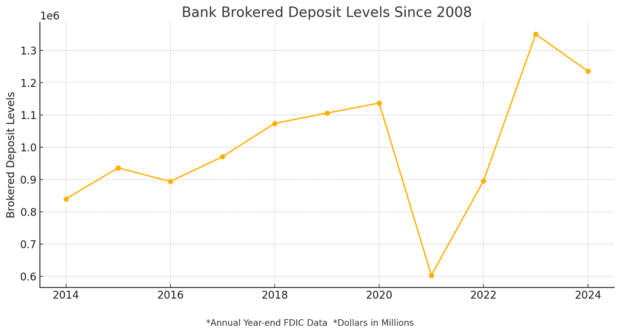
Banks haven’t wanted to raise rates locally, and they haven’t wanted to reprice their funding book. For those two purposes, brokered deposits have worked very well. In bank data, you can see the popularity of brokered rising – with a brief interlude caused by the pandemic – since well before the Federal Reserve began raising interest rates to combat inflation.
Brokered deposits at banks reached a historic level at the end of 2023 at $1.35 trillion. The industry now has $1.23 trillion; prior to 2023 brokered levels had only climbed above $1.1 trillion once before (when looking at yearend totals) in 2020.
Why is that an opportunity?
Today’s $1.23 trillion in brokered deposits at banks are not relationship deposits, and a portion of those no-relationship deposits have a term.
Moreover, some 87% of banks’ $2.8 trillion in time deposits will come to term and reprice this year. Whether it’s from the $1.23 trillion in brokered, meaning the institution does not know the personally identifiable information of those depositors, or the trillions in certificates that will mature, each person within those trillions in deposits is a potential saver that your institutions could win over.
Wooing CD savers to become core depositors is likely a trillion-dollar opportunity.
Dig deeper:
- Timing, the New Way to Outcompete Peers for Time Deposits
Attracting Savers by Serving their Goals
Saving money is hard, especially in an environment where inflation remains stubbornly elevated, and the future of the U.S. economy remains uncertain. When people save for a down payment on their home, it can feel like they’re crawling towards that goal. A financial institution can’t fix that problem, but it can make it easier with good old-time service. And some CD depositors will reward good service with less rate sensitivity; some may even begin to see your institution as the best long-term place to invest savings.
So, how can a bank or credit union do that?
Consider a depositor who wants to begin shopping for a home at a certain time of year. A 12-month CD may be too long as an investment for their downpayment, and a six-month CD may not pay as much interest as they are looking for. Perhaps an eight-month CD would earn interest at a CD rate for most of the time and mature in time for home shopping to begin. Yet, few local institutions may offer specials for the term needed by the goal-oriented depositor.
Most institutions do not know which depositors are saving for a goal like a mortgage down payment. However, they can get data on the terms in demand in their market and create CDs with in-demand maturities. In this way, institutions can use term as a starting place to better serve savers by providing CD terms not offered elsewhere in the market.
Depositors with a goal for their savings are more likely to choose non-standard terms because they need the money at a particular time. To serve them, institutions can improve at designing specials that profitably harness demand for odd terms within their marketplace.
Data is an essential tool here because gaps in terms offered in your marketplace often overlap with less competition from other institutions. According to 2024 data gathered by CD Valet’s Market Intelligence Tool, which covers over 3,900 U.S. banks and credit unions, gaps are common, overlap with non-standard maturities, and have healthy demand.
So far in 2025, one-third of depositor demand observed on CD Valet has been for 6-month CDs, followed by 12-month (26%), 7-month (15%), and 3-month (7%) terms. However, it is noteworthy that CD Valet visitors spend nearly 70 percent of their shopping on promotional CD rates that provide off terms vs. the standard terms. The popularity in terms shifts throughout the year, depending on the market and interest rate trends.
Serving savers starts with promotions designed to get them to consider your institutions, especially when no one else in the market is competing for them. After that, bankers and marketing teams should engage them as a segment that values their financial goal more than receiving the absolute highest rate. That’s how institutions’ cost of funds begins to benefit from depositors choosing a bank with good options over the work to move to a bank with the best rates.
Making the CD Cool Again
Some 15 years of near-zero interest rates forced CD holders to become rate shoppers, making CDs markedly less popular and “hot money” among banking executives. But now rates linger at levels well above recent historic lows, and opinions differ on which direction the Federal Reserve will take from here.
Savers and bankers are in the same boat as they face rate risk. But banks and credit unions know interest rate risk better than anyone. Using data and products designed based on that data, organizations can attract the necessary volumes of funds without focusing entirely on offering the highest price.
Using CD terms to show savers that your institution is serious about serving them can earn the loyalty that creates core deposits. And when CDs are no longer (always) hot money, they can become cool again for depositors and banking institutions alike.


