
Online Neobanks Deliver Lousy Customer Service. Can Banks Exploit the Opening?
By Steve Cocheo, Senior Executive Editor at The Financial Brand
Simple Subscribe
Subscribe Now!
Online banks and neobanks have been gnawing into traditional institutions’ market share for more than a decade, providing checking and savings accounts that typically offer higher interest rates than banks with branches. Neobanks have also led the way on extra services, including faster access to funds and credit-like services designed to help strapped customers stretch from payday to payday. And these fintech providers also have the technology to offer greater personalization.
Key competitive insight: However, something’s missing — and that’s a gap that can be leveraged.
New research from JD Power, the 2026 U.S. Direct Banking Satisfaction Study, indicates that some neobanks have a weak spot that would-be competitors of all stripes can exploit: a higher frequency of customer problems, compounded by weaker telephone and online chat support.
“Day-to-day customer service is not as strong as it needs to be,” according to the firm.
In fact, of those neobank customers who have had a problem, a combined 38% say they probably or definitely will switch to another provider.
Another competitive insight: JD Power also found that chartered online banks that are online-only, like Ally and Charles Schwab Bank, and providers that lean into online access, like Capital One with its Capital One 360 brand, as a group have higher overall satisfaction ratings than do the neobanks as a group.
Note that there are better-scoring neobank players, such as Chime, which ranked #4 among online checking providers and #3 among online high-yield savings providers.
The 2026 edition of the firm’s report, now in its tenth year, reflects a major redesign. JD Power expanded it to include unchartered neobanks in addition to Chime, including the likes of Cash App, Revolut, Current, Dave, T-Mobile Money, MoneyLion and two offerings from Walmart, Walmart MoneyCard and Walmart OnePay. (Walmart MoneyCard is operated by Green Dot Bank, while OnePay is owned by a joint venture of Walmart and Ribbit Capital and operated by Coastal Community Bank.)
Need to Know:
- The overall customer satisfaction level among online bank checking providers was 674 out of 1,000. That’s 52 points higher than the overall customer satisfaction rating for neobanks (622).
- The overall customer satisfaction level among online bank high-yield savings account providers was 689 out of 1,000. That’s 32 points higher than seen among neobanks (657).
- JD Power believes these and other gaps in satisfaction create opportunities for banks that try to win over disappointed neobank customers.
What sets neobank customer service at a lower level than seen among online chartered banks?
A key reason: Fintech-spawned neobanks have tended to focus on growth and new customer generation, according to Paul McAdam, senior director of financial services intelligence at JD Power.
Historically, he continues, “they’ve consciously accepted some level of operational fragility.” He explains that with their growth focus, they tend to let operational problems continue to be solved another day.
The neobanks have been “letting those fires burn,” says McAdam.
This attitude, coupled with the fact that many neobanks focus on consumers who are more financially stressed, pulled down neobank satisfaction scores, summarized in charts that follow.
Read more: This $6.9B Community Bank Competes with Chase — By Running a $1.3B Digital Brand on the Side
The Wide Gap in Satisfaction Between Online Bank and Neobank Customers
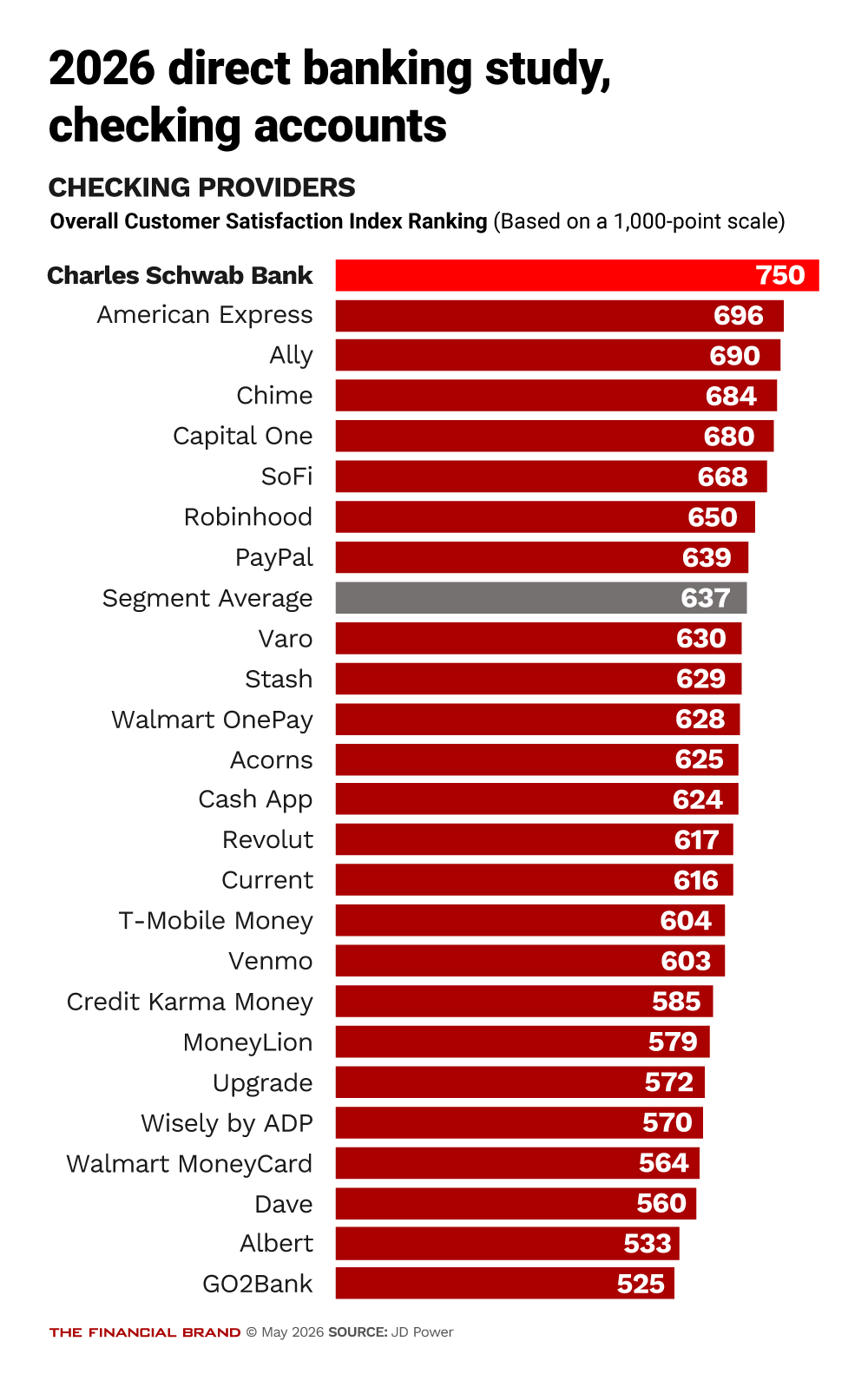
Charles Schwab Bank, which caters to affluent customers, topped the rankings for checking account providers at 750 out of 1,000 points. The higher ratings customers gave the leaders pulled up the average ranking of 637.
On the other hand, about half of the neobanks studied didn’t make it out of the 500s, including brands like Dave, Albert and Walmart MoneyCard. GO2Bank, which was in last place at 525, is a neobank-like brand of Green Dot Bank. The neobanks rely on chartered banks to provide the machinery behind their products and services, and, often, customer service, via banking-as-a-service arrangements.
The gap between the leader and the bottom of the checking ranking was 225 points.
Marcus by Goldman Sachs topped the list among online high-yield savings account providers at 739 out of 1,000. The average among firms that offer high-yield savings accounts was higher, at 674, than among checking-only providers. Only a handful of providers’ ratings fell below 600 points. These included Dave, GO2Bank and Albert.
The gap between the leader and the bottom of the savings ranking was 186 points.

Key finding: The study found that customers of online banks (23%) were less likely than customers of neobanks (28%) to have a problem or complaint with their accounts in the previous 12 months.
“The gaps in performance are driven by a higher incidence of problems associated with the debit card and fraud/unauthorized activity, and with weaker satisfaction with telephone, online chat, and email support,” according to JD Power.
The study also found that customers of online banks resolve their problems 85% of the time, versus 79% among neobank customers. They are also more likely to have the trouble cleared up after one contact with the provider, 60% to 55%, respectively.
Online bank customers reported greater satisfaction with their institutions’ automated phone/interactive voice response systems, promptness in being able to speak to someone, and higher satisfaction with online chat and email support.
Read more: How Many of These Mobile App Best Practices Is Your Bank Following?
How Banks Can Capitalize on Neobank Customer Dissatisfaction
McAdam points out that online banks and neobanks charge lower fees, typically, and offer competitive savings rates. The study also found that they are noted by customers for making them feel like the provider knows them better and are more innovative.
The chink in neobanks’ armor. However, the dissatisfaction among neobank customers suggests to McAdam that there’s still room for traditional institutions to claim some prospects.
“The fact that the neobank customers are encountering more problems means that some portion of them are going to cry uncle after a while,” says McAdam. “They’ll decide they have to switch to somebody else.”
Key insight: Current liberal chartering and deposit insurance policies in Washington suggest that this is the window for cultivating a reputation for strong customer service.
“Let’s face it,” says McAdam. “Vanguard is launching a checking account, Edward Jones is getting a [Utah industrial] banking charter, Ford Motor Credit got an industrial loan charter in Utah as well.”
“So, literally anybody’s going to be able to get into the game here,” says McAdam. He believes customer experience will help set traditional brands apart from newcomers.
“Customer service will be a really important differentiator in this marketplace,” he says, “as the digital features advance and products commoditize further.”
Read next: ‘Money Experiences’ Are Replacing Traditional Digital Banking KPIs


