
Credit Unions Should Own Wealth Management. So Why Do They Lag Their Competitors?
By Alexandros Argyriou, CEO of FinΤech Insights
Simple Subscribe
Subscribe Now!
Demand for digital-first wealth management services is growing. And the stakes — customers’ financial wellbeing and future prosperity — make wealth management a natural fit for credit unions, with their community-focused ethos and the high levels of trust they enjoy.
Yet, our research consistently finds credit unions lagging behind both incumbents and challengers when it comes to digital wealth management capabilities.
Seeing as the top 4 national banks — Citi, JP Morgan Chase, Bank of America, and Wells Fargo — dominate the U.S. market, and challengers are steadily gaining momentum, this is a missed opportunity for credit unions to carve out more space and revenue.
Reality check: Here’s a look at where credit unions’ digital wealth management capabilities currently stand and what their options are moving forward, based on the latest data from our digital banking research platform FinTech Insights.
The U.S. Wealth Management Landscape In 2026
For this article, we created a data-set — FinTech Insights calls this a market of focus — made up of 49 credit unions, selected as a representative sample of the market, along with 20 legacy banks.
Right off the bat, it’s clear incumbents’ wealth management capabilities far outstrip those of credit unions.
The gap analysis graph below shows that incumbents support 151 wealth management features in total, compared to credit unions’ 55. Only two out of the 49 credit unions in our sample support these capabilities, with Navy Federal Credit Union supporting all 55, while First Florida CU supports just one: opening a retirement account.
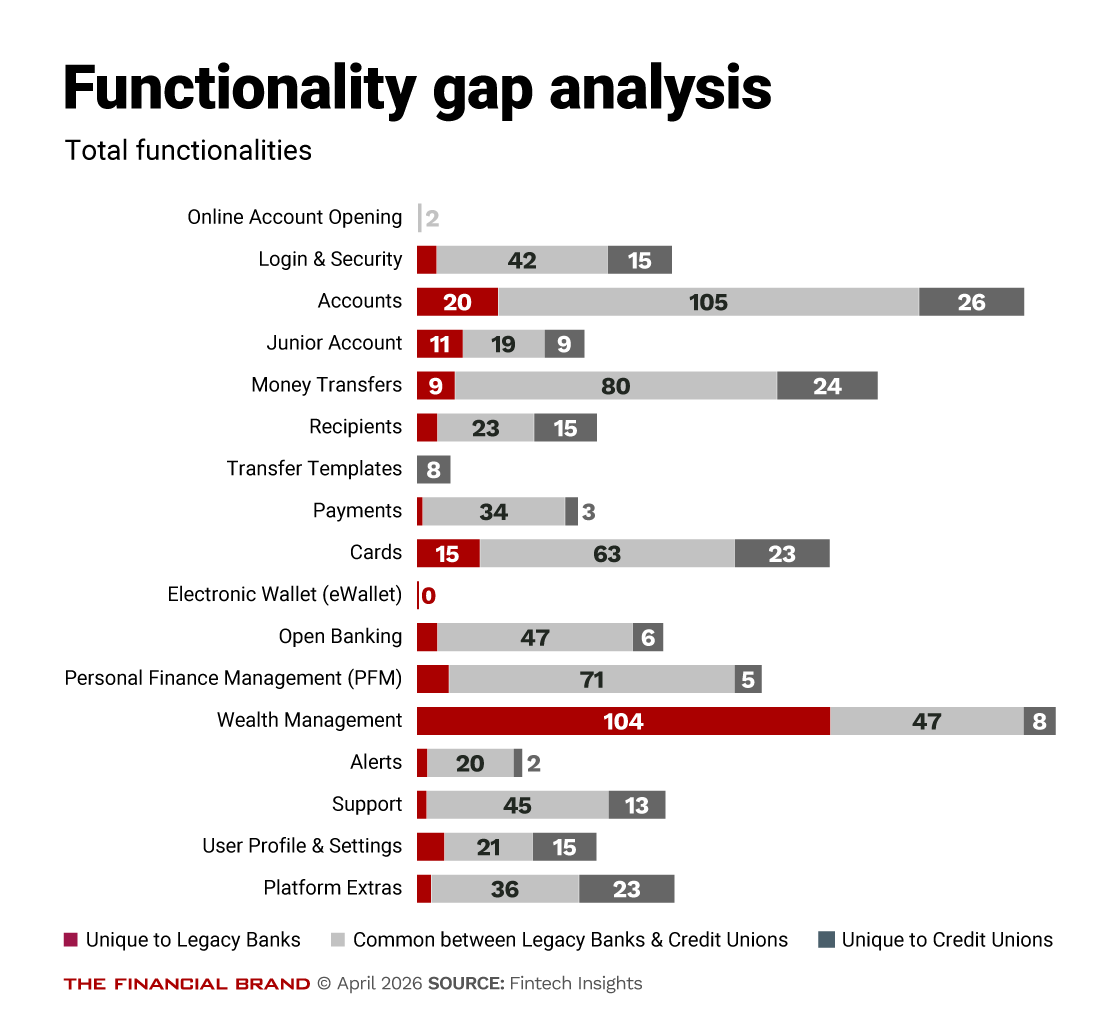
Despite being the only firm with a meaningful digital wealth management offering, Navy Federal Credit Union’s capabilities are still relatively limited: all 55 of its wealth management functionalities are mainly focused on products such as stocks and ETFs.
It’s worth noting that many credit unions do offer investment products. But, instead of offering them natively through their apps — Navy Federal Credit Union is the one notable exception — most have an advisor-led model offered in partnership with a third-party provider. This is unlikely to resonate with younger wealth management consumers, who overwhelmingly expect top notch digital experiences.
That’s not to say legacy banks are doing particularly well on the digital front. While the above gap analysis graph shows they support more wealth management capabilities overall, these are concentrated in a handful of firms. 60% of the banks in our sample don’t have any digital wealth management capabilities.
Investment selection is also limited: stocks, ETFs, and mutual funds. Only three banks — Bank of America, Charles Schwab, and Chase — offer bonds, despite them being among the safer mainstream products you can invest in. And none of the banks in our sample support cryptocurrency investments.
How Challengers Fit Into The U.S. Wealth Management Picture
Bringing challengers into the picture makes the digital wealth management gap that much clearer. Challengers invest more heavily in wealth management than either banks or credit unions, with almost 70% of firms out of a sample of 26 challengers offering at least one type of investment product.
The most offered wealth management products, at 58% of the sample, are stocks. 50% offer ETFs.
Key insight: it’s bonds, not cryptocurrencies, that are the least commonly-offered product among challengers. But, with four firms offering it — Ally, e-Trade, Fidelity, and Webull — they still have a slight edge over legacy banks.
Fidelity and Webull — two platforms that are primarily focused on trading — are the only two platforms that offer all six types of investment product on the market, that is bonds, stocks, ETFs, mutual funds, options, and cryptocurrencies. No bank in our sample offers this selection.
The wealth management opportunity for credit unions is right there. Will they seize it?
The data is clear: when it comes to digital-first wealth management services, the bar is low.
Why this matters: With a more comprehensive digital wealth management offering — one that incorporates a greater breadth of functionalities and a wider selection of investments — credit unions would have a more well-rounded offering and, so, be better-positioned to compete with legacy banks.
Factor in the high levels of customer trust and satisfaction they enjoy, and they could also be well-placed to compete with challengers, including trading-focused ones.
While still early days, a growing number of wealth management providers are offering API-first wealth-management-as-a-service products using embedded finance technology.
Partnering with one of these providers could help speed up credit unions’ digital wealth management services go-to-market time, though the trade-off is less flexibility when it comes to design and reliance on a third-party’s core infrastructure.
While nominally more costly, the alternative — building digital wealth management capabilities in house — would give credit unions full control over the user experience.
And, using a digital banking research platform to support planning cuts many risks, such as lengthy trial and error and sub-par implementation, by enabling teams to identify must-haves, differentiators, and MVP features early on.
Of course, there’s also a third option: keeping things as they are. But why pass up a $124 trillion opportunity, when it’s right there for the taking?


