
The CD Term Tsunami is Back. This Time It’s About More than Interest Rates.
By John Blizzard, president and CEO at Seattle Bank and CEO at CD Valet.
Simple Subscribe
Subscribe Now!
Banking experiences well-known cycles. Mortgage rates rise and fall, spurring refinancings. Ag lending booms seasonally as farmers prepare for growing season. And trillions of dollars of certificates of deposit come to term and renew each year.
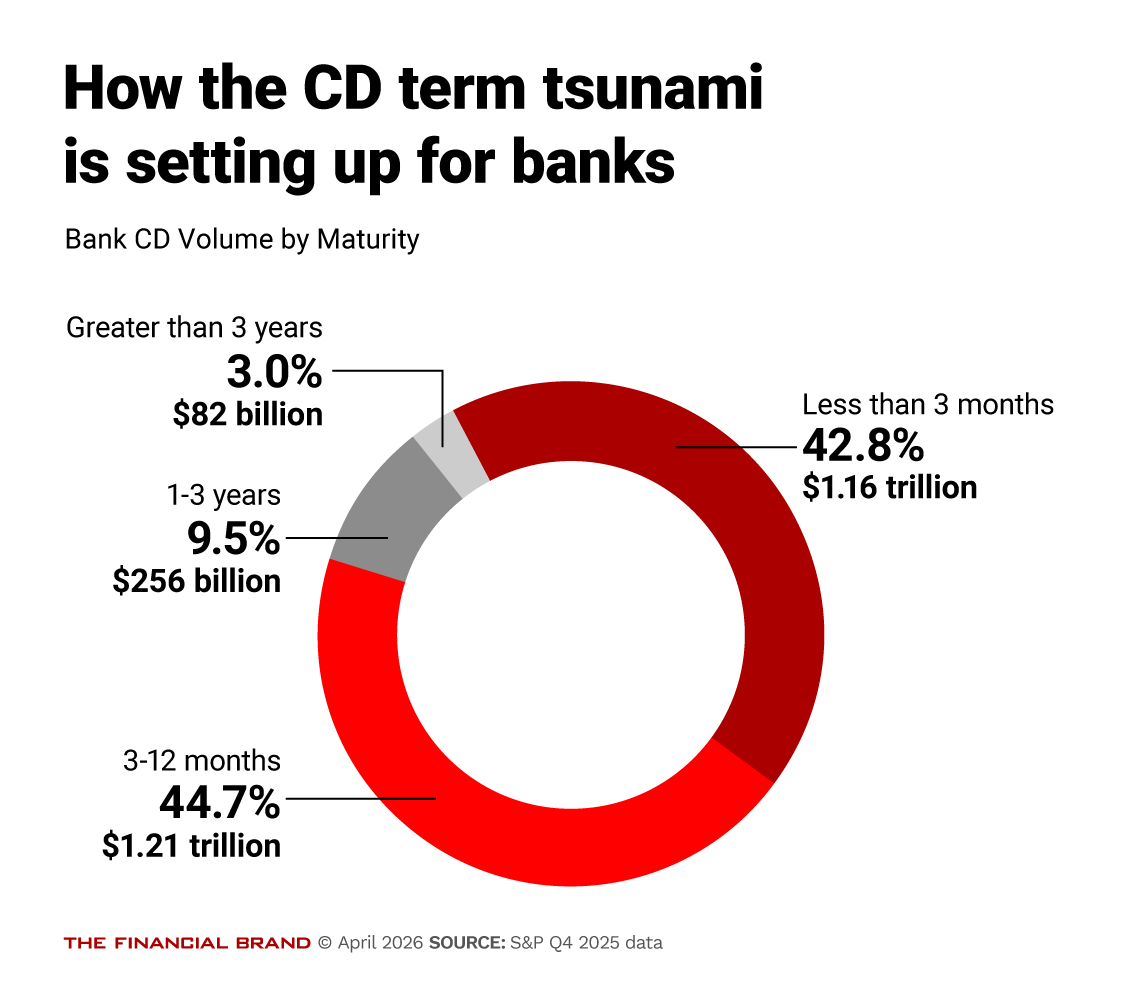
During the rest of this year, savers holding some $2.37 trillion in bank CDs will be shopping for a new place to invest their funds. The credit union industry is going through a similar cycle.
This “term tsunami” cycle for CDs and share certificates is different than the cycles of other banking products, however. It’s not created by the seasonality of agriculture or rate movements tied to decisions by the Federal Open Market Committee. Depositors simply tend to choose the maturities with the best rates offered, based on the decisions of bank and credit union management teams.
Key challenge: One year ago, most banks and credit unions wanted to stay short. So they incentivized savers to choose maturities of a year or less by offering the highest rates on the shortest-term CDs. Looking at the yield curve and its history, that pricing decision was rational.
However, that move has habituated savers to chase higher rates for shorter terms.
That can become a challenge as institutions want to shift their deposit portfolios. However, alternatively, it can become a significant opportunity for institutions to grow new relationships through CDs.
Here’s why, and what institutions can do to capitalize on the industry’s annual repricing ritual and see that the true all-in-cost-of-funds with CDs is lower than it may appear.
Need to Know:
- As of the fourth quarter 2025, some $1.16 trillion in bank CDs was set to mature by the end of March. Another $1.21 trillion will mature by Dec. 31, but we don’t know precisely how much will mature in each month between now and then. (S&P data isn’t that granular.)
- Put those two volumes together and $2.37 trillion in bank CDs may move around the banking system this year.
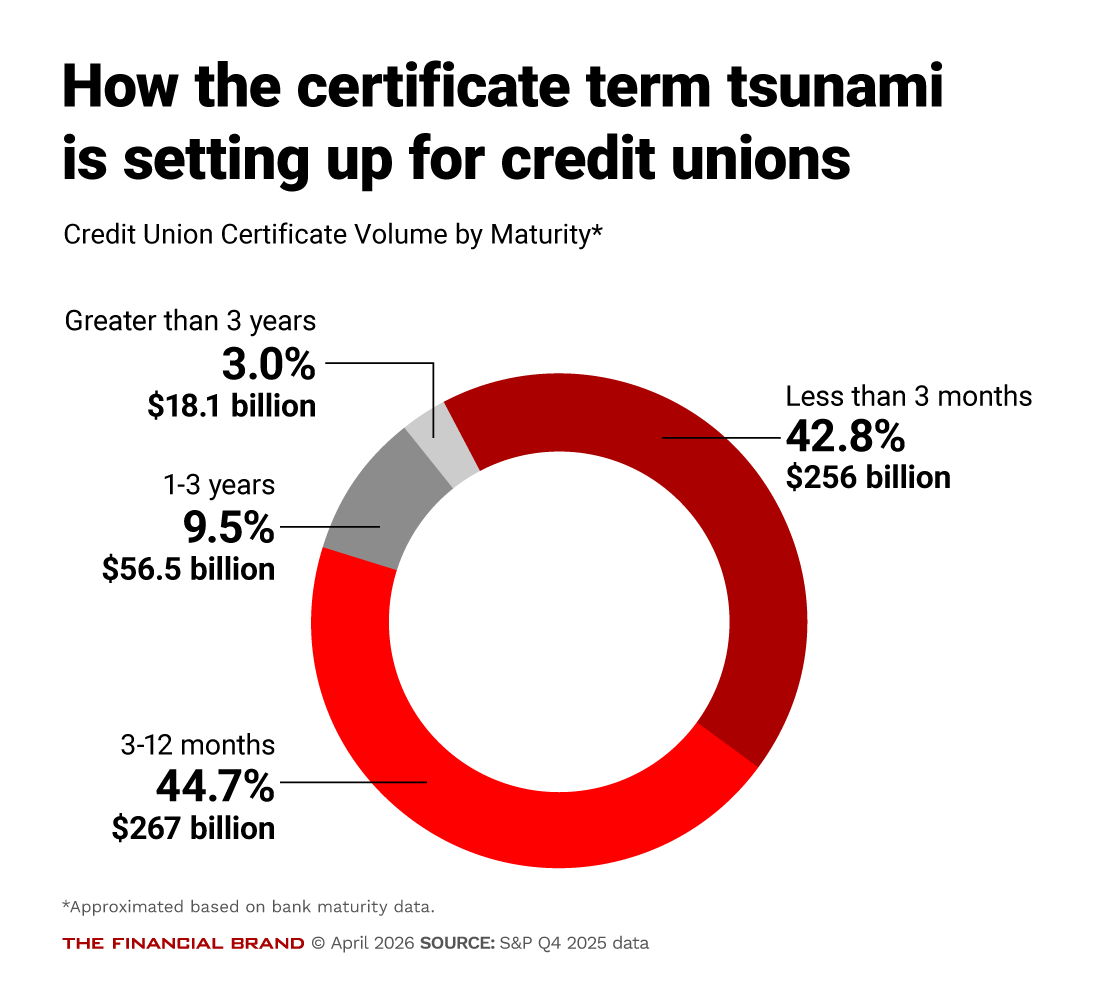
- Volume-by-maturity data is hard to come by for credit unions, which hold $597.6 billion in share certificates. Using banks’ distribution by maturity as a proxy, credit unions may have $497 billion in share certificates maturing by Sept. 30.
- Some $2.5 trillion in bank time deposits matured during the spring and summer of 2025. During that period most of that volume re-entered time investments like CDs.
- The industry is about to reprice trillions in deposits again. This time the potential total volume could be closer to $2.8 trillion maturing during 2026.
Annual CD Renewals = New Customer Acquisition Season
Given that the volume in term deposits is so substantial, and now cycles in terms of a year or less, executives should be asking: How can we capitalize on a trend that’s become fairly predictable?
Key insight: This annual “term tsunami” is a massive opportunity, and not just for new relationships. Institutions can use it to attract deposits at a lower cost as well. This may seem counterintuitive, but this opportunity comes from depositors’ needs for different maturities and the competitive nature of standard term pricing.
Standard terms are well-understood by depositors. The most-popular, standard-term CD is the 12-month maturity, and it accounts for 73% of the demand for standard terms when depositors visit the CD Valet site.
But that demand and popularity have a cost. Standard terms have heavy competition in pricing, as well.
For example, in February, the top three banks on CD Valet were offering rates of 4.04% or more for 12-month CDs. The top three credit unions offered rates at or above 4.85%.
Institutions were paying a premium as a result of stiff competition. Those rates compare to a 12-month treasury bill that yielded 3.45% at the time. A 24-month treasury note yielded 3.5%. Institutions competing on price for standard terms will continue to face these kinds of deposit costs.
Read more: The Lose-Lose CD Penalty That’s Ruining Deposit Profitability
Try Fishing in a Different Spot
So, how can a bank or credit union use a term tsunami to attract new depositor relationships that are also more profitable?
Key strategy: Offering a range of maturities chosen on the basis of data can be a more economical way to introduce your brand to potential new depositors. The trillion-dollar term tsunami has provided an opening to attract depositors who need a wider choice of maturities, based on local market data.
Consumers have varied interest in maturities, according to shopping activity data published in CD Valet’s Market Intelligence Tool. The tool aggregates CD rate data from 4,164 U.S. banks and credit unions. As of early April, over 28% of depositor demand observed on CD Valet has been for six-month CDs, followed by 9-month (11.1%), 7-month (10.7%), and 8-month (10%) terms — for a total of nearly 60-%. Looking beyond those terms, there are other maturities for which competition may be quite low locally.
The highest rate offered on a 6-month CD at the time of our study was at a credit union, at 4.57%. From a bank, the highest rate was 4.33%. By contrast, for a 9-month certificate, rate offerings topped out at 4.25% for credit unions and 4.2% for banks.
An essential constant: While rates will change, of course, bankers know a key fact will remain true: Depositors who need these types of maturities may have non-rate-driven motivations. For such depositors, there are factors more influential than yield.
Depositors attracted to these maturities have some reason for not choosing the highest rate on a standard term. The term tsunami opens the door to serving savers at a lower APY by offering nonstandard terms.
The trend also allows an institution to learn why that term was attractive and to turn a “CD rate shopper” into a customer who values an institution that’s interested in their financial outcomes.
Read more: Personalization Didn’t Save Bank Deposits, But Product Customization Can
All-in-Cost of CDs: Lower Than You Think
CDs also offer other cost savings to help pay for this type of “attract and expand” strategy.
Banking executives understand the expense associated with rate shoppers in terms of cost of funds, but what about other costs? Institutions have begun to find that CD depositors can cost less than other depositors when the CD is originated through a digital channel. Those depositors also bring another beneficial attribute not often discussed by executives.
An example of the strategy: At TBO Bank, a $200 million-asset bank based in Orrick, Mo., CD holders represent an opportunity to connect outside of the traditional branch footprint.
“Many Americans prefer digital convenience, but not all are comfortable banking with an institution they do not know locally,” says Andrew Hansen, COO. “If consumer behavior continues moving toward digital relationships, then building trust at that level is invaluable.”
What’s more, “CDs carry far lower fraud risk than checking or savings accounts when offered nationally through digital account opening,” Hansen observes.
He argues that, from a risk-management standpoint, the CD can be the strongest deposit product. “While the rate is higher, the costs associated with fraud and servicing are significantly lower,” says Hansen.
Hansen says that when total cost is taken into account, rather than just the cost of funds, a CD offered nationally via a digital channel can be attractive.
When it comes to deposits gathered digitally, CDs may be considered the least expensive deposit around, even if the institution competes for standard terms. Typically CDs are of larger size and simply cost much less in terms of fraud and its spillover operational costs.
Read more: How LendingClub Is Wielding Its Bank Charter to Steal Your Customers
Get Ready for Seasonal Hunting for New Relationships
The “term tsunami” is a rare window to win relationships.
Institutions that use local demand signals to offer the right maturities can turn a repricing wave into durable growth. CDs can be an entry point into broader digital relationships.
Banks and credit unions that make offers that intersect with depositors and their timelines, and use that first CD to earn trust, can grow the relationship, based on depositors’ focus on product fit over only product price.
Read next: How BMO is Leaning into Fundamentals to Drive More U.S. Deposits


