
Why Digital Leader Chase is Ramping Up Marketing for its Expanding Branch System
By Steve Cocheo, Senior Executive Editor at The Financial Brand
Simple Subscribe
Subscribe Now!
This spring and summer, JPMorgan Chase, a leader in banking AI and digital development, has been promoting something very different than many other providers large and small. The campaign has appeared on national television, connected TV services like Tubi and YouTube Television, YouTube itself and more digital channels including social media.
What’s different: Chase has been marketing its branches and the bankers inside them. One spot takes aim at automation that annoys many consumers. The other highlights how young people, notably high schoolers earning money for the first time, can start their banking connections with a local Chase banker. More such will be coming later in the year.
People, not locations. The campaign hasn’t taken the wide-angle view, only lightly promoting the growing geographic spread of its branch system, now over 5,000 strong in more and more markets. Instead, it has been zeroing in on the ability to make a person-to-person connection over a desk at your local branch.
The megabank hasn’t stopped promoting digital banking by any means, but Ryan MacDonald, CMO for Chase Consumer Bank, says the company saw the benefit of marketing physical offices, based on consumer behavior and feedback.
Why this matters: “We have almost a million customers a day walking into our branches across the country,” says MacDonald, a Chase veteran who was named to his present post in late 2024. “We hear firsthand that customers really need and want human connection.”
Need to Know:
- Chase has built 1,000 branches since 2018 with more coming, and 1,000 after the bank’s acquisition of Washington Mutual in 2008. Presently it is building at a rate of about 160 a year.
- About 40% of Chase market share gains are coming from new branch builds, with the remaining 60% coming from the bank’s existing footprint. To keep the latter coming, the bank has invested in refreshes of branches and relocations of others, as well as attention to branding.
- A key goal for Chase’s new branches is densifying the bank’s expansion into new growth markets.
- “Omnichannel is the winning answer here in the U.S.,” according to Marianne Lake, CEO of consumer and community banking, in early June. “It lifts digital production when we have branches. Our credit card business lifts new branches when we build them in new markets. It’s symbiotic.” (Lake’s retirement was announced in late June.)
Key insight: MacDonald says consumers tell the bank that AI, automation and technology are all essential to their daily lives. “But when things get hard, when customers need a little bit more, they do want a human to talk to, and this is where service comes in,” says MacDonald.
Many competitive brands lean into their digital abilities and low costs — programs carrying a Chase branch promo could easily also air spots for Chime, Dave, Albert and others fintechs, for example.
MacDonald says the bank has been trying to make the case that digital and physical work hand-in-hand.
“We’ll continue to build great digital tools and services for our customers,” says the CMO. “But we’re also going to invest in people in local communities that know the community and in experts that can provide an alternative to the low-cost digital providers out there.”
Putting Branches in Perspective for the Digital Generations
“Customers are very hungry for human connection,” says MacDonald and one of the two spots the bank has been airing addresses this very directly.
“David” is having a bad day with technology, in the bank’s “Places for People” ad. At home (1), as David prepares to go out, his smart speaker — not identified by brand — responds, “I didn’t understand you,” when he asks that it turn on his kitchen’s lights. When he repeats the order, the device simply beeps at him. The lights stay off.
Outside, David gets into the back seat of a car service, and says “Good morning” to … no one. As he looks into the front seat (2), he realizes there’s no one behind the wheel (3) and that the “cheery” voice greeting him is robotic. He stares out the window with a resigned look on his face.
Places for People spot
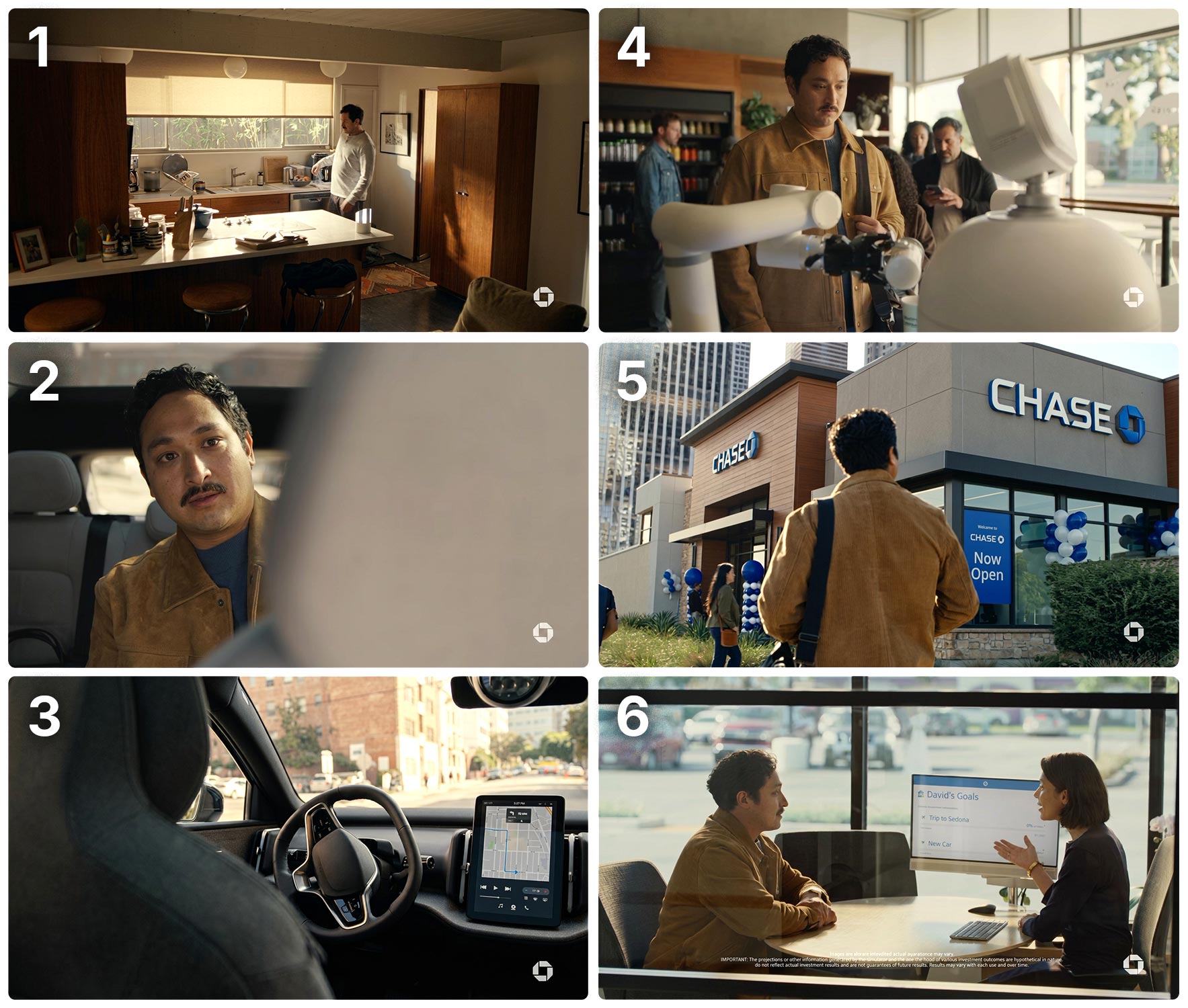
Things grow worse. Having joined the line at a coffee shop, David tells a robot barista, “Black coffee, no sugar,” and grimaces as the robot pours way too much sugar into his cup (4). It finishes by telling him to enjoy his sweetened coffee. David looks disgusted with tech.
Disgruntled David walks out, cup in hand, and spots a Chase branch sporting grand opening balloons (5). Inside, he is greeted by a live banker, who sits him down (6) and before long they have his financial plans up on a screen.
The pitch: “Instead of building new ways for machines to talk to people, Chase is building new places for people to talk to people,” the voiceover says, “with tech that’s actually helpful and 5,000 branches in 48 states.”
Next-gen appeal. In the bank’s other spot, “Kids Making Money,” the target is young people who want to earn some money (and do something with it) as well as their parents.
Kids Making Money spot
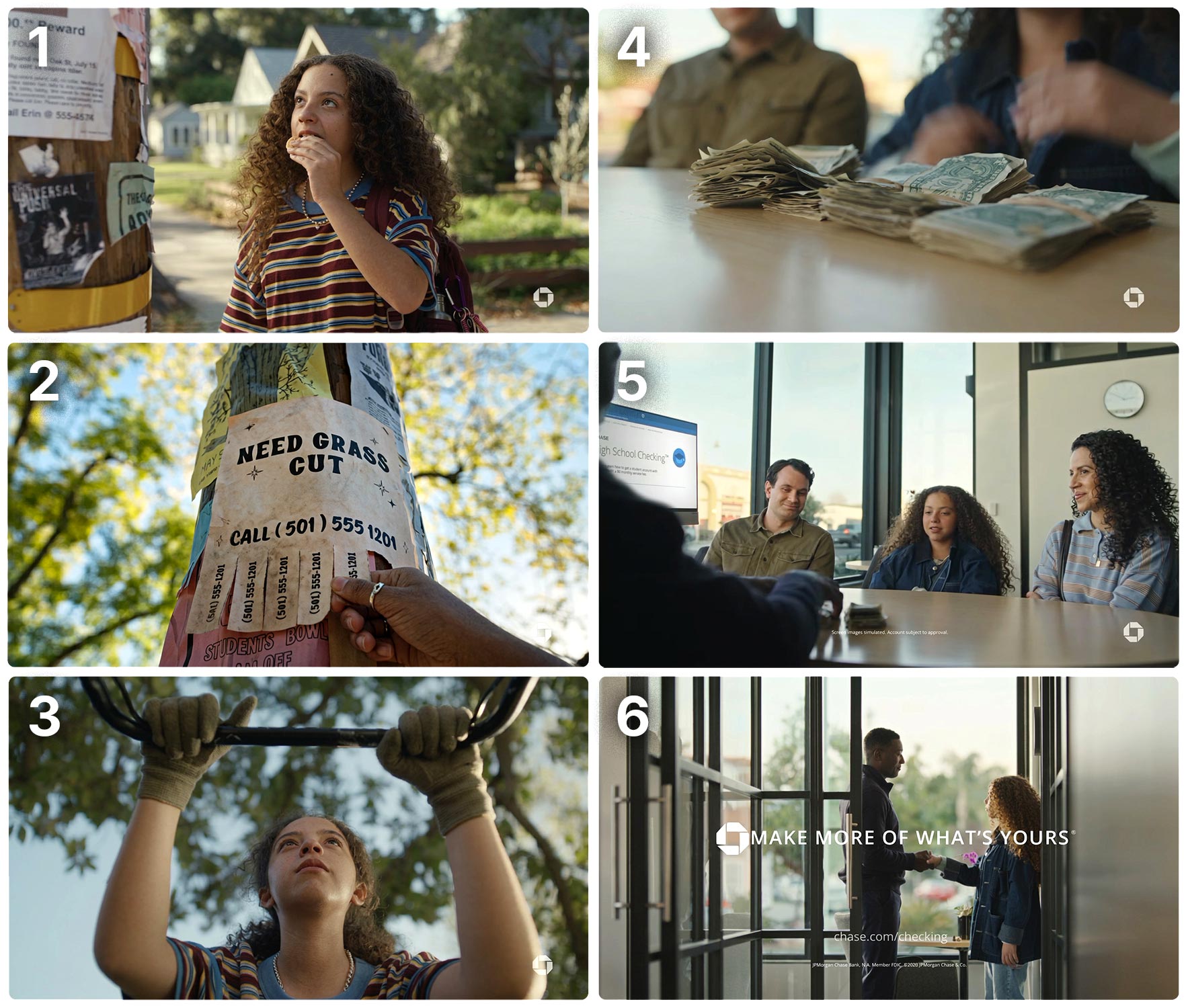
The spot opens with a teenage girl perusing ads stapled to a utility pole (1). She spots one seeking someone to mow a homeowner’s lawn, and she tears off a slip with a phone number (2). As the scene shifts to the girl pushing a mower (3), other entrepreneurial teens are shown in action — giving haircuts in garages, selling collector cards, and walking dogs.
The lawn-mowing girl accumulates wads of cash from her enterprise and, flanked by her folks, plunks them down in front of an impressed Chase branch banker (4).
“Wow,” says the banker, surveying stacks of crumpled bills. “Let’s get your account opened,” (5) and fist-bumps her.
In the final shot (6), the girl shakes the banker’s hand as she leaves the branch, a new Chase depositor.
Read more: How Chase Is Evolving Its Consumer Products from ‘What Can I Do Now?’ to ‘What Should I Do Next?’
National Marketing Scope, with Local Tailoring
The bank has been doing additional, more specific promotions on social media, tailored to various segments pointing out how branches can serve their needs. While the main campaign is national in scope, MacDonald says the social campaigns can be targeted to local markets.
MacDonald explains that his group works very closely with Chase branch expansion teams. In addition, they use regional and market directors, as well as bankers at other levels in the branch system, to help keep the national-level marketing on point.
He explains that much of Chase’s base marketing is orchestrated at the national level to maximize reach and scale, though social media and other efforts can help customize messages. In college and university towns, for example, connections with faculty, staff and student bodies help the bank to adapt marketing strategy locally.
While print is mostly off the table other than an occasional national ad in a paper like the Wall Street Journal, MacDonald says some traditional media still work for local needs. Direct mail is one that the bank has stepped up of late. And then there is radio, which “is a great channel, especially when you want to get in at the local level.”
“When people are on their morning or evening commutes, they’re potentially driving by a branch,” says MacDonald, “and so it’s a great time to make that real-life connection. So the tie-in there is actually quite good.”
Chase’s community office format. Specialized Chase community center offices also play to local needs. MacDonald points out that the bank has about 160 community managers throughout its 48-state footprint and has plans to double that specialized effort. They run specialized branches designed to improve community residents’ financial health.
In late June, the company announced that it would hire more than 150 additional community managers, with new community center offices initially planned for Phoenix, Ariz., Riverside, Calif., and Huntsville, Ala., “as well as other locations where there is a need for greater financial health resources.”
Read more:
Building Towards Increased Market Presence
Chase anticipates significant growth out of its newer branches, according to statements in the bank’s annual report and in an analyst presentation by Marianne Lake.
“There is a large percentage of our branch network that is still not yet mature, which is to say that we have a tailwind of growth behind us,” Lake said at the Morgan Stanley U.S. Financials Conference in early June. Lake said that there are many markets where the bank’s branch share is still quite low and where deposit share thus lags.
Why this matters: Lake noted that Chase new builds in year five are outperforming major competitors’ new builds by a factor of 150%, in terms of deposit growth.
A key measure of the ongoing campaign’s success will be how well it drives new customer relationships, according to MacDonald. “We’re able to measure that with sophisticated incrementality testing that we conduct on a regular basis,” he says. So far, he says, the bank has seen good results.
Read next: Banking’s Branch Comeback Carries Higher Stakes Than You Realize


