
Wells Fargo Is Leaning Hard Into Branches Again – And With a Fresh Take
By Steve Cocheo, Senior Executive Editor at The Financial Brand
Simple Subscribe
Subscribe Now!
Executive Summary
- Wells Fargo, out from under a federal consent agreement, is ramping up to grow retail banking share again. Branches will be a key part.
- Branch optimization is mostly complete. Now Wells Fargo will pivot to grow its number of branches again, to serve new markets and to increase density in areas where service needs allow.
- A key lesson for all banks: Customers want privacy when discussing their affairs. Wells branches are going back to enclosed offices, where bankers and customers can converse out of earshot.
Wells Fargo is back in the consumer banking game, and as it steps things up, it will be relying heavily on branches. This will include new openings and renovations, including heavily contested turf in the New York metropolitan area, the Chicago area, Nashville and other areas.
Complying with a federal consent order (issued in the wake of the bank’s sales practices scandals), cost the bank momentum in recent years.
“We had to literally scale back almost everything that we were doing to drive growth in the retail system, and then rebuild it from the bottom up,” Charles Scharf, CEO, said during a late May analyst conference. Many typical and development practices went on hold, he said, as the bank concentrated on compliance.
But now the sales practice consent order, and many of the other federal strictures, have been lifted. Scharf’s Wells is back in and swinging, and he told analysts that a key, renewed focus is primary checking account growth.
“We worked really hard to try to preserve share before,” said Scharf. “Now the focus is what do we have to do to increase share.” He describes a multi-faceted push that includes spending more on marketing, building digital capabilities “to be among the best out there,” and a hard focus on branches. This includes net new growth and ongoing reinvention of the Wells branch experience.
In an interview with The Financial Brand, Brad Nolan, head of branch systems and transformation, discussed why the bank is investing in both branches and digital services, and how they are converging. Nolan also discussed how the bank plans to grow its branch network, with a focus on its plans in the hotly contested New York City area. The conversation also covered how Wells has been rethinking what happens in branches, and how it happens.
“The branch is not dead,” says Nolan. “It’s no secret that having a physical presence in a market is important to customers when they’re making tough choices about who they are going to entrust their financial assets with.” Study after study has shown that even when people intend to never go to a branch, they want to have one nearby, he says. Even when they have accounts with branchless providers, they typically also maintain an account with a traditional institution.
“They want to know that they can go somewhere local, speak with somebody who lives in their community, and look ’em in the eyes and have a conversation,” Nolan says. “Just follow the trail of what we’re doing and what our major competitors are doing — building more, right?”
The bank’s current count stands at about 4,000 branches, and Nolan says “we will end the year north of that.”
As Branch Consolidation Cools, Growth Beckons
The bank’s regulatory filings over the last year or so indicate mostly branch closures and relocations. Nolan says a sea change is coming.
“Consolidations are starting to cool, to come down,” says Nolan. “That should tell you that we think that in our legacy markets we’re largely optimized.”
Nolan noted that the bank rarely does “a straight-up closure, unless we’ve got a branch literally sitting between two other branches and it’s a short drive time between all of them. We’d just look at it and say, ‘You know what? The lease on that one is expiring. It’s redundant’.”
More commonly, he explains, Wells’ consolidations involve, say, two branches that aren’t in optimal locations. While those are slated for closure, the bank builds a new branch in the vicinity. “But it’s more conveniently located, at a busier street corner where customers already shop for their groceries, their Starbucks, that type of thing,” Nolan says. Wells has been constantly analyzing traffic patterns, new retail developments, and other trends that suggest where a branch has the best potential.
With increased use of digital banking, the number of branch teller transactions at Wells, as well as in the industry generally, “is down year on year on year,” says Nolan.
However, the situation flips when it comes to the rest of the branch. “While transactions are down, visits to the branch to meet with bankers are actually going up,” says Nolan.
Increasingly this traffic for consultations and account openings occurs by appointment, Nolan says. This has implications for what ideal density is. Where the bank once strove to put a branch within five minutes of a customer — afoot in a city and by car in the suburbs — now the goal is 10 minutes.
“That could continue to shift over the next decade,” says Nolan, “to 15 minutes, or maybe at some point, 20 minutes.” The more traffic shifts to people looking for guidance, to solve problems, the more leeway branch planners will have.
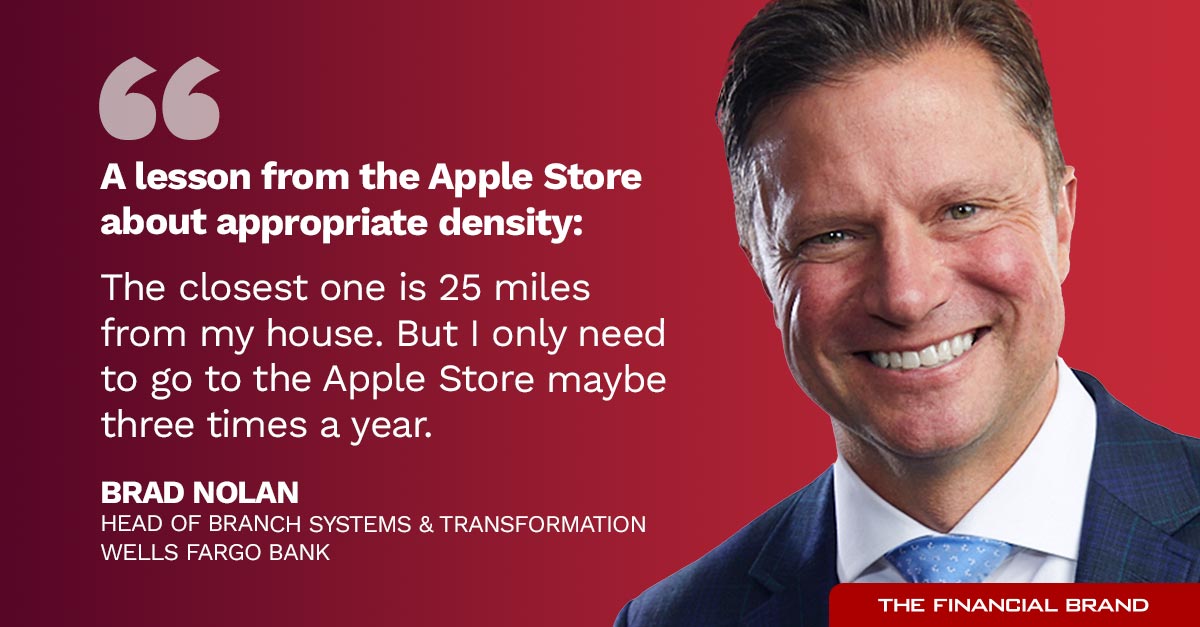
How so? Nolan compares this to his own experience as a patron of the Apple Store. He lives in Columbus, Ohio, where Apple has three locations. “The closest one is 25 miles from my house,” says Nolan, “but I only need to go to the Apple Store maybe three times a year, and that one is located by Nordstrom’s, a place I go to anyway.”
One other factor in siting decisions is changing market boundaries. Wells Fargo has had good density in the Dallas-Fort Worth market, for example, but Nolan says the area has seen sprawl in its northeast that must be addressed. “We’re going to ramp up there over the next several years,” says Nolan.
Read more:
Rethinking Branch Design
Wells Fargo recently opened a new branch in Manhattan at Broadway and 82nd Street, with Scharf at the ribbon cutting. Another branch recently opened in Queens, one of the four outer boroughs of New York, in the Long Island City section.
Wells was already in the New York metro, but has lacked the density leadership wants to achieve. This gap will dictate new branches in NYC areas like Queens and Brooklyn, and in suburban Nassau and Suffolk counties on Long Island, N.Y. Between now and the end of 2026, the bank plans to open 20 more locations.
“But we’re casting a much wider net, beyond 2026,” says Nolan. “So the number will be well north of 20 once we’re said and done.”
Beyond being part of the vanguard of this push, the uptown Manhattan location epitomizes what Wells is going for as it leans into branches.
First, after having tried cubicles with open tops, the bank is going back to offices with full walls and doors.
“This is a direct result of feedback we heard from customers and bankers alike,” says Nolan. “Customers don’t want to feel like somebody else can hear the conversation they’re having, especially when they’re relaying private information about their lives, their accounts, and whatnot.” This shift is reflected wherever possible in renovations of existing branches and will be incorporated into both new builds and takeovers of existing space.
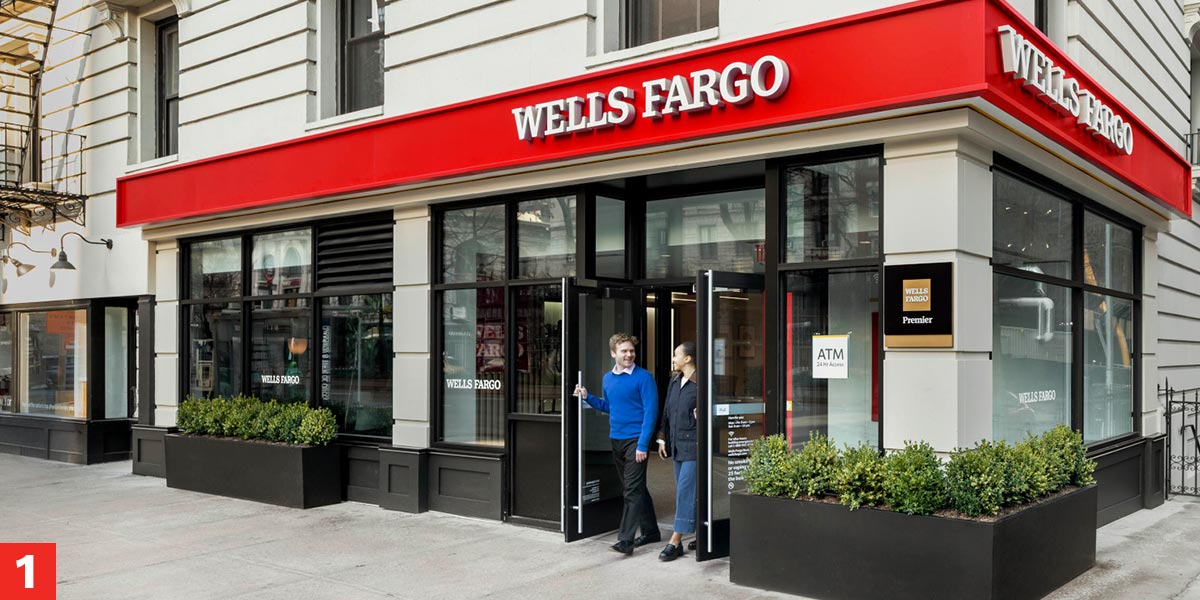

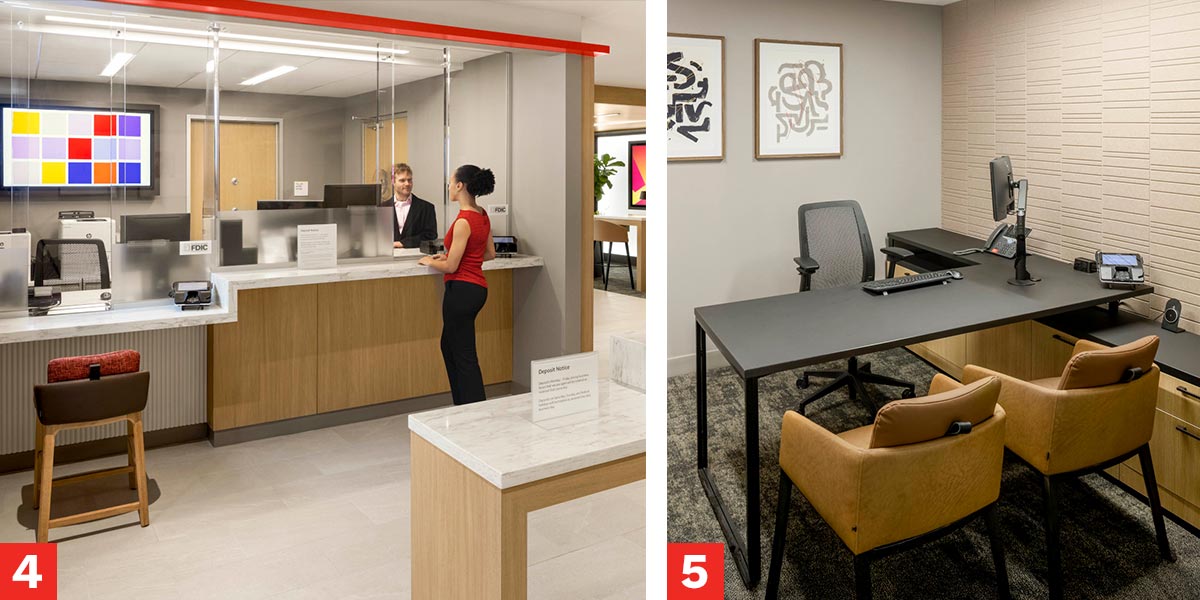
The new Wells Fargo branch (1) in Manhattan at Broadway and 82nd Street demonstrates concepts going into new branches and renovations. First stop after the ATM lobby is the “Welcome Touchpoint” desk (2), where a staffer can handle basics and let bankers beyond that point know that a customer wants to see them. (3) The customers can wait in an area patterned more after a living room than a bank branch. Nearby (not shown) is a giant, interactive replica of the bank’s mobile app, for demos. (4) Just around the corner is a small teller station. (5) Finally, beyond those areas, bankers and financial advisors await, with fully walled offices to accomodate customers’ expressed desire for privacy.
Another shift is a switch to warmer tones and softer accents in general to move away from the coldness that some perceived in the bank’s traditional design. As part of a rebranding that started a few years ago, the trademark Wells Fargo yellow left both its logo and its walls. In branches earth tones have taken its place. A waiting area for appointments features soft furniture and a large video screen. (The branch does offer a small teller area, with two stations, tucked in a corner. This reflects the dwindling need for massive teller coverage.)
Read more: Big Banks Are Heading South… and Loving It
Where Wells Branch Meets Wells Digital
A key change in approach is the branch’s “Welcome Touchpoint.” This is a station just past the ATM lobby where a Wells staffer sits at a tall freestanding podium to check people in for appointments and to answer questions. The banker at the station can help out with cash withdrawals or deposits or bring the customer to the teller station. Barstools for customers are also available.
The station is also close to a tall live replica of a smartphone screen to demo Wells digital features to interested customers.
This giant screen can help the banker show the customer how to handle simple or even more complicated transactions, such as setting up a wire transfer, on their own, from anywhere.
“The name of the game in banking has always been, will always be, convenience, and there’s nothing more convenient than being able to do something from your couch,” says Nolan. “So if we can put the right tool sets in our customer’s hands, then we win.”
The bank is also working to pull the customer into processes like account enrollment. Instead of simply having customers sit passively, answering a banker’s questions as they input data on a screen, the banker does the setup and then presents the customer with a QR code that pulls their phone or tablet into the process. They can then answer questions directly, with prompts from the banker.
“From start to finish, it’s much quicker,” says Nolan. “If the customer is just sitting there watching the banker do everything, the perception is it takes a lot longer than if the customer is actively involved.” He says the bank also believes that this practice will help customers become comfortable with more features of the bank’s mobile banking app.
Read more: For This Bank, Branches Are Key to Defending Its Market Primacy
Specialists, Yes. Exclusion? No.
Increasingly, the bankers who customers meet also have higher degrees of training than before. Nolan says over the last few years Wells has invested significantly in training towards professional licenses for branch officers. The bank is also beginning to apply artificial intelligence to determine what expertise would best meet a given customer’s needs.
Some branches are designated as “Wells Fargo Premier” locations, which means that Premier bankers, trained to help wealthier customers, are based there. Other locations may have such bankers present on a rotation or by appointment.
This said, no branch is meant to be exclusive.
“We have intentionally said our branches are for everybody,” says Nolan. “We’re not bifurcating our branch experience the way some of our competitors are. Right now, we’re focused on building one holistic experience.”


