
Storytelling Is Hot. But Is Your Bank Telling the Right Stories to the Right People?
By Steve Cocheo, Senior Executive Editor at The Financial Brand
Simple Subscribe
Subscribe Now!
Veteran financial marketer Daniel Darst is a storytelling wizard, often spinning his spells around a single word.
An example: The simple word “patience.”
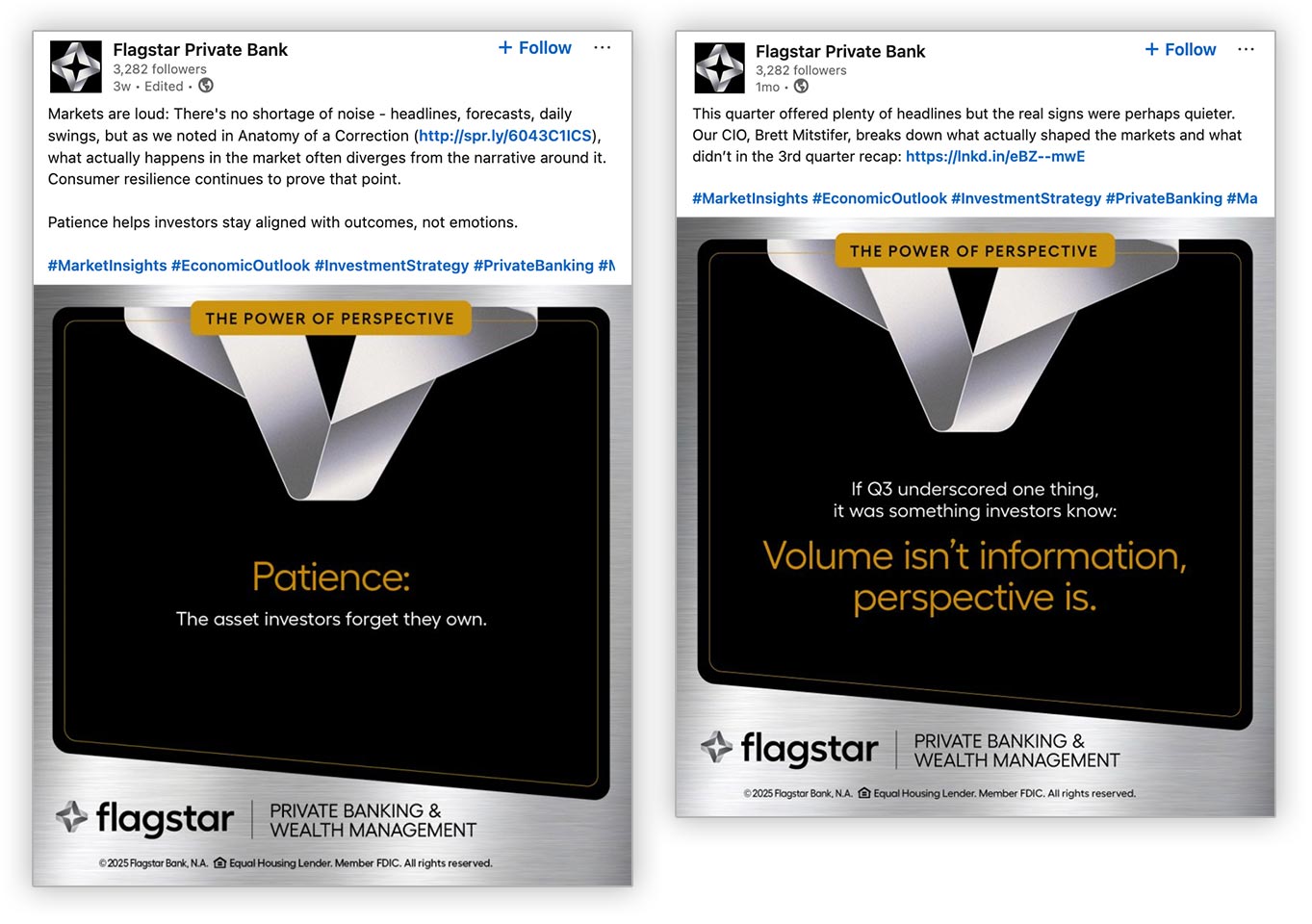
Lately, Darst has been wrestling with how to set Flagstar’s investment expertise apart. The bank has been enhancing its efforts in wealth management and private banking, in a bid to grow beyond retail banking.
“I thought, ‘What’s an investor got that they don’t think about?’ It’s patience. It’s a beautiful word,” says Darst, who is SVP and deputy CMO. He ran the idea past the bank’s chief investment officer, who greenlit several posts focusing on the concept of patience and related virtues.
Before Matching the Story to the Audience, Think Hard about Who the Audience Is
“The hardest part of the marketer’s job is getting the story right,” says Darst. “Being a storyteller requires that you get to the essence of what people are looking for. And you then translate that story to different audiences, to different demographics.”
Go beyond standard generational models: Understanding demographic differences is important, but Darst believes that too many bank marketers get stuck in generational pigeonholing that dictates every subsequent decision. Wrong — good storytellers look beyond such silos.
Need to Know:
- Storytelling is coming to the fore because web-based analytics are falling apart in the face of AI-driven search.
- In the absence of these numbers, “the messaging, the storytelling, the value proposition, and the actual attributes of your brand are more important than ever,” says Darst.
- Brand basics will become more important, too. “Your brand has to have resonance and stickiness.”
Storytelling Counters ‘The Rise of the Engineers’
Much marketing these days claims to be “data driven.” But Darst believes that sometimes that emphasis can go too far. He blames this on what he calls “the rise of the engineers,” data scientists for whom demographic segmentation is everything.
Darst says that he’s often in meetings where data devotees refine everything by generation: “What’s the message for this age demographic? What’s the message for this other group?”
Typing people by crude demographics is misguided, says Darst.
“A 75-year-old woman can have the same response as a 25-year-old man to a checking account offer or a message about wealth management,” says Darst.
“There’s a lot of movement and porosity between groups,” says Darst. Speaking of people he knows, one 16-year-old could crave new things, and yet another 16-year-old could be very conservative and clinging to the status quo. A “wild and crazy 52-year-old may say ‘Hey, I’ll try that offer, I’ll click on this link’.” But another sees a digital ad with a “representative” piece of stock art and doesn’t click. They may be thinking, “That’s just a fake model, so I’ll never click on that,” says Darst.
“You have to put some energy into this,” Darst advises. Marketers can’t settle for simply assigning one message to each group as if they were homogenous.
Read more from Daniel Darst: Flagstar Deputy CMO on 5 Ways to Be a Better Bank Marketer
Instead, Look for Clusters and Slices that Others are Missing or Ignoring
“If you want to do your work well as a storyteller, you need to spend time thinking through a lot of nuances,” says Darst. “Whether it’s five generations or an infinite number of groups, you want to customize your messaging.”
Go beyond the obvious. Sure, people in their 70s are much more likely to be thinking about retirement than people in their 20s. Many marketers assume that seniors are focused on income management because they are all retired. And that will lead to wasting a lot of marketing on people for whom income management is not their prime directive. Some may be more focused on being stuck in a multigenerational sandwich, taking care of elderly parents, adult children and grandkids. Others, says Darst, may think, “Hey, I’m rich. I’ve got a whole different set of concerns.”
Financial Services Aren’t Pills and Potions
Darst thinks many marketers completely miss opportunities among older consumers because of pigeonholing.
“Just look at all those insidious pharmaceutical ads with old people dancing in the street with their medical problems,” says Darst. He says people over 50 rarely get marketing messages based on any factor other than that they are old, “in the bag and waiting to go into the retirement home.”
“Yet I would rather try to bring in a 50-to-70-year-old who has money, who can make good financial decisions, and become a loyal customer than some flighty 22-year-old who is clicking on every link they see,” Darst adds.
So, how would a storyteller like Darst frame that message? Here’s his take:
“Build a story around the importance of a healthy, mature life with a healthy, mature bank that can flex with you, listen to you, and offer you solutions.”
Read more: Why Banks Should Stop Chasing Youth and Target Aging Americans Instead
String the Beads that Others Fail to Put Together
Dig into the needs that aren’t on the surface, and which defy demographics, advises Darst.
Case study: Helping consumers scared of financial fraud.
One of the weaknesses of performance marketing is that it puts the emphasis on pushing product — outbound selling. Darst points out that many consumers of all ages and income groups worry about being defrauded.
Older consumers may be aware of “pig butchering” and other elder fraud and worry about the risks for themselves or their parents. Younger consumers, so digitally native that they trust every link they see, he says, worry about losing critical personal data.
“They’re savvy about technology, but also kind of naïve about technology,” says Darst.
Sell people on security. Darst says Flagstar is participating in multiple industry-level anti-fraud efforts and is adopting various white label solutions. Banks and credit unions following the same path may have a story to tell to a paranoid population that spans the generations.
Read more: Four Ways Banks Can Turn Fraud Into a Loyalty Play
Don’t Dismiss the Creative
The marketing fraternity’s emphasis on data can lead to a dismissive attitude toward creative energies, even as people speak more today of storytelling.
Darst thinks this is a dangerous error.
“If we’re not getting the story across, if we’re not communicating it with the right language, the right images, the right color pattern, the right fonts, then, even if it’s only a two-second digital message, we’re missing our opportunity.”
Darst believes banking organizations must focus more attention on upper-funnel marketing today. It’s in the upper funnel that telling stories works best, he says, ultimately driving a halo effect that improves the lower funnel.


