
How Five Local Institutions Rewired Their Brands for Digital Banking
By Jerald Stiedaman, VSA Partners
Simple Subscribe
Subscribe Now!
Executive Summary
- Branding gets knocked around today, but it’s what many people think of first when financial companies come to mind.
- But being a “local brand” means something different, when people live both physically and digitally.
- Here are five ways to give your branding a shot in the arm.
Fintechs are sleek. Megabanks seem to be everywhere. And being “local” alone no longer closes a deal.
In a financial services world where geography is optional and digital expectations are sky-high, community banks and credit unions face an existential question: How can we matter more to the people we serve?
The answer is brand.
Not as a marketing afterthought, but as a strategic engine that defines relevance, builds trust and turns transactions into relationships.
In some ways, brand is the only asset most institutions fully own, and it’s also one that can’t be commoditized. It shapes how people feel about your institution before they ever walk through a door or download your app. It’s the reason someone chooses you over a fintech with a better interface or a megabank with deeper pockets and more locations. Brand determines how often you come up in conversations among community members.
In a crowded, digital-first financial ecosystem, brand isn’t the icing, it’s the infrastructure.
What Brand Can Do That Marketing Alone Can’t
Brand is more than aesthetics and visuals. It’s about how people feel about your institution, and how those feelings turn into action. Done right, brand gives community financial institutions the ability to:
- Compete on connection, not just rates.
- Lead with emotional resonance, not just rational arguments.
- Reinvent what “community” means for a digital-first generation.
Here are five ways community banks and credit unions are using brand as a lever for growth, and winning.
1. Redefine what makes you different.
Don’t just say “We’re local.” Prove why it matters.
Today’s customers may live in your market, but they also live online. Instead of relying on geography, define your value through purpose, focus or community impact.
Case in point: Teachers Federal Credit Union
Originally centered around educators, TFCU has embraced a purpose-driven brand to expand its reach without losing its mission. By highlighting empowerment through education and designing specialized financial products, the organization has retained credibility while growing membership.

Read more: The Growth Secret of Fast Growing Small and Midsize Banks: Marketing Matters
2. Tell a more emotional story.
Trust, empathy, mission — these are emotional ideas. Treat them that way.
Instead of messaging that lists features or rates, lead with human benefit and purpose. Why do you exist? Who are you for? Why should someone care?
Case in point: Redwood Credit Union
When wildfires devastated communities in northern California, it became a symbol of recovery. Redwood CU’s campaigns told emotional, member-led stories and reinforced its longstanding role as a community pillar.

3. Modernize without losing your soul.
A visual refresh can signal relevance without abandoning heritage.
Many institutions haven’t touched their identity in years. But a dated look sends the wrong message, especially to digital natives. The key is evolution, not reinvention.
Case in point: First Horizon Bank
Following its merger with Iberiabank, First Horizon undertook a brand refresh to unify the two institutions. The new visual identity blended clean, modern design with regional warmth, preserving familiarity while signaling a future-ready mindset.

4. Make the customer journey part of the brand.
Surprise and delight aren’t just for big brands.
Map key interactions, online and off, and find places to infuse them with your brand values. From onboarding to app user experience to how your staff answers the phone, brand can show up in meaningful, unexpected ways.
Case in point: Vibrant Credit Union
Vibrant redesigned branches and customer onboarding with hospitality in mind — drawing inspiration from Apple Stores and boutique hotels. Even its ATM screens feature playful, brand-consistent messages that stand out in an otherwise mundane category.

Read more: Flagstar Deputy CMO on 5 Ways to Be a Better Bank Marketer
5. Campaign with heart and clarity.
Integrated marketing isn’t just multichannel, it’s multidimensional.
Today’s campaigns must speak to both hearts and minds, combining digital fluency with your authentic voice. Use brand as your north star for every touchpoint, from social media to branch signage.
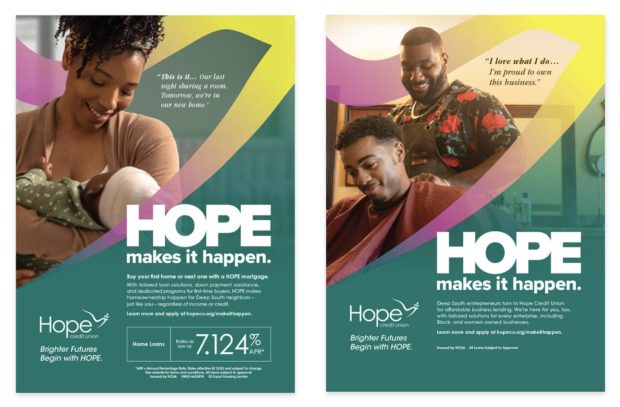
Case in point: Hope Credit Union
HOPE serves historically underserved communities across the Deep South, combining community-driven storytelling with powerful, mission-based messaging. Its campaigns bridge local activism and financial education, all under a clear, authentic brand mission.
The middle ground is disappearing. But that doesn’t mean there’s no room to grow. Brand-savvy community banks and credit unions have a once-in-a-generation opportunity to punch above their weight, not by acting bigger, but by acting bolder.
Read more: How Bank of Oklahoma’s ‘Brand Journalism’ Nurtures Customer Needs Instead of Selling Things


