
How Well Do You Know Your Best Prospects? Enough to Outpace Your Competition?
By Nicole Volpe, Contributor at The Financial Brand
Simple Subscribe
Subscribe Now!
For most community banks and credit unions, deep and locally-rooted knowledge of customers and markets is a critical — perhaps the defining — characteristic of their business model. That context allows them to tailor credit underwriting beyond rigid algorithmic models, build resilient customer loyalty, and design products specifically tuned to their region’s economic ecosystem.
That said, while these institutions’ close community relationships give them an edge that larger players struggle to replicate, that advantage only goes so far. In an increasingly competitive marketplace, banks and credit unions often come up against institutions with greater resources and increasingly sophisticated approaches not just to reaching prospective accountholders but to identifying and understanding their needs. Market knowledge born of direct experience and community roots — even augmented with core demographic data — may no longer be enough.
To be sure, highly granular consumer data that would fill this gap has long been available to those with the resources to access and analyze it. But more recently, those capabilities have come within reach of smaller banks and credit unions too. This larger universe of consumer and behavioral data, combined with modern modeling capabilities, can reveal considerably more about prospects: what they intend to buy, how they consume media, and what might motivate them to act.
“The value–cost equation has shifted,” said Scott Hopkins, EVP at Anderson, a growth marketing agency with a focus on financial services. “More institutions have access to do next-level marketing to compete with your larger competitors — to know even more about your customers.”
This matters because small financial institutions typically operate with significantly constrained marketing budgets compared to larger institutions and growth-focused fintechs. Traditional institutions may allocate just 0.05% to 0.07% of total assets to marketing, according to data from ABA Banking Journal Benchmarks — less than $1 million annually for a billion-dollar asset institution. By contrast, venture-backed fintechs and digital-native platforms, which often deploy hyper-aggressive acquisition strategies, may spend three times more on sales and marketing than incumbent banks, plowing as much as 40% to 60% of net revenue into customer acquisition and brand visibility.
Insights In Action
Traditional demographic data remains useful, but it doesn’t describe the whole prospect. Age, income, household composition, and location might establish who someone is, but more-sophisticated consumer intelligence can add layers of insight — helping to build far more complete and actionable psychographics and intent profiles.
Those insights can come from multiple sources: self-reported survey data, observed digital behavior, historical purchases, and other consumer attributes. Combined and modeled, they can reveal everything from personal values and brand affinities to preferred media channels and indications that someone may soon be in the market for a particular product. The result is less a replacement for local market knowledge and insight than a higher-resolution version of it.
“When you go the next level down, you start to get a strong picture of who they are as human beings,” Hopkins said in an interview with The Financial Brand. “You now know where they’re shopping, what kind of media they consume, and what actually moves them.”
Consider a community bank planning a deposit acquisition campaign in Atlanta. Previously, it might have started with the geography around its branches and basic demographic characteristics such as age, income, and household composition. That could define a viable target market, but still leave large numbers of prospects looking essentially alike.
Add behavioral, psychographic, media and purchase-intent data, and the same market can be divided into audiences that differ materially in what they value, where they spend their time, which financial products they may soon need and how receptive they are to particular offers. The result is a sharper view of where the most promising opportunities lie.
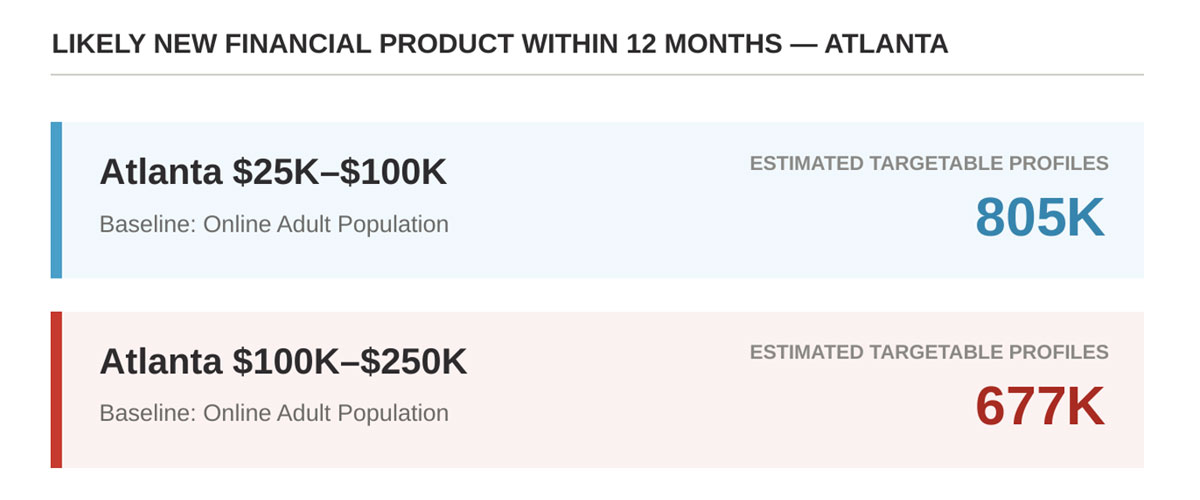
Drawing on Anderson’s predictive intelligence — which incorporates quarterly online consumer surveys, modeled consumer and household data, and live behavioral signals, Hopkins explained how next-level insights might differentiate two groups of consumers in the Atlanta DMA. Based on modeled purchase-intent signals, both groups have been identified as likely to seek a new financial product within the next 12 months. One has household income of $25,000 to $100,000; the other, $100,000 to $250,000. Together they represent roughly 1.4 million targetable profiles, as shown below.
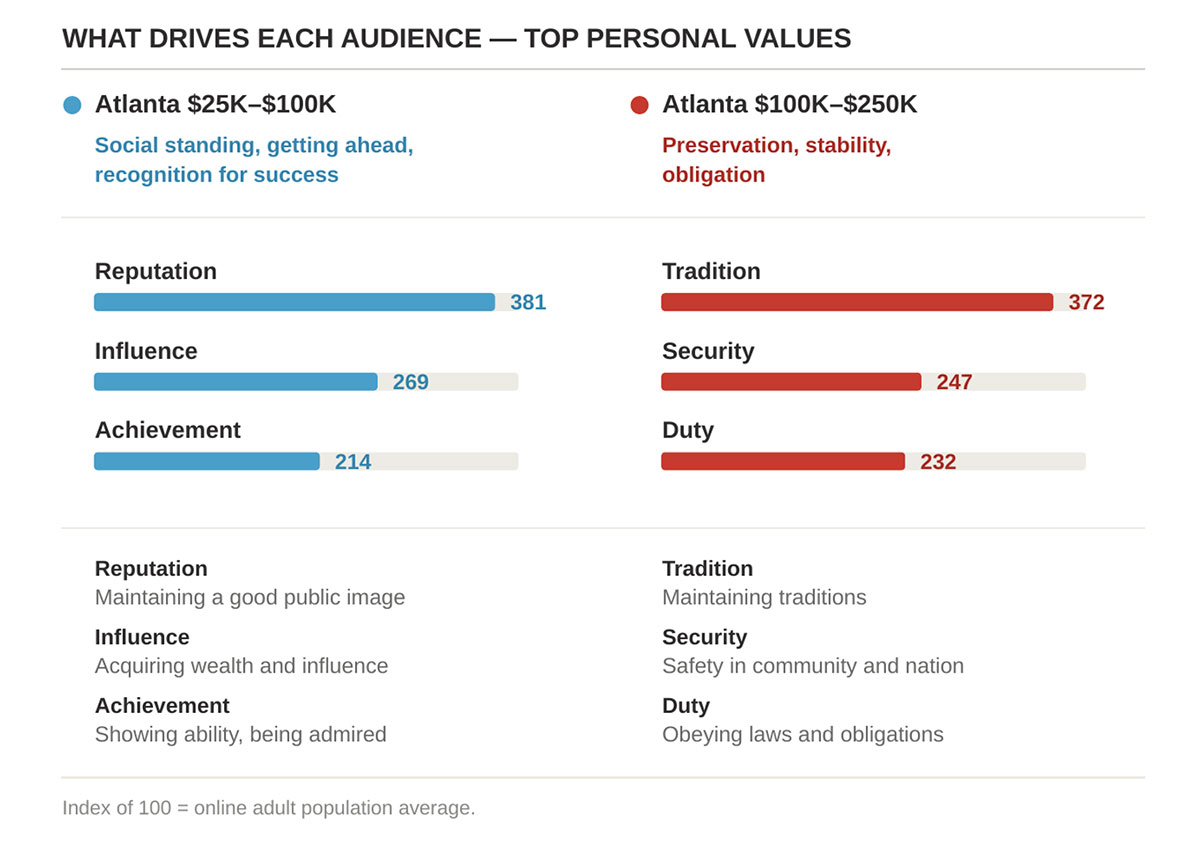
But while income may indicate product relevance and scale of opportunity, a psychographic profile can uncover more, including insight into their likely personal value systems. As shown below, the lower-income group strongly over-indexes on reputation, influence, and achievement — values associated with social standing, getting ahead, and being recognized for success. The higher-income group, by contrast, over-indexes on tradition, security and duty — a much more preservation- and stability-oriented profile.
Media consumption data can tell a further story, Hopkins said. Among the lower-income audience, Threads, Snapchat, TikTok and Twitch all index strongly; among the higher-income group, Nextdoor and LinkedIn stand out. Their time online differs too: 47% of the higher-income group spends 20 to 40 hours online each week, compared with 13% of the lower-income group.
And a deeper dive into financial product intent adds another layer. In the lower-income group, 42% are likely to open a checking account and 61% to apply for a new credit card within the next year, versus 11% and 31%, respectively, among the higher-income group. Yet 71% of the higher-income audience says it is likely to open a new account if presented with an appealing offer, compared with 27% of the lower-income audience. The two cohorts have similar near-term interest in financial products, but beneath those broad similarities are very different consumers.
Test and Learn
These additional layers of data and insight can help turn a broadly defined market opportunity into multiple distinct opportunities and campaigns. For acquisition marketers, that can start with product and timing. An audience showing active interest in CDs, mortgages, or new checking relationships can be prioritized accordingly, with live behavioral signals adding evidence that the interest is current rather than merely demographic. Hopkins stresses that these signals do not guarantee a response but identify a stronger hypothesis to test in the market.
The same intelligence can influence the offer and the creative around it. The lower-income, achievement-oriented audience may be more responsive to themes of progress and success; they may be more interested in products associated with upward mobility, such as mortgages. All else equal, the higher-income cohort, oriented toward security and tradition, may be likelier to respond to CD offers. Lifestyle and brand affinities provide additional clues about imagery and context, while media-consumption data helps determine where those messages should appear.
The applications can extend beyond marketing. Product teams could use the same audience intelligence to reconsider terms and features against both customer demand and the competitive landscape.
Finally, community banks and credit unions may also find strategic insight in deeper market data — not simply to find more prospects who resemble their existing customers and members but to challenge the institution’s own assumptions about where growth can come from.
“Most institutions instinctively look for more people who resemble their best customers,” Hopkins said. “The bigger opportunity is often the prospects who don’t look like them at all.” Comparing the current customer base with the broader market can reveal segments in which the bank is underrepresented, including prospects who are otherwise squarely within the institution’s catchment. In this way, market intelligence can give an institution a view into its own future.


