
How First Horizon’s CMO Stays Ahead of Bank Marketing’s Headlong Evolution
By Steve Cocheo, Senior Executive Editor at The Financial Brand
Simple Subscribe
Subscribe Now!
When practitioners talk about “always on” marketing, the language increasingly doesn’t match the reality of marketing today: The pace of change is so rapid that bank marketing leaders are nearly always revamping something, adapting to new developments, anticipating or reacting to shifts in customer expectations or technology.
Reality check: Consider changing the buzz-phrase to “always revising marketing.”
A good example is the website of First Horizon Bank, 35th largest bank in the country at $84.4 billion in assets. The bank, which leans commercial, brought Erin Pryor, formerly of USAA, on board as chief marketing officer and head of client experience at the end of 2020, in the midst of the pandemic. Pryor also arrived in the wake of a merger of equals with IberiaBank. She set about crafting a new marketing thrust. In early 2022, TD Bank Group made a deal to acquire First Horizon — ultimately encountering regulatory resistance and aborting the proposed purchase in the first half of 2023.
Even as the deal percolated, Pryor continued to hone the marketing of First Horizon. This included a major redesign of its website, intended in part to accommodate the end of third-party cookies, that debuted in October 2022.
That was yesterday’s problem.
Need to Know:
- First Horizon has 407 banking centers in 12 states, nearly all in the increasingly contested Southeast and Texas. During a June analyst meeting, the company’s SEVP and CFO, Hope Dmuchowski, noted that branch growth is so frenetic in the region that it has become difficult to engage general contractors to build more of them.
- As financial institutions are fighting for slices of pie, the pie is also growing larger in some areas such as Miami and the Carolinas, per Dmuchowski.
- First Horizon spent three years and $100 million upping its technology game. A big chunk of that money came from TD Bank Group in settlement of the aborted acquisition of First Horizon.
In June, the bank relaunched its website again, after about ten months of development, emphasizing a more user-friendly interface, better navigation, and upgraded content. Pryor says content will be a continual focus going forward. In part, this is because the bank tends not to compete on rate and price, but more in an effort to build on customer relationships for the long term.
Key motivation: Along the way, today’s problem for financial websites arose — the impact of AI-based search and the risk of becoming invisible.
“That wasn’t a factor when we began the redesign,” says Pryor. “But as we continued to move through the project, the importance of it became more elevated and it definitely influenced where we ended up. Staying relevant in search is the Holy Grail. I call the site our biggest banking center, because we are getting millions of visits per year.”
Key adjustment: A seemingly small, but meaningful shift for the new site was ditching bankspeak.
“Often bank sites say things like ‘retail banking’ or ‘commercial banking,’ but we decided to use more solution-oriented navigation, so people can find what they’re looking for,” says Pryor.
So, visitors to the home page see “Everyday banking,” “Business banking,” and “Private clients” as the three key segments. Alternatively, they can navigate by type of needs — “Individuals and families,” “Small business owners,” “Commercial and industry,” and “Wealth management.”
Content is easy to find, with a large window on the home page highlighting a handful of articles, along with a link to a more-extensive landing page chock-full of material.
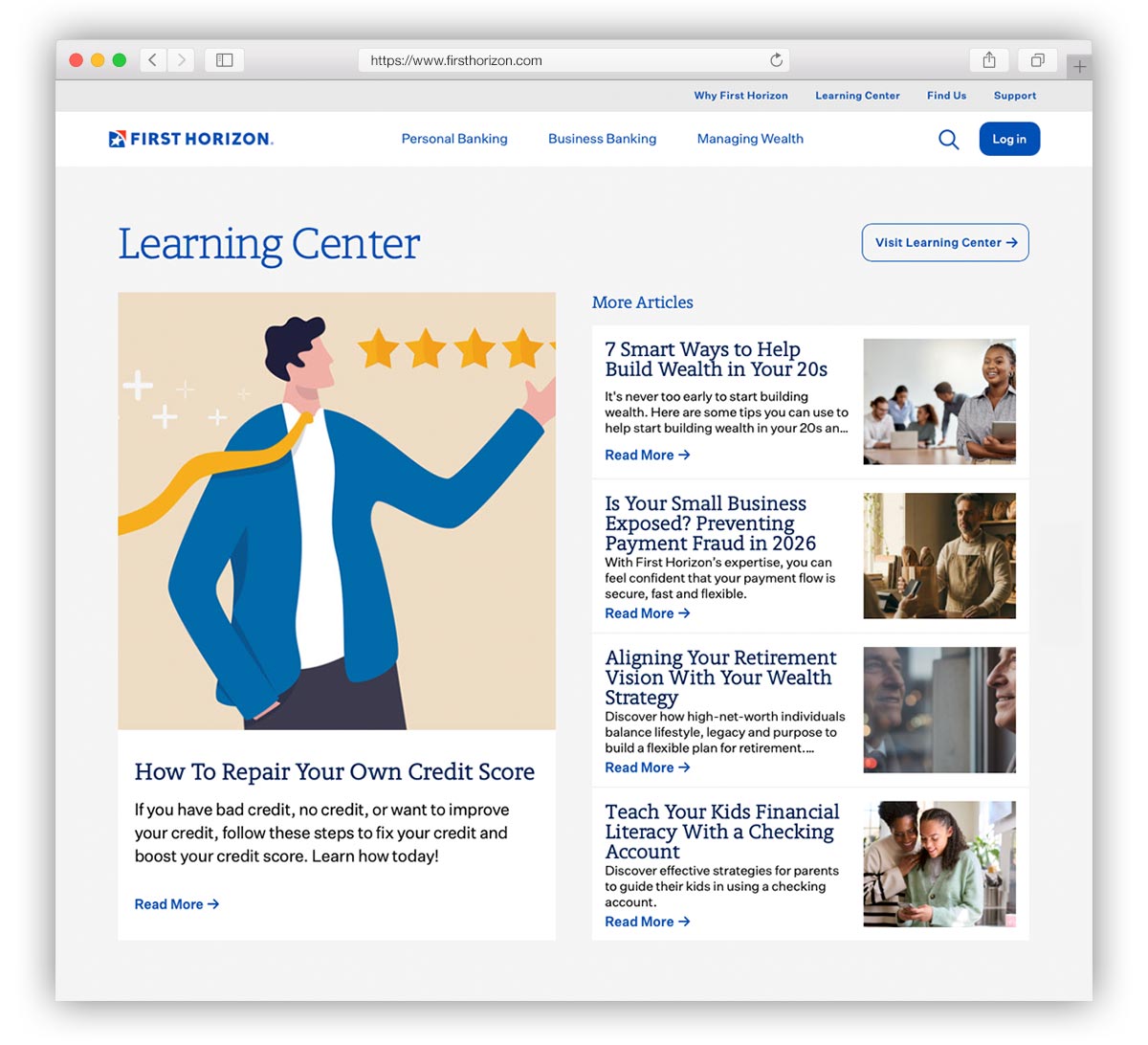
“But a website’s never done,” says Pryor. “Now, it’s a process of constant iteration. So, we’ll continue to build on it and to build out the content within it so we can stay relevant within all of the search platforms.”
Read more: Fifth Third’s CMO: Focus on the Customer, Not the Product
Getting to Know the Analyst Community
At the time of her interview with The Financial Brand, Pryor had recently had an unusual opportunity for a marketer: She accompanied Dmuchowski to the Morgan Stanley U.S. Financials Conference. During a fireside chat, the CFO actually alerted analysts to Pryor’s presence at the event.
“We keep getting asked about deposits,” Dmuchowski told the gathering. “I thought it would be great for her to spend two days with investors hearing how the investor community thinks about it.”
An executive training strategy. Pryor says this was her first time for going on the road with top executives at an analyst meeting. She explains that the senior team had been talking about bringing the bank’s functional leaders to such meetings to hear what analysts and investors are interested in, and to add value.
Pryor didn’t share the dais with Dmuchowski but spoke during investor meetings the bank conducted for two days in conjunction with the presentation.
“Those are very long days,” says Pryor. Much of her time went to asking direct questions from attendees.
She says her bank role includes consumer debit and credit cards, consumer lending and other product areas, as well as marketing. These areas, as well as deposits, are subjects the investor audience often broached.
Pryor saw the field trip as an opportunity to learn more about what she considers key constituencies for today’s bank marketer: shareholders, customers and associates in the bank.
For example, she says, “your brand story and your positioning has to resonate with your shareholders.”
Key insight: Part of what she says she took away from the experience was fresh ideas on what she produces for Dmuchowski and Bryan Jordan, chairman, president and CEO, when they go on the road.
“I learned that there are some things that I could be packaging better for them to have in their pocket when they are asked about some matters,” says Pryor.
Read more: How Bank of Oklahoma’s ‘Brand Journalism’ Nurtures Customer Needs Instead of Selling Things
Building Better Connections with Business Units
One of the bank’s strategies, as a commercial specialist, is asking for the personal banking business of leaders of client companies. She refers to this strategy as “H2H” — human to human.
Pryor places a great deal of reliance on alignment between marketing and the bank’s sales teams. She points out that while marketing puts the bank’s message out there, ultimately it’s the sales teams in branches and other parts of the bank that earn the business and build the relationships.
“I’m pretty adamant that my teams understand the business of the bank and talk to the sales team leaders,” says Pryor.
In the next couple of months, as part of her continuing stress on that connection, all of Pryor’s direct reports will be spending a day in a branch. The idea is to see how the marketing function’s ideas fit into the front-line’s world. Her people regularly listen-in on contact center calls for the same reason.
“It’s rare that anybody calls to say, ‘Oh my gosh, I love your bank so much’,” says Pryor. “Usually they are having an issue. If you get too far away from the customer and their business, you become disconnected.”
Read next: How TD Bank is Attacking Its Primacy Challenge in the U.S.


