
Consumers Are Breaking Up with Brands. Three Strategies to Keep the Love Alive
By David Evans, Chief Content Officer at The Financial Brand
Simple Subscribe
Subscribe Now!
According to a new report from Omnicom Media, consumer influence has fundamentally shifted, from institution-controlled messaging to distributed, consumer-driven validation. For retail banking executives, the rules of market share capture have been completely rewritten:
- “Physical availability” now means omnichannel ubiquity beyond branches.
- “Mental availability” requires cutting through unprecedented noise and AI disintermediation.
- “Emotional availability,” a new dimension, has emerged as critical for building lasting customer relationships.
Meanwhile, marketing budgets have shifted dangerously toward short-term performance, precisely when brand investment needs to deliver measurable long-term value.
Key takeaway: Financial institutions that master the balance between the three dimensions above, while marketing to both humans and AI systems, will capture the loyalty of customers who increasingly make decisions through fragmented, non-linear journeys across platforms banks don’t control.
Need to Know:
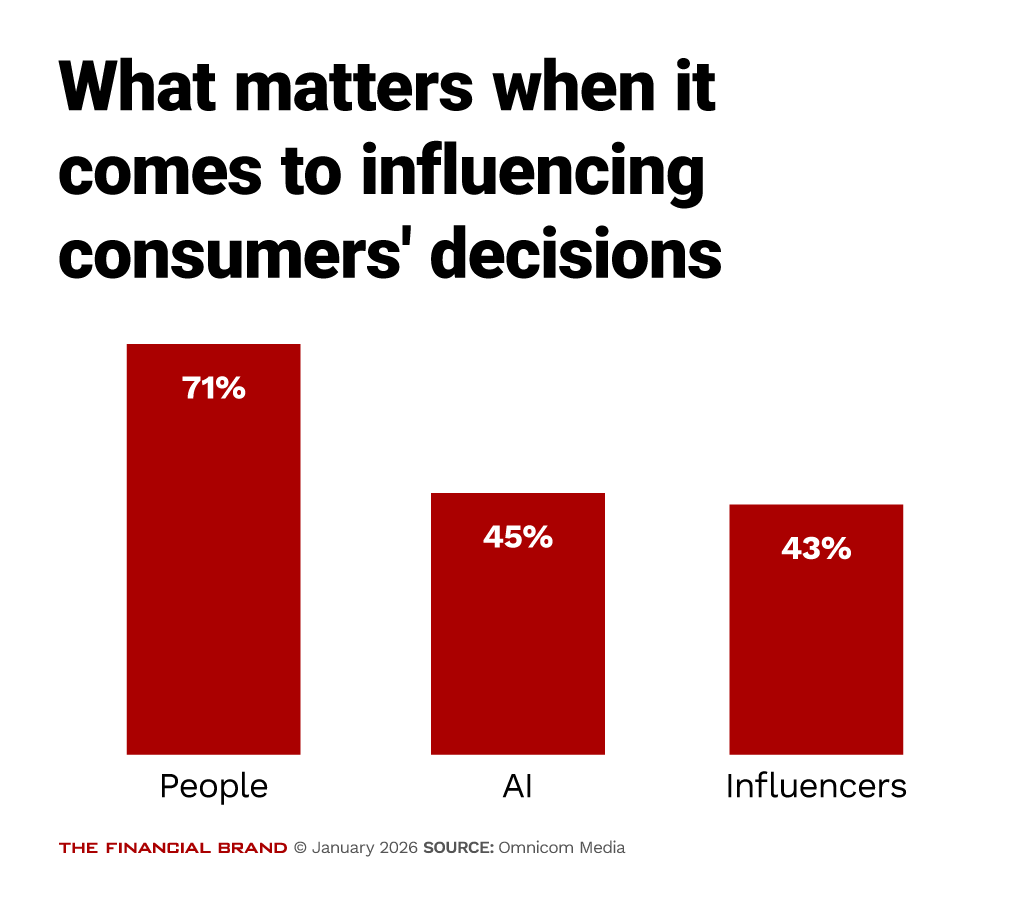
- 71% of consumers say what people say about a brand matters more than the brand’s advertising when influencing their opinions and decisions.
- 92% of consumers now find all the information they need to make faster purchase decisions due to abundant sources. But this also creates decision paralysis from information overload.
- 63% of consumers report their attention span is “just OK or not great,” driven by content fragmentation and multi-device usage that averages 9 hours daily with digital media.
- 44% of consumers trust AI brand/product recommendations, up from 35% in 2024, with 33% using generative AI to help make final purchase decisions.
- 62% of consumers say brands must create or tap into shared cultural moments to grab their attention, and 50% feel more positive about brands advertising during major events
What This Means
Consumer trust has migrated from institutions to individuals: 54% of consumers trust people (influencers, Reddit users) more than publications or journalists, with Gen Z reaching 67%. Banks must recognize that peer validation on forums and social platforms now outweighs traditional advertising claims.
AI platforms are disintermediating customer discovery: 70% of consumers say generative AI enables them to become experts in any product category, including financial services. Banks risk invisibility if they don’t optimize for how AI systems surface and recommend their products.
Emotional availability is now a required growth driver: 75% of consumers say a brand’s relatability is essential to purchase decisions, yet 72% feel brands care more about their dollars than their loyalty. Banks must authentically connect through shared values and cultural moments, not just product features.
The purchase journey has become radically non-linear: 80% of consumers take non-linear paths from discovery to purchase, searching across multiple platforms from social media (54%) to retail sites (76%) to AI chatbots (27%). Banks must meet customers wherever they search, not just on owned channels.
Budget allocation contradicts optimal strategy: CMOs report 50:50 brand-to-performance is ideal, but actual spending reached 68.8% performance focus in 2024. This short-term emphasis undermines the brand equity proven to drive sustained business growth in financial services.
What To Do Now
According to Omnicom, the future of growth in retail banking requires simultaneous optimization across physical, mental, and emotional availability. Banks must be frictionlessly accessible wherever customers transact (physical), consistently discoverable across fragmented search behaviors and AI systems (mental), and authentically resonant with customer values and cultural participation (emotional).
Excelling at only one or two dimensions leaves banks vulnerable to competitors who master all three.
Physical Availability: Beyond Branches to Everywhere Commerce
The traditional banking model relied on branch density and ATM networks to drive physical availability. Today’s retail banking customers demand frictionless omnichannel experiences. Research shows 78% of consumers expect financial institutions to maintain seamless presence across physical branches, mobile apps, websites, and digital marketplaces—essentially bringing services to them on their terms. The rise of embedded finance means banks compete not just with other banks but with any company that can integrate financial services into consumer journeys.
The strategic imperative for banks: Physical availability now means being discoverable and accessible wherever customers are making financial decisions, from AI chatbot conversations to TikTok videos to embedded checkout experiences. Community banks and regional institutions must compete on convenience and integration, not just local presence, according to Omnicom. This requires investment in API-first infrastructure, partnership ecosystems, and shoppable advertising formats that reduce friction between discovery and action.
Mental Availability: Cut Through Noise and Disintermediation
Traditional mental availability focused on maximizing reach and frequency to build brand recall. Banks invested heavily in awareness campaigns expecting that consumers who recognized their brand would consider them at decision time. This model assumed a relatively stable set of touchpoints—TV, radio, print, outdoor—where banks could reliably reach target audiences.
The explosion of digital channels has shattered this paradigm, argues Omnicom. Consumers now search for financial information across at least seven major platform types, from traditional search engines (98% usage) to social media (54%) to generative AI (27%).
More concerning for banks: 40% of consumers say online rhetoric about brands matters more than brand websites (38%) or brand advertising (32%) in forming opinions. Nearly 4 in 10 consumers don’t even notice ads on social media despite billions in banking ad spend.
Generative AI platforms represent the most disruptive threat to mental availability. These systems can synthesize information about banking products, compare features, and make recommendations without consumers ever seeing a bank’s logo or messaging. As AI adoption reaches 75% of U.S. consumers (46% using it daily), banks face the prospect of being completely disintermediated from customer consideration.
The strategic imperative for banks: For retail banking executives, this means reach and frequency remain necessary but insufficient. Banks must optimize for how they appear in AI-generated responses, ensure their products surface in social search results, and maintain relevance in the fragmented discovery environments where customers now research financial decisions. The shift from push marketing to pull discovery demands new measurement frameworks that track brand salience across these distributed touchpoints.
Emotional Availability: The Missing Dimension of Banking Growth
The most significant evolution in brand growth strategy is recognizing emotional availability as a distinct driver of consumer choice. This dimension captures consumers’ willingness to connect and engage based on authenticity, value alignment, trust, and the emotional resonance a brand creates.
Research reveals a stark disconnect:
- 72% of consumers believe banks care more about their dollars than their loyalty, and
- 55% feel banks don’t try to connect the way they used to.
- Yet 66% say brand values must align with their own when making purchase decisions, and 75% report that relatability is essential.
Banks face a perception problem that product features and pricing alone cannot solve.
This emotional dimension becomes particularly powerful during shared cultural moments. When banks advertise during major live events, 50% of consumers report feeling more positive about those banks. The emotional elevation that comes from participating in collective experiences — whether Super Bowl ads or sponsoring local community events — creates lasting impression that pure performance marketing cannot replicate.
The challenge for retail banking executives: Emotional availability requires long-term investment in brand building at precisely the moment when budget pressures push toward short-term performance tactics.
Yet, evidence from MMA research and Harvard Business Review demonstrates that brand equity directly drives business growth in financial services. Banks that authentically connect with customers’ values and participate meaningfully in cultural moments build emotional availability that translates to customer acquisition, deeper relationships, and lifetime value.
The New Growth Model: How to Balance All Three Dimensions
Integrating all three approaches demands organizational change:
- Marketing teams need tools and measurement frameworks that capture influence across the full customer journey, not just last-click attribution.
- Product teams must design for embedded, API-first distribution.
- Brand teams require budget protection to build the emotional connections that sustain long-term growth.
- Digital teams must optimize for both human and machine audiences as AI systems increasingly mediate discovery.
The retail banks that thrive will market to both humans (through culturally resonant content, influencer partnerships, and live moment participation) and machines (through generative engine optimization, structured data, and AI-friendly content architecture).
Omnicom believes that this approach creates a virtuous cycle: strong emotional availability with humans generates the authentic reviews and social proof that AI systems surface in recommendations, while optimized presence in AI responses drives discovery that leads to emotional engagement.


