
Citibank Doubles Down on Integrating Retail Banking and Wealth Management to Build Primacy
By Steve Cocheo, Senior Executive Editor at The Financial Brand
Simple Subscribe
Subscribe Now!
As part of its renewed strategy to build primacy — the target being the $3 trillion that it estimates its customers have with competitors — Citibank recently unveiled an improved value proposition, with a program called “Citi Premium Boost.” Patty Sachs, a veteran financial marketer who joined the bank in 2025, is leading the massive marketing push to turn the program’s concepts into concrete results.
The big picture: “Citi is at a point right now where we’re re-establishing ourselves as a brand,” says Sachs, managing director and head of wealth marketing. The bank integrated retail banking and wealth management in an effort to convince people to consolidate their banking and investment relationships in one institution, instead of spreading their business around, either through inertia or chasing promotional rates.
Selling consolidation, which runs against the behavioral tide among many consumers, will ride on a hybrid marketing campaign that is both product marketing and brand marketing. Sachs says this is a major investment in marketing that Citi is committed to for the long-term.
“Historically banks have been in a very short-term marketing stance,” says Sachs. “You’ve had to hit the performance numbers.”
Sachs says the bank aims to play a long-term game. “We want our clients to consider us, not just to get a rate or a promo, but to build a longstanding relationship and partnership with us,” says Sachs. “We want them to bring it all together here — and that’s not a short-term game.”
The bank has launched into this new marketing push at a point where success means not only reaching human eyeballs but also attracting the attention of the AI tools that people increasingly use to find financial services opportunities.
Need to Know:
- Citibank is eschewing significant branch expansion like some of the other major banks and instead working to deepen relationships with present clients.
- The bank’s Premium Boost program overlays its account tier structure, promoting higher savings account rates for those who consolidate more business with Citi.
- In November the bank launched the first broad and deep wave of marketing for Premium Boost, concentrating on the New York market. Next year promotions will be rolled out in Citi’s five other key markets.
Key insight: Sachs says a key facet of the bank’s campaign is to push the brand past the perception that banks offer a commodity line of products and to convince key audiences that they are the customers Citi hopes to woo and keep.
“We’re going after the clients who we call the ‘change makers’,” says Sachs. “These are individuals who are very ambitious about the world they’re living in, ambitious around their careers, around their families. Ambition has no age.”
What to watch: It’s very early days for Citi Premium Boost, but Sachs has been pursuing a pilot all-fronts marketing push, “Get It Together, New York,” that will inform the bank’s promotion of Boost in its six key markets as the marketing scales. The key markets also include Miami, Washington, D.C., Chicago, Los Angeles and San Francisco.
“The idea has been to focus first on our New York footprint, where we have the majority of our Citi customers today, to get them to lift their heads and bring more of their money to us,” says Sachs.
Read more: How BofA’s Rewards Bet Is Changing the Loyalty Equation
Pushing Out Premium Boost to New Yorkers
Premium Boost adds on to Citi’s Relationship Tiers framework. Customers who bring both a savings account and a checking account to the bank qualify for a higher rate on savings, the APY depending on their overall balance. The highest level commands a 4.35% APY. Citi’s tiers begin with the Citi Priority level, which requires a combined average monthly balance of $30,000, and rises to Citigold Private Client, which starts at $1 million. (See this page for details.)
“We’re trying to switch a behavior where clients are chasing promotional rates,” says Sachs. “Premium Boost is meant to deepen our relationships. The goal is to not only attract the money coming in, but to retain it as well.” The bank offers the program nationally.
The “Get It Together, New York” marketing push began in early November.
One strategy was “owning the morning commute.” The idea is to reach the bank’s targets at a point in the day when they can dwell a bit on their finances. This dovetailed with the bank’s desire to drench the New York market with Citi messaging, a return to “above the line” marketing as part of the rebranding aspect of the hybrid campaign.
Elements of this major out-of-home marketing effort include digital placements in major commuting hubs, such as New York’s Port Authority Bus Terminal and Moynihan Train Hall (pictured below). Placements have also been made at the ubiquitous kiosks serving the Citi Bike program, in the bank’s branches and on ATM screens.
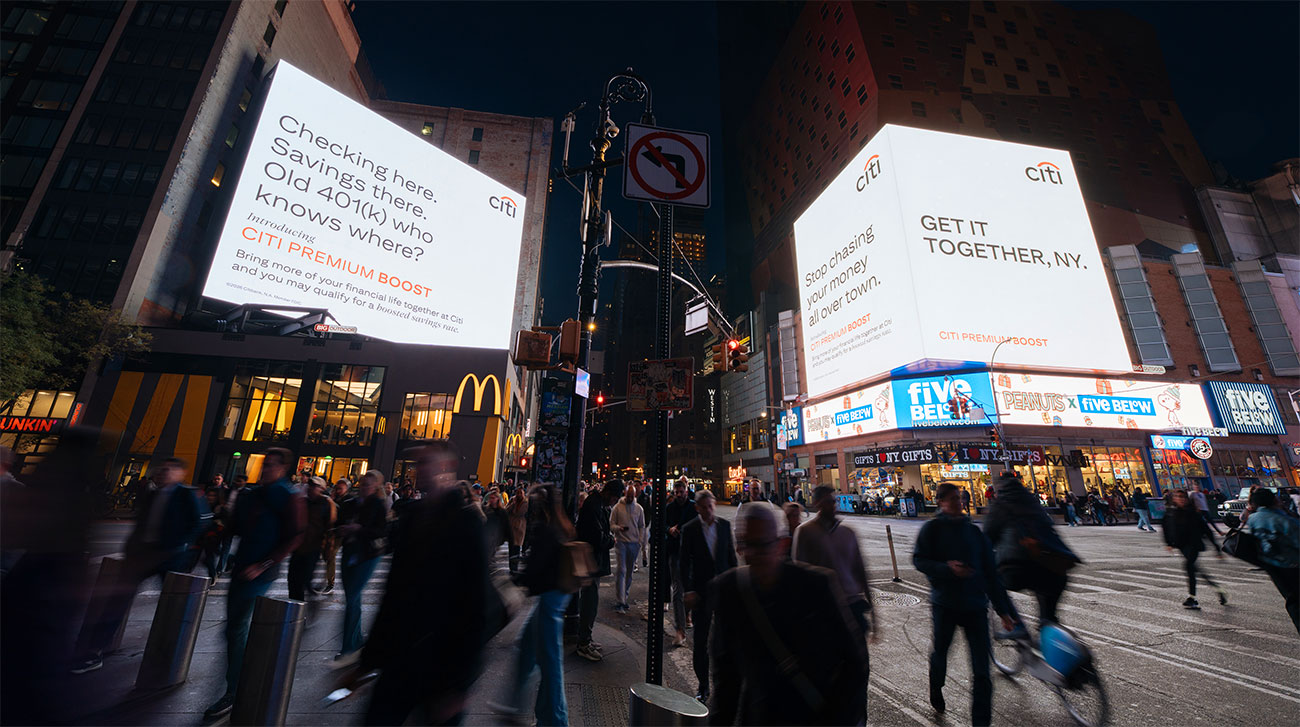
Photo by Eric Van Nynatten

Photo by Eric Van Nynatten
Citibank used digital out-of-home as part of its media mix for the “Get It Together, NY” promotion of its Citi Premium Boost program. Locations included the vicinity of Manhattan’s Port Authority Bus Terminal (top) and Moynihan Train Hall at Pennsylvania Station.
“Out-of-home is high-impact and a good way to make a statement,” says Sachs.
The bank has also been trying to reach target consumers with cultural tie-ins. Sports marketing, notably including the New York Knicks basketball franchise, has been one part. There have also been shorter-term efforts to stand out, such as the “Bodega Boost.” This consisted of a Citi takeover of selected food trucks — complete with branded wraps — that set up near branch locations, offering free snacks from gourmet chefs.
Key fact: “Citi hasn’t shown up with this amount of swagger in a long time,” says Sachs.
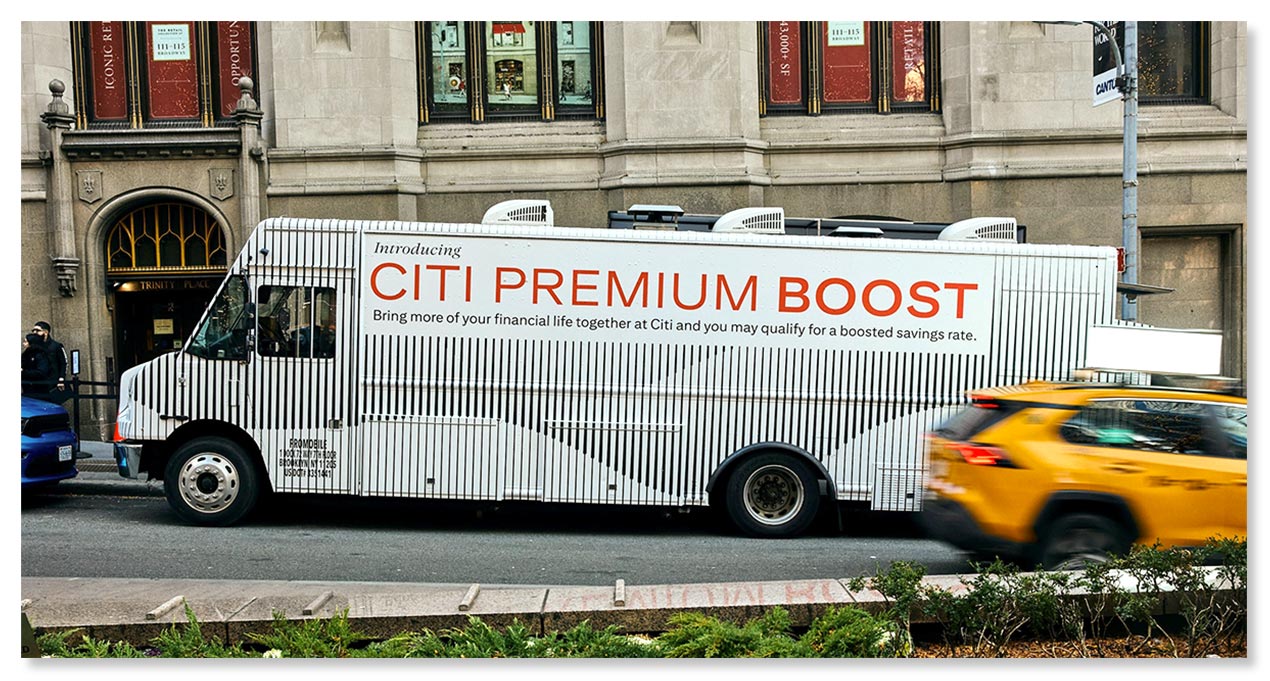
Photos by Paul Quitoriano
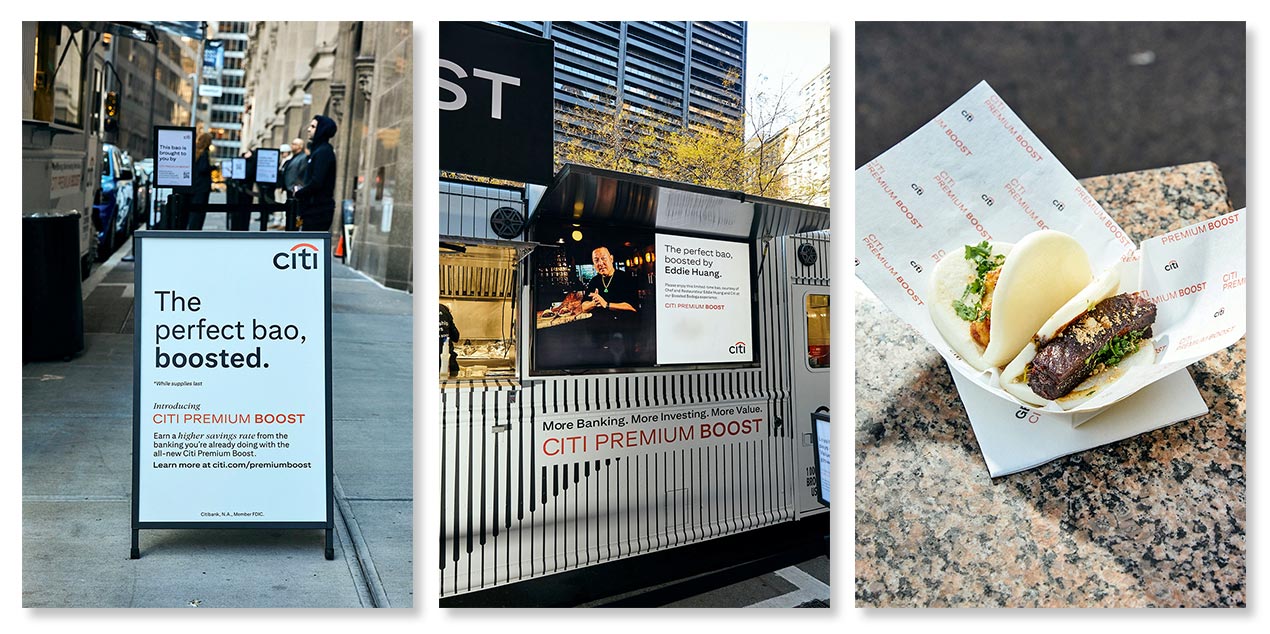
A five-day tour by “Bodega Boost” trucks offered passersby a taste of New York food-truck cuisine and Citibank’s Premium Boost program.
Read more: Millennials and Gen Z Now Dominate New Checking Accounts. That’s Not Good News for Banks
But What About AI-driven ‘Eyeballs’?
While Citi is among the major banks that are, for now, blocking AI agents from accessing customer accounts, many consumers now use AI search tools to find, evaluate and compare financial products. And those tools don’t commute and they don’t eat.
Sachs acknowledges the challenge.
“This is a whole new world for all of us, in terms of the role that agents play and how they’ll guide people’s decisions around their financial wellbeing,” says Sachs. “AI tools may not look at our advertisements, but they certainly look at our content.”
She says marketers have to “get under the hood of how agents influence decisions on behalf of our clients,” and admits that that understanding is still developing. “We haven’t cracked the code on it yet.”
Sachs says it has become clear that AI has made digital content more important than ever because that’s where it derives its understanding of what a bank offers. Some of this is within the bank’s control, in terms of the content it publishes, but some can’t be controlled directly. One example Sachs points to is Reddit posts that AI search may draw on.
Lessons learned so far: “Number one, your own content has to be really strong, clear and transparent,” says Sachs. “You have to have a robust front-end digital experience that is scannable, not only to target our existing clients, but also the large language models.”
Failure to do that means that LLMs won’t even consider a bank’s offerings, she adds.
“We have to post content that is very clear on what our value proposition is, what makes us different, ,” says Sachs. “It’s table stakes to say what you have. You have to explain why it really matters.”
Read more: How Ally Aims to Push Its Primacy Appeal with Checking and a New Rewards Program
It’s No Longer Just About What Banks Say About Themselves
Sachs notes that it’s no longer just your own brand telling your story.
“Historically, Citi felt like the onus was all on us to tell our story, but that’s not the case anymore. We have to expand our reach and engage with others who can influence decisions,” according to Sachs.
The bank is using an outside agency to identify digital influencers who can put out the positive word about Citi for both humans and AI. The effort leans hard into data indicating the following a given influencer has in financial circles. A given, she says, is that while the bank will be paying for their voices, the influencers must be genuine Citi customers.
“I don’t think you could talk authentically about Citi without having a relationship,” says Sachs.


