
Just Say ‘Hello’: Almost 60% of Bank Visits Start Without a Welcome
By David Evans, Chief Content Officer at The Financial Brand
Simple Subscribe
Subscribe Now!
Executive Summary
- According to Adrenaline’s mystery shopping report, “Closing Customer Experience Gaps in Branch Banking,” customer experiences succeed when there is an alignment of people, place and process that transform the branch from a transaction center into a trust -building environment.
- The greeting moment is systematically failing, with 58% of branch visits beginning without any welcome from staff, creating immediate friction that undermines trust-building and forces customers to seek out employees rather than being proactively engaged.
- Branches feel transactional, not consultative, as 66% of interactions were product-led rather than needs-based, making customers feel sold to instead of understood, a critical miss when 54% of customers expect personalized experiences based on their data..
- Digital activation is virtually nonexistent, with 98% of staff failing to use tablets, QR codes, or digital content during customer interactions, leaving technology investments underutilized and missing opportunities for seamless handoffs and enhanced engagement.
Retail banking executives live in a comfortable delusion: According to a recent report from Adrenaline, 80% believe their institutions deliver superior customer experiences, while only 8% of actual customers agree. This isn’t a rounding error. It’s a 72-percentage-point chasm between self-perception and reality that explains why institutions hemorrhage relationships despite investing millions in branch networks.
The Adrenaline report, based on mystery shopping of over 50 US banks and credit unions from $5 billion to $500 billion in assets, reveals exactly where and how this gap manifests in the daily interactions that shape customer loyalty.
The findings are stark. Nearly six in ten branch visits began without any greeting from staff. Two-thirds of interactions felt transactional rather than consultative, with customers reporting they felt “sold to” instead of understood. 98% of staff never leveraged digital tools — tablets, QR codes, interactive screens — during the exchange, leaving expensive technology investments sitting idle while customers waited for information that could have been delivered instantly.
Most damning, 62% of visits failed to inspire any intent to return, turning what should be relationship-building moments into forgettable errands that subtly encourage customers to handle future needs digitally or with competitors.
“What happens in the first ten seconds of a branch visit defines the entire relationship trajectory,” says Juliet D’Ambrosio, Chief Experience Officer at Adrenaline. “It’s a trust moment — not a transaction.”
This matters because branches still drive banking relationships in ways digital channels cannot replicate. A third of consumers cite access to a local branch as a primary reason for choosing their current bank — ranking second only to brand trust and ahead of digital experience quality. Three out of five consumers across all generations say branch access is crucial, and 65% see physical locations as symbols of stability. When institutions fail to capitalize on this preference through subpar in-branch experiences, they’re not just disappointing customers. They’re actively undermining the competitive advantage that justifies their extensive real estate footprints and associated costs.
For banking executives, this creates both crisis and opportunity. The institutions that close the experience gap through intentional choreography, staff training, and space optimization will capture disproportionate market share from competitors still operating on autopilot. Those that continue believing their branches perform better than customers actually experience will watch relationships erode one disappointing visit at a time, wondering why digital adoption isn’t translating to loyalty, and why younger customers defect to institutions with smaller footprints but superior execution.
When the Journey Breaks Before It Begins
Adrenaline organizes the in-branch experience into five zones that shape the customer journey —attract, engage, transact, consult, and support. Each has specific purposes and success metrics. Yet mystery shopping reveals most institutions fail at the earliest, most critical moment: the greeting that shapes everything that follows. When 58% of visits begin without acknowledgment, customers start their experience feeling uncertain, unwelcome, and as if they’re imposing rather than valued. This initial friction raises the psychological bar for building rapport and trust in subsequent interactions, turning what should be effortless engagement into uphill relationship work.
“Design alone can’t fix experience gaps,” says Chris Howe, Design Principal at Adrenaline. “Every experience can be programmed. As an experience company, we think differently. We put the ideal interaction and outcome in the middle, then determine the physical space, staff behaviors, and technologies that enable that experience. It’s a way of reverse engineering an experience.”
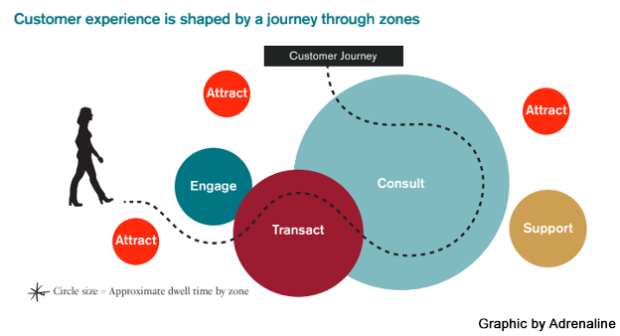
Adrenaline’s zonal breakdown exposes systemic failures across the customer journey.
- The attract zone — exterior signage, lighting, window graphics — should create a brand beacon that draws business, yet many branches blend into surroundings with dated facades that fail to communicate institutional presence or relevance.
- The engage zone at entry should deliver immediate hospitality through staff positioned to greet and triage, but teller-focused layouts leave employees tethered to back counters, unable to acknowledge arrivals.
- The transact zone becomes painful when wait times stretch without queue management or digital engagement, creating idle dwell that breeds frustration rather than using the moment for cross-sell messaging or financial education.
- The consult zone — offices and advisory spaces — represents the highest-value interaction opportunity but often disappoints. Privacy expectations go unmet in open cubicle environments, appointment scheduling remains inconsistent, and staff rarely leverage data to personalize conversations despite customers’ willingness to share information for better service.
- The support zone — self-service kiosks, ATMs, educational content — sits underutilized because staff don’t actively guide customers toward these tools or teach their use. Together, these failures create experiences that feel disjointed, transactional, and forgettable rather than the seamless, consultative journeys that build lasting relationships.
Two patterns emerged with striking clarity. First, credit unions struggled more than banks with articulating value propositions. Only about one-third of CUs visited by Adrenaline effectively conveyed membership benefits during mystery shops.
Banks demonstrated stronger consultative tones but proved less consistent on hospitality basics like using customer names or offering closing handshakes. Second, branch format mattered, but not how most executives assume.
Yes, pod-style layouts outperformed legacy teller lines on flexibility and customer comfort, but only when staff understood their roles and greeting choreography was rigorously defined. Shiny new spaces with poorly trained teams delivered disappointing experiences, while well-choreographed legacy formats occasionally outperformed despite dated aesthetics.
Dig deeper:
- How the End of the Safe Deposit Box Is a Signal for Banking’s Future
- Response Time is a Persistent Customer Pain Point. The Solution is on Your Desk
- Brett King: Why Branches Will Never Be the Center of Banking Again
The Behavioral Fixes That Transform Branches Without Capital Investment
Retail banking executives instinctively reach for capital solutions when branches underperform — renovations, technology upgrades, format conversions. Yet Adrenaline’s mystery shopping reveals the highest-impact improvements require zero construction. Focus instead on behavioral changes in how staff greet, engage, and guide customers through the branch experience. Institutions that nail these fundamentals in dated spaces consistently outperform competitors with modern designs but poor choreography, proving culture and training trump fixtures and finishes when building customer loyalty.
“Often leaders jump straight into renovation mode thinking primarily of the space as their primary challenge, when it’s more human than that,” says D’Ambrosio. “The biggest ROI actually comes from staff — how people greet, listen to, and guide customers — not from what’s built into the environment.”
The greeting moment represents the single highest-leverage improvement opportunity. Customers who receive positive welcomes report 40% increased dwell time and higher satisfaction across every subsequent interaction. Yet most branches delegate greeting to whoever happens to be available rather than making it a defined role with clear standards. Adrenaline’s recommendations include “productive perching” — strategic seating near entries where staff can work during slow periods but immediately engage arrivals, using mobile devices to accelerate service during peak times. This doesn’t require additional headcount or dedicated greeter stations; it demands role clarity and accountability to ensure no customer enters unacknowledged.
According to Adrenaline’s findings, personalization emerges as the second critical behavioral lever. A little over half (54%) of customers expect institutions to leverage existing data for personalized experiences, and 48% would provide more data if it led to better service. Yet staff rarely use customer names during interactions or reference relationship history to inform conversations. The solution isn’t technological — it’s training that emphasizes open-ended discovery questions, active listening, and data-aware conversations that demonstrate institutional knowledge of customer needs.
When bankers ask “What brings you in today?” instead of “How can I help you?”, they create openings for consultative dialogue rather than transactional fulfillment.
Cross-sell execution during the consult zone separates relationship-building institutions from transaction processors. 37% of consumers choose their current bank based on trust and brand recognition, yet only 17% cited “good advice” as a selection factor — a massive gap suggesting advisory quality lags customer acquisition strength. Mystery shops revealed staff rarely identified obvious cross-sell opportunities or made appointment-based follow-up offers. The fix combines training on needs-based selling rather than product pushing, privacy-enhanced office environments that encourage deeper conversations, and digital tools that surface relevant product recommendations based on customer data during the interaction.
The most surprising finding in the report: digital activation remains virtually absent despite massive technology investments. 98% of staff never used tablets, QR codes, or interactive content during customer exchanges, leaving digital signage as wallpaper rather than engagement tools.
Yet 38% of customers report reduced perceived wait times when viewing digital screens, and institutions using technology-enabled handoffs see measurably higher satisfaction. The opportunity doesn’t require new systems — it demands training that embeds digital tool usage into standard interaction choreography, from using tablets for account applications to providing QR codes for post-visit follow-up resources.
Space Design That Supports Rather Than Hinders Service Excellence
While behavioral changes deliver the highest ROI, physical space design either enables or constrains service excellence. Legacy branch layouts designed for high-volume transaction processing actively work against relationship-building by tethering staff to teller lines, creating visual barriers between customers and advisors, and offering limited consultation spaces that meet privacy expectations. Adrenaline’s data revealed modern spaces with defined zones consistently outperformed traditional formats — but only when staff training and operational choreography aligned with the physical design.
For institutions operating legacy buildings, exterior improvements often deliver better ROI than interior renovations by driving increased walk-in traffic.
“Banks that curate each customer moment, from hello to choreographed goodbyes, turn everyday engagements into brand-building experiences,” says Howe. “That choreography is born out of our experience strategy — not in the fixtures and finishes, but in the intent behind every interaction.”
The Bottom Line
Branch experience gaps aren’t inevitable — they’re the result of misaligned priorities, insufficient training, and spaces designed for yesterday’s transaction-focused banking rather than today’s relationship-driven reality. The institutions winning customer loyalty aren’t necessarily operating the newest branches or investing the most capital in renovations. They’re the ones who’ve aligned people, place, and process around a clear experience vision: greeting every customer immediately, personalizing every interaction based on data and genuine discovery, leveraging digital tools to accelerate rather than replace human connections, and designing spaces that support consultative conversations in comfortable, private environments.
These findings are drawn from Adrenaline’s report, “Closing Customer Experience Gaps in Branch Banking.” Through 50+ mystery shops, this report details how to close the most common customer experience gaps and transform routine retail visits into meaningful moments.


