
Agentic AI Could Trigger a Deposit Exodus. What Banks Can Do About It
By Neil Stanley, CEO & Founder of The CorePoint, and James White, Vice President of Growth and Market Strategy at Engage fi
Simple Subscribe
Subscribe Now!
Marketing teams at banks and credit unions across the country are assessing how to ensure people can find their promotions when searching with AI. Now Meta has launched its agentic-AI app, Muse, which can find those promotions, connect to online banking, and may soon sweep depositors’ funds automatically into accounts with much higher rates.
But is that threat real, or is it just a possibility acknowledged by strategists?
In 2006, banks held $95 in loans for every $100 in deposits. Today, they hold $65 for every $100 in deposits, yet industry returns in the latest quarter were just as strong. What’s powered similar profits when loan-to-deposit ratios are so low by comparison?
It’s not payments, and it’s not loans. It’s low-cost deposits.
Forecasting that innovators will now target deposits is just economics. Like payments and loans before it, the deposit business is what drives profits. Now, Muse, or apps like it, will pull back the curtain on where banking profitability comes from, and where it can be accessed by others, be they depositors or competitors.
Every boardroom should be discussing “What does Muse mean for our core deposits?”
Need to Know:
- Low-cost deposits are the target. AI agents could help depositors capture more of the earnings banks retain by paying low rates.
- CDs are exposed, too. Low renewal rates and modest early withdrawal penalties can create opportunities for agents to find depositors better returns.
- Blocking agents is an incomplete defense. Restrictions may slow adoption, but the financial incentive to help depositors move their money remains.
- Product design is within executives’ control. Reassess withdrawal terms and develop offers that reward funding commitments while meeting depositors’ liquidity needs.
- Reach customers before the money moves. Identify vulnerable balances and upcoming maturities, then equip employees to offer competitive options while developing your institution’s AI capabilities.
Our perspective: Here’s why talk of “not allowing agents” will not derail the allure of the pot of gold (despite what the largest banks say), how institutions must adapt their approach to deposit product design, service, and technology, and why they must act quickly.
Conditions Are Perfect: Liquid Accounts
Liquid deposits are core deposits when depositors park the funds. If the money is operationally liquid for the depositor, it is no longer a “stable, long-term, low-cost” deposit to the bank. Agentic sweeping in noteworthy volumes turns that table, transforming what were core, liquid accounts into not just operationally liquid funds, but into actively managed funds that move for better returns.
Bank and credit union deposits have been becoming more and more “operationally liquid” for 15 years. In fact, platforms were automating sweeping before Muse launched in September. The difference now is that nearly all the inertia can leave the deposit marketplace because all the friction is gone.
Roughly 85% of bank deposits are non-maturing. They can leave at a moment’s notice. The same is true for 72% of credit union deposits. And that’s simply because the deposit chosen by customers and members is a checking, savings, or money market account.
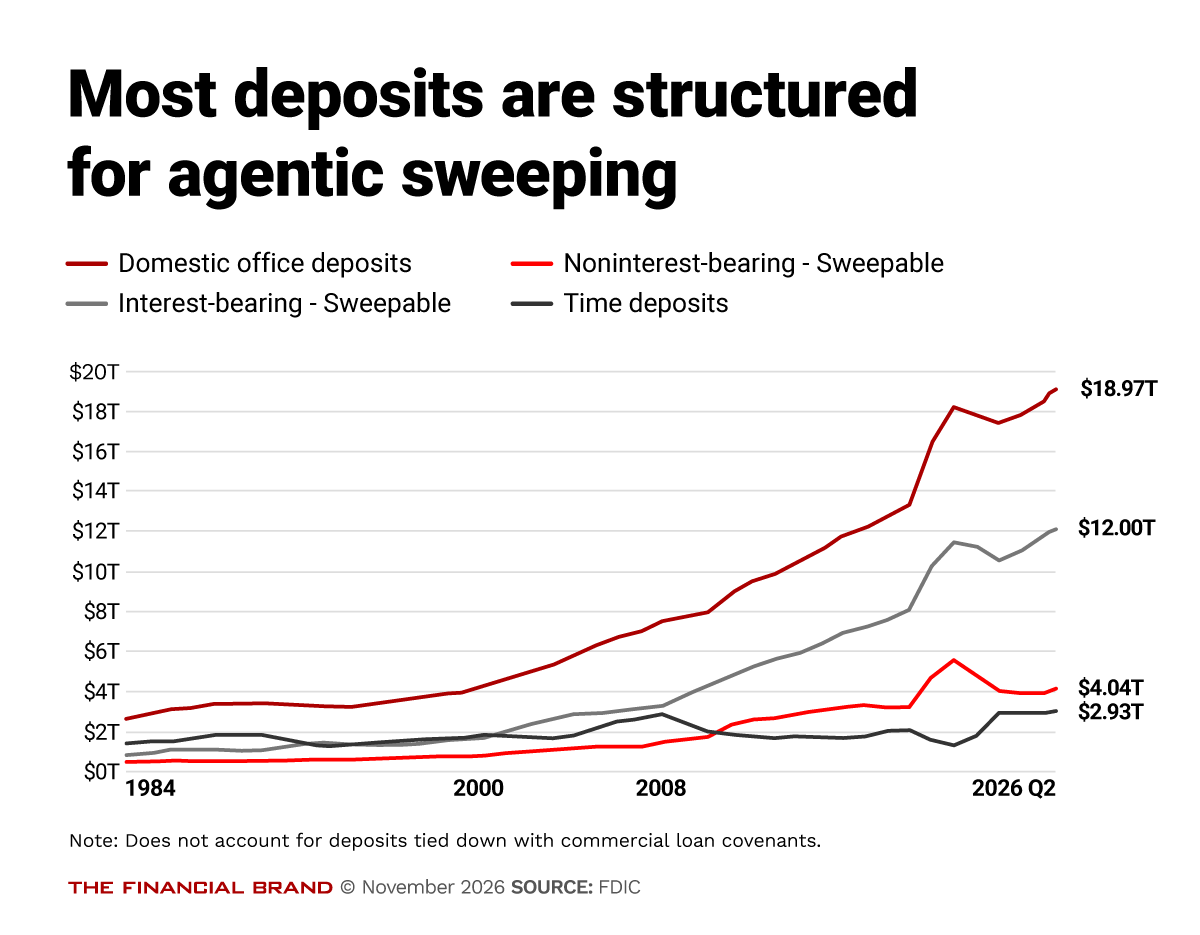
Key insight: The threat here is not simply the funding portfolio’s liquidity. Money moves around more easily today than at any point in human history, and it will get even easier with each passing year. Now, it’s not only liquid and tech-connected, but it’s also advantageous (in some cases extremely so) for depositors to find a new home for their money.
The average APY for a U.S. savings account is 0.64%, according to Bankrate. That’s just over half of the national deposit rate cap published by the FDIC of 1.13%, and much lower than the comparable U.S. Treasury yield of 3.88%. In what some have called the “laziness” or “friction tax,” depositors now forgo well over $150 billion a year in interest. A company that targets that missed yield could share 50% of the gain with depositors, leaving a potential $75 billion revenue opportunity.
Conditions Are Perfect: Maturing Accounts
It’s not just liquid accounts that will likely suffer.
An estimated $570 billion in bank CDs pay 3.25% or less, according to S&P data. Competitors could target those balances at renewal by offering depositors a better rate while earning the 3.88% risk-free rate available in mid-October. Paying up to 3.25% would leave a spread of at least 63 basis points.
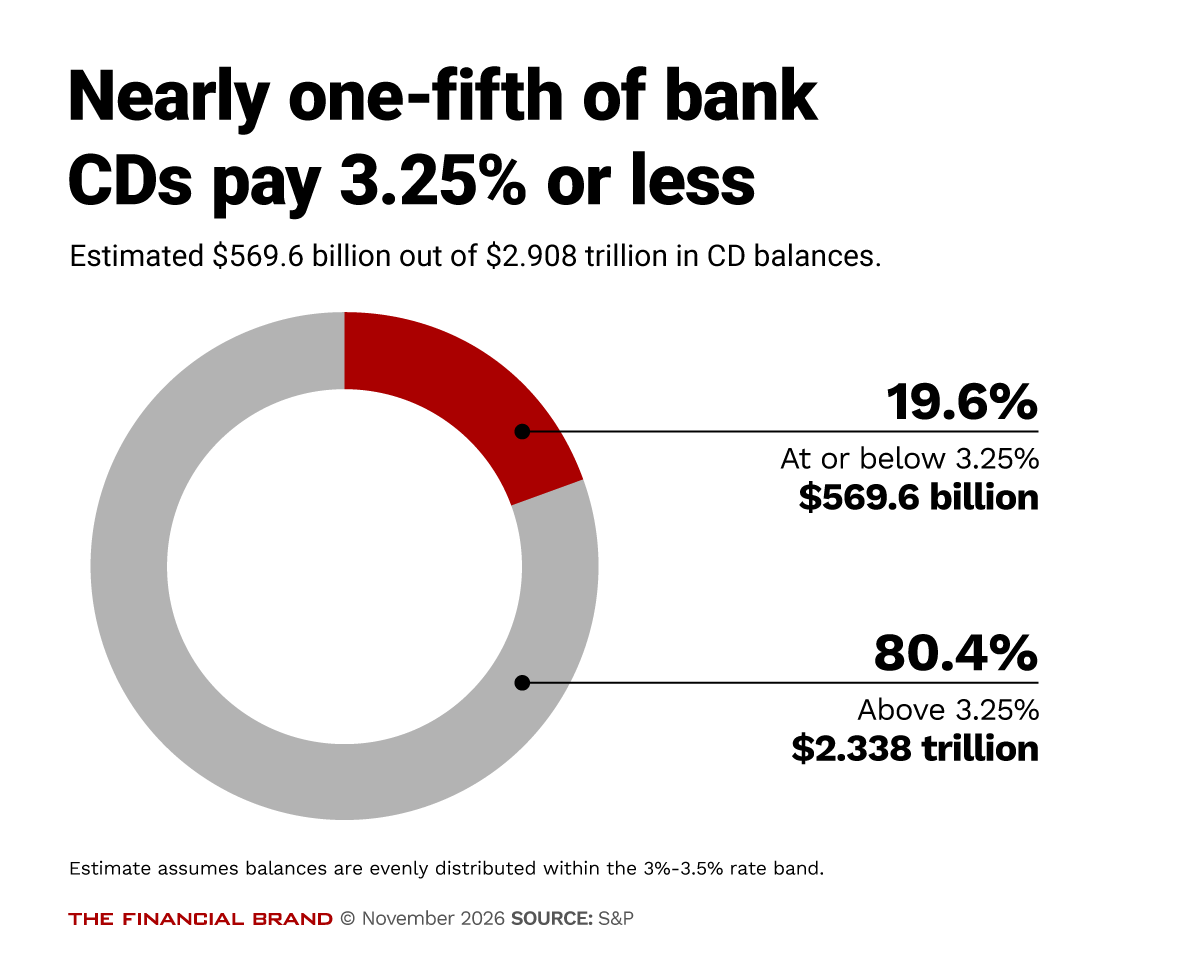
Even before maturity, the best CDs for banks are the long-term, low-yield ones. But what is the penalty usually based on? The interest rate. If so, the option to leave is mathematically available in the disclosures, and agentic AI can find it and exploit the weakness.
If a deposit rate is less than half the comparable U.S. Treasury yield, someone could double the depositor’s return and still have a spread left to cover costs and profit. The same is true of those fantastically inexpensive CDs that auto-renewed this year at disclosed rates.
But Will Depositors Actually Give AI Their Credentials?
No, but it doesn’t matter. Depositors now have a digital universal banker in their pocket, and it doesn’t work for a traditional institution.
Muse accesses banking platforms through a partnership with Plaid. Do people connect Plaid to their bank accounts? Yes, nearly 1 million daily connections are processed by the platform across its network. It already connects more than 150 million consumer financial accounts and more than 12,000 U.S. financial institutions.
It’s best not to be fooled by “that will never happen” straw men, even when vocalized by the largest institutions. If the question is “will depositors connect it,” it has happened before with many apps. Now, Meta’s chief AI officer has challenged users to see whether Muse can find them $1,000, giving users a number to imagine, and all they need to do is connect their accounts to a platform they likely already use.
The largest banks are drawing lines. PNC’s CEO Bill Demchak, who spoke at Money 20/20 this year, said, “No [bank] is going to let people transact inside of accounts without a human in the loop. It’s just not going to happen.” He echoed mid-October comments by JPMorgan CEO Jamie Dimon, who said the bank won’t allow external AI agents inside.
These statements are likely just strategic delay.
For depositors, the point of a liquid account is its liquidity. And yield-boosting transactions are usually between bank accounts owned by the same person. If innovators must demonstrate that their software can “safely and compliantly take on the work” of finding depositors more yield, they will.
The last bastion of inertia for bank funding was that very work.
Taking the Work: A Private Banker in Every Pocket
Banking executives got an education in “having too much cash” after 2009, but depositors learned as much about investing over an almost-15-year period when returns above 1% weren’t available in safe bank accounts.
Where did people move money for higher returns? The stock market, cryptocurrency, mutual funds, or U.S. Treasuries. What’s inherent to many of those investments? Risk of some kind.
If account holders would risk capital in stocks or cryptocurrency, would they try an AI agent from one of the country’s foremost tech companies on a $20,000 checking account earning 0.1%? How about on a $10,000 savings account earning 0.64%?
If people begin to use this and it goes well, say when shopping for shoes at first, would they try it for banking? Would they share the experience with others? Muse, after all, belongs to the company that practically invented viral content.
On Meta’s Oct. 21, 2026, third-quarter earnings call, Meta executives said:
- Over 10 million users in the U.S. and Canada since its launch.
- Approximately 25% of users engaged on a daily basis (roughly 2.5 million daily active users).
- More than 25% of weekly active users have the agent help with shopping.
- The average purchase amount for shoppers using Muse exceeds $200.
Now, agentic AI has the potential for social contagion because a successful banking agent leaves almost no work left for depositors. If regulators require a click to “accept” before a transaction happens, it changes little. The inertia created by unpleasant deposit tasks – finding promotions, learning about rates, maturities, and options, meeting criteria, opening accounts, moving money in and out – is largely gone.
The Ball Is in Banks’ Hands, Believe it or Not
AI agents are a novel technology that may not become mainstream. But the gaping holes exploited by AI in deposit product designs have been found. Society will know more easily, even if it takes time for agents to act for them. Banks and credit unions cannot continue to approach their most profitable business line as they have. Boards and executives must:
1. Shore up the weaknesses of your deposit products.
Tech companies build software; banking institutions define the products themselves. Executives, however, can control the rules of the deposit game, even though the counterparty may soon always act like a rate shopper.
Reassess your institution’s product designs with that in mind:
- Could depositors take advantage of the traditional CD penalty if they were aware of its frailty?
- How might bundled products incentivize time commitments while still offering liquidity?
- How might other liquidity offers retain deposits that are about to leave?
- If the institution is not going to use AI as well, how will it enable the staff of the bank to engage depositors successfully when they have a banker in their pocket?
Institutions cannot wait for technology alone to respond to agentic sweeping. They must turn to the products they control and protect themselves in ways not requiring years-long IT projects.
2. Use technology to get even closer to depositors.
Friction was the load-bearing wall of deposit pricing, and full digital transparency collapses the spread between standard and special rates. Digitizing everything is efficient, but it also makes it easier for agents to optimize on the customer’s behalf. Raising rates across the board only raises cost of funds; a rate war is not winnable.
Identify the balances an agent would move first and decide which relationships justify a proactive rate conversation. Paying a loyal customer 3.5% before an agent finds them 4.5% may cost less than replacing the deposit.
3. Learn the use cases AI companies will pursue and prioritize them.
Fighting the sweep (blocking agents, hoping inertia holds, teaser-and-reset specials) loses the balance anyway. Depositors will be attracted to AI agents because they appear independent.
Launch a digital universal banker pilot now, using AI where it earns its keep, aimed at the topics that savings investors worry about, such as duration and interest rate risk.
Work from the other side as well, focused on intuitive use cases for an AI agent: idle balances above a threshold, maturing CDs and recurring bills that creep upward. Then put a named human behind every alert, giving customers a direct connection to someone at their institution.
Given the pace of technology development, and Muse’s adoption pace thus far, the window to act is likely months rather than years.
Reach the Customer Before the Agent Does
Skepticism is healthy for boards and executives at financial institutions. It’s the culture that has built such trust in safe and sound institutions. But make no mistake, talk of fraud by the largest banks is likely a real concern, but not the only concern: AI agents are after the $75 billion in revenue available to sleeping deposits, and many of the largest banks have enormous portfolios at very low cost of funds.
Bottom line: Institutions must find what they can do about this risk, rather than racing to find a reason to do nothing. They control their product designs, can identify relationships worth a proactive pricing conversation, and can equip employees to help depositors weigh their options. Those steps can protect relationships while institutions develop their own AI capabilities.
Address the weaknesses now before agents use them against you.


