
How to Earn Your Bank’s Place in Financial Answers from AI
By Jessica Kendall, Contributor at The Financial Brand
Simple Subscribe
Subscribe Now!
Instead of starting with Google searches or bank websites, consumers are increasingly asking generative AI platforms for recommendations for financial institutions and products. And according to new research from EMARKETER’s AI Visibility Index, the same handful of brands consistently surface in those answers — and they are not always the largest institutions.
In a recent Banking Transformed podcast, Tiffani Montez, Principal Analyst for Financial Services at EMARKETER, explained why this shift matters for retail banking marketers. The research suggests visibility in AI-generated recommendations depends less on size or advertising spend and more on trust, clarity, and customer relevance.
Key insight:Institutions that clearly define what they stand for, align messaging with customer intent, and consistently deliver positive experiences are gaining an early advantage in a new era of financial discovery.
Need to Know:
- AI is becoming a new discovery channel for financial products, influencing consumers before they visit a bank website or branch.
- Clear positioning matters more than broad messaging. Brands with a focused identity are surfacing more consistently in AI recommendations.
- Customer trust increasingly shapes discoverability. Reviews, sentiment, digital engagement and satisfaction all influence visibility.
- Banks should rethink product marketing around customer language and intent, not internal product taxonomy.
- Long-term differentiation will come from experiences, not products, especially around key life stages and financial moments.
Why AI Visibility Suddenly Matters
For years, digital marketing in banking centered on traditional search. Institutions invested heavily in SEO, paid acquisition, and website optimization to improve visibility when consumers searched for products online.
According to Montez, generative AI is beginning to change that discovery process. Consumers increasingly use AI platforms to evaluate products and services before ever visiting a website.
EMARKETER forecasts that roughly one-quarter of U.S. internet users will use generative AI for shopping-related tasks in 2026, a behavioral shift that has major implications for financial marketers.
“AI is starting to influence consideration well before consumers ever reach a brand’s website or app,” Montez explained.
To better understand what financial visibility looks like in an AI environment, EMARKETER developed the AI Visibility Index, analyzing thousands of ChatGPT responses across nine financial services categories like credit cards and banking accounts using real consumer-style prompts.
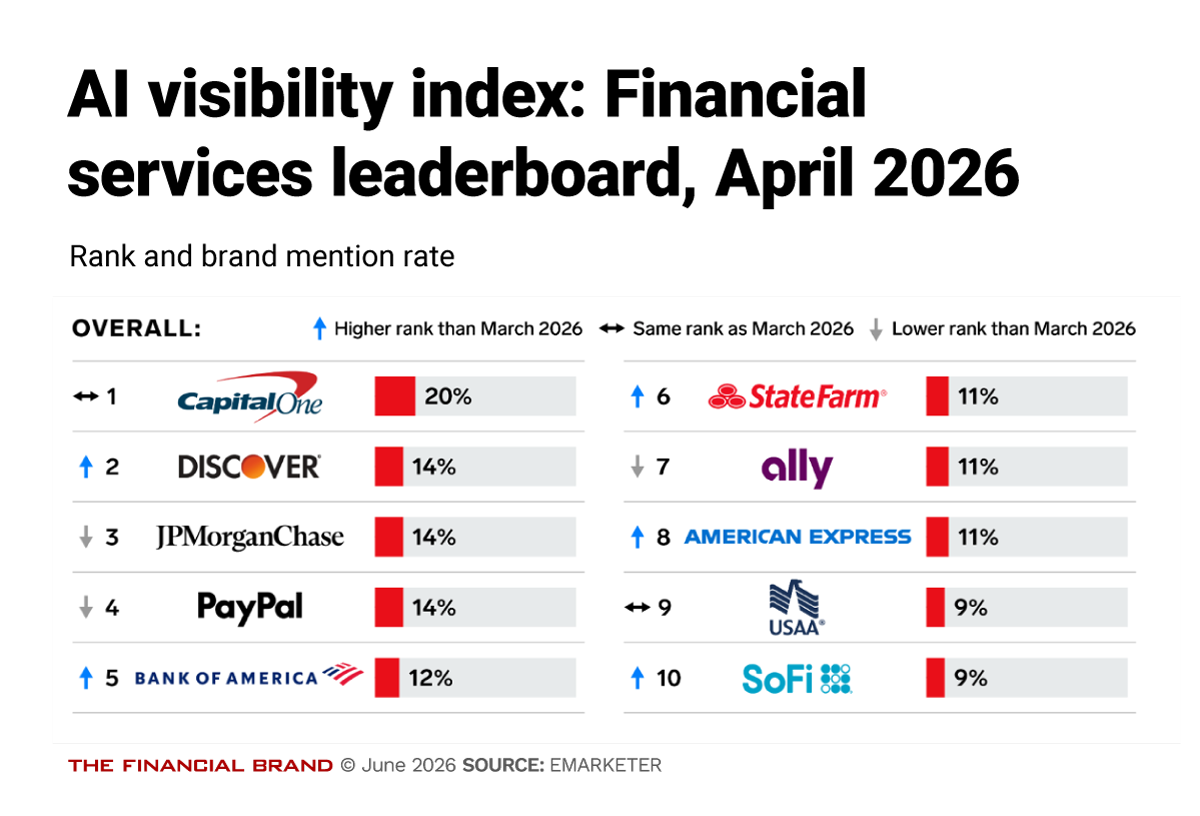
What surprised Montez most was how concentrated visibility already is. A relatively small group of brands repeatedly dominate recommendations, and in many categories, those winners are not necessarily the largest institutions. More importantly, rankings can change quickly, making AI visibility far more dynamic than traditional search positioning.
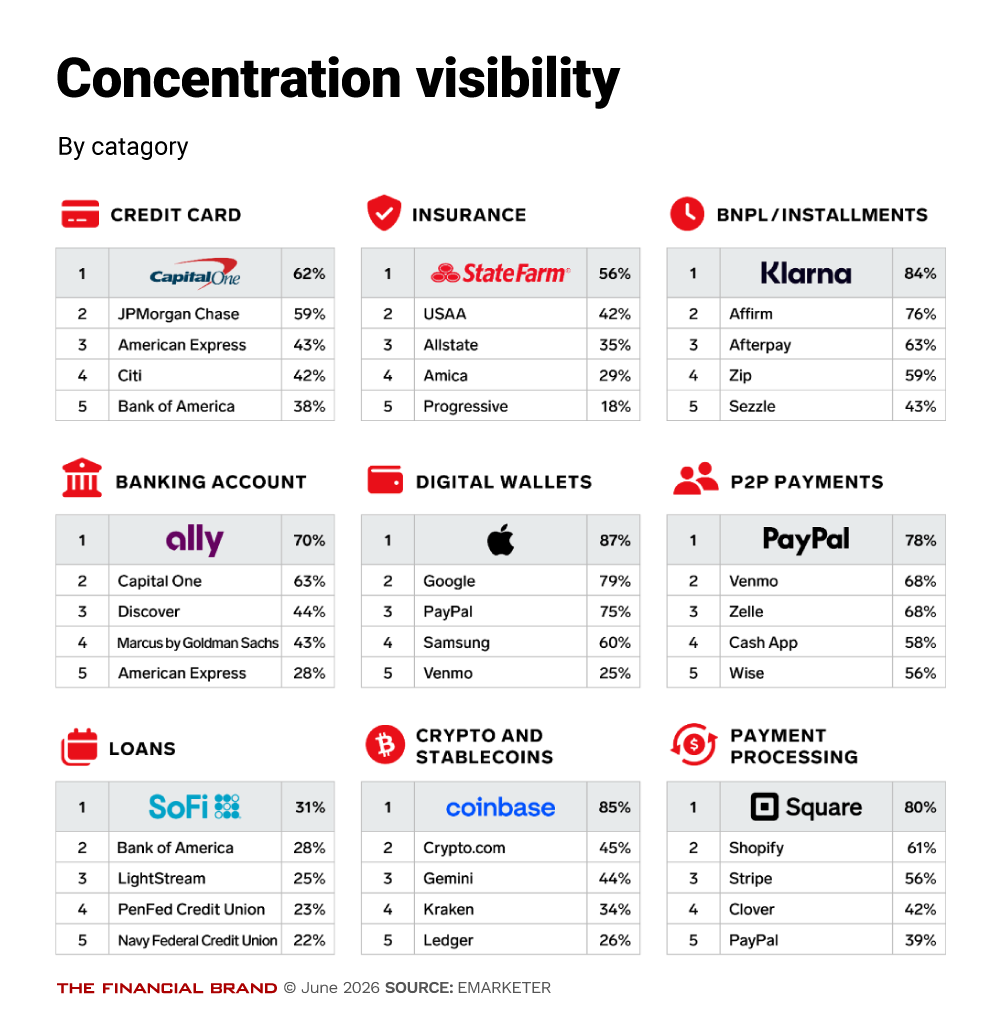
Key takeaway: The reality is that a bank can rank well in traditional search, dominate paid search, and still struggle to appear in AI-generated recommendations. The key to AI visibility is clarity and relevance.
Why Clarity Beats Breadth
One of Montez’s strongest observations is that generative AI rewards simplicity.
Brands performing well in AI recommendations tend to be extremely clear about who they are, what they offer, and when they should be considered. She points to companies like Capital One as examples of organizations that consistently reinforce a clear identity around simplicity, accessibility, and digital convenience.
For institutions that still market themselves as everything to everyone, that strategy becomes less effective in an AI-driven discovery environment.
Traditional SEO rewarded taxonomy. Banks could organize content around product names and categories, helping customers navigate checking accounts, auto loans or savings products.
GEO — generative engine optimization — operates differently. Consumers ask questions in their own language. They describe needs rather than products:
- I need a bank that makes opening an account easy.
- I want help managing money as a young parent.
- I need financing quickly.
AI systems interpret intent, evaluate trust signals, and determine which brands most closely align with those needs.
“The brands that perform the best are the ones that have very little ambiguity around who they are, what they stand for and what they should be recommended for,” Montez said.
What should you do? Montez suggests banks should spend more time journey mapping around customer intent and less time relying on internal product language. Instead of asking how to market a HELOC, for example, institutions may need to think about how consumers describe home renovation plans, debt consolidation, or managing rising expenses.
The difference sounds subtle but it changes how products are positioned, explained, and ultimately discovered.
Trust Is Becoming a Ranking Signal
Financial institutions have always competed on trust. What is changing, according to Montez, is that trust increasingly shapes visibility itself.
Brands that appear most consistently in AI recommendations often have strong customer satisfaction, positive reviews, high engagement, and broader visibility across third-party channels.
AI systems are evaluating more than bank websites. They are absorbing signals from social media conversations, customer sentiment, and external digital activity to determine which institutions feel relevant and credible.
Montez sees this play out differently depending on the category. Traditional institutions still dominate recommendations tied to stability and long-term trust, such as many credit products. Meanwhile, fintechs often gain traction in categories tied to flexibility, speed, and embedded experiences.
This dynamic reflects how consumers think about trust today. Customers do not trust every institution for every financial moment. They trust different brands for different problems.
That creates new pressure on banks to become known for something specific.
“AI systems reward simplicity much more than they reward breadth,” Montez said.
Key takeaway: Customer experience and brand positioning are becoming inseparable. If a bank wants recognition for speed, convenience, or ease of onboarding, customers must consistently reinforce that perception through reviews, engagement, and real-world experience.
A better onboarding process matters. But talking about it — and earning validation from customers and third parties — matters too.
From Products to Financial Moments
While the AI Visibility Index provides a useful lens into changing discovery patterns, Montez believes the bigger strategic challenge sits elsewhere. Too many institutions still organize around products while consumers increasingly organize their financial lives around experiences.
Mortgages offer a useful example. Most institutions treat homeownership as a transactional relationship centered on financing. Montez argues banks should think much more broadly about the customer journey. How does an institution help customers search for a home? Understand affordability? Build equity? Maintain a property? Decide what comes next financially?
Those moments create opportunities for relevance that extend far beyond loan origination.
The same thinking applies to nearly every life stage — first jobs, marriage, children, retirement planning, or unexpected financial stress.
Bottom line: “Products are commodities,” Montez said. “Experiences are your differentiators.” This is increasingly important as digital wallets, embedded finance and AI-driven guidance move closer to the center of consumer financial lives. In many cases, banks may no longer control the full customer journey. Institutions that remain relevant will be those that show up naturally in moments where financial guidance matters most.


