
The Emerging Agentic Playbook for Community Banks and Credit Unions
By Nicole Volpe
Simple Subscribe
Subscribe Now!
For community banks and credit unions, the AI conversation is entering a new phase. After spending the past few years focused on fundamental issues — Is it safe? Does it work? Can we afford it? — smaller institutions are now turning to a different set of concerns:
- Where can AI create meaningful value?
- How much authority should we give to agents?
- What controls must remain in place?
The shift has become evident in the way financial institutions are thinking and talking about their AI decisions. Banking technology provider Narmi has tracked this shift in its own conversations with banks and credit unions: Gating issues — concerns that might lead to a go or no-go decision — have fallen as a proportion of all objections, while implementation challenges have increased.
Key insight: Worries about data privacy, the company says, long one of banks’ biggest AI adoption barriers, fell nearly 22 percentage points between 2025 and 2026. Also declining were concerns about lead times and resource requirements.
In contrast, according to Narmi, implementation issues gained share, with compliance and legal concerns rising by 13 points, control and transparency by 12, and maturity and readiness by 9.
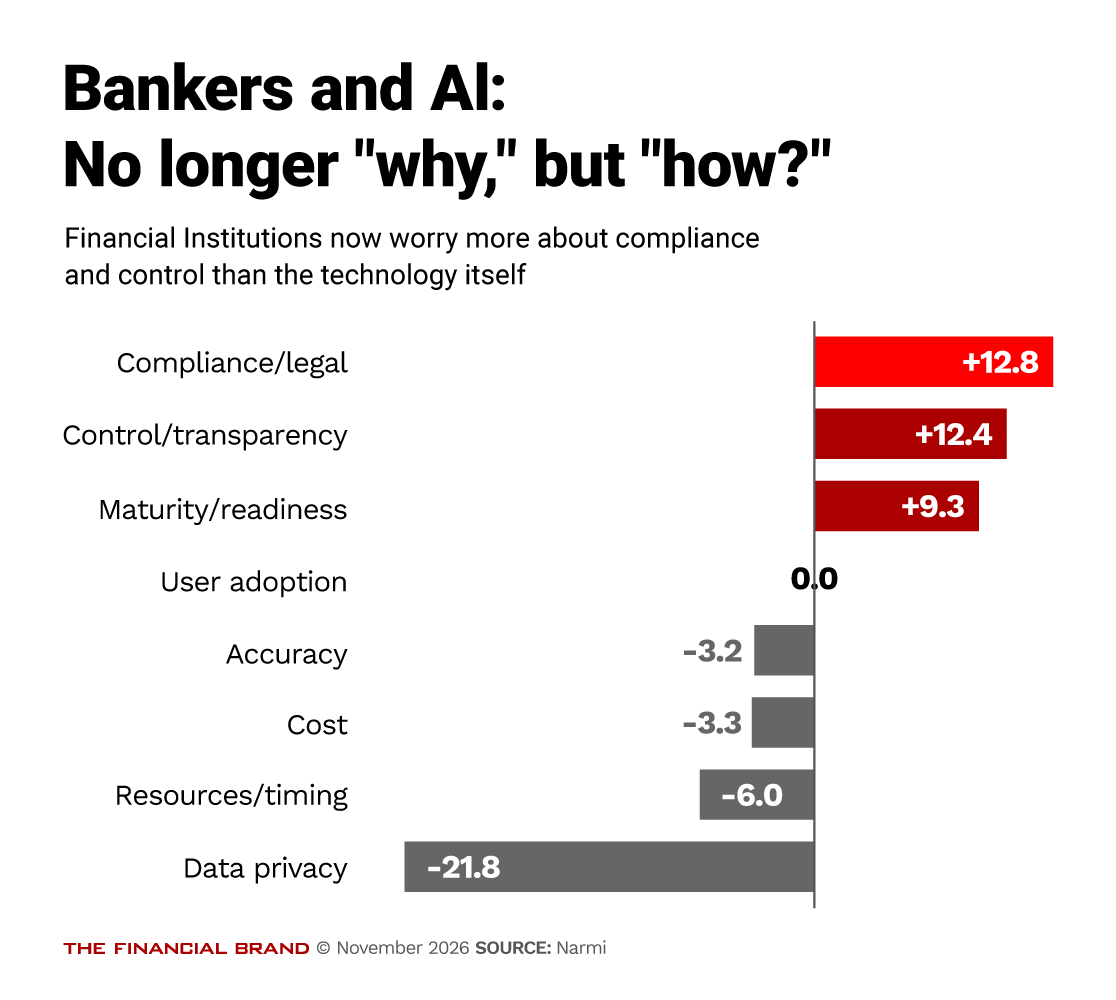
The change in these institutions’ AI posture comes amid accelerating AI adoption across all industries and markets, including especially fast growth for autonomous applications. In a 2026 McKinsey survey, 40% of large companies and 22% of small ones said they were expanding AI agents in production environments.
Key takeaway: As smaller institutions navigate this turning point, they are embracing a new AI agenda, one shaped by greater confidence in the technology, clearer expectations around governance, and a growing body of compelling use cases. The Financial Brand spoke with Narmi Head of Strategy & Operations Fiaz Sindhu to learn more about the changing environment and how it’s playing out.
What’s Changed and What Hasn’t
Some of the most important new developments have come from regulatory agencies. Spring 2026 policy statements by bank and credit union regulators have set a new tone, Sindhu said — opening a clear lane for AI adoption while at the same time emphasizing that institutions’ compliance responsibilities remain unchanged.
At a financial stability roundtable in May, Federal Reserve Vice Chair for Supervision Michelle Bowman declared that “supervisory guidance should not be a barrier for banks to engage with new and evolving tools and technologies.” Calling out smaller banks in particular, Bowman said “they too must be able to innovate and provide the latest technology to their customers” despite the fact that “they may not have access to the same resources as their larger peers.”
The NCUA was similarly direct: “Credit unions may use AI tools and technologies,” provided they do so in compliance with existing rules. The agency said its supervisory focus would continue to be on risk management, rather than AI itself. “Having this type of guidance out there represents permission to start working with the technology and start using it in live applications,” Sindhu said.
At the same time, institutions today have far more live, in-market examples to learn from, and to direct board members’ attention to as their own projects take shape. These range from prominent large-bank deployments — JPMorganChase CEO Jamie Dimon has been outspoken about the bank’s extensive AI program — to regional players such as Customers Bank ($27 billion in assets), which is working with OpenAI to apply AI across its lending, deposit, and payments businesses.
Smaller institutions are pushing ahead as well. Working with Narmi, the $1.6 billion-asset Grasshopper Bank became the first U.S. bank to deploy an MCP server, allowing its small-business clients to securely query live account data through AI assistants such as Claude and ChatGPT. And $890 million First Citizens’ Federal Credit Union, also a Narmi client, is using AI within secure messaging to translate member inquiries and help staff respond in members’ preferred languages.
Complex Issues Require Deeper Questions
While clearer regulatory guidance and more in-market examples should make operationalizing AI easier for bank and credit union leaders, in practical terms, these conditions set the bar higher.
Concerns about AI’s ability to meet minimum data-privacy standards might once have been a straightforward blocker to deployment. Now institutions must ask deeper questions about their own maturity and readiness:
- Have we selected our highest-potential use cases and developed a vision for redesigning them?
- How will we address AI deployments that require access to data spread across three, or six, siloed platforms that do not share a common taxonomy?
- What about human accountability?
“Some institutions don’t even have AI policies documented yet,” Sindhu said.
Key insight: Explainability and auditability are especially consequential. Since 2021, with AI in sight, interagency guidance has distinguished between understanding how a system works overall and being able to show how it arrived at any single result. More recent Federal Reserve guidance has flagged explainability as a particular AI risk, alongside the need for effective testing, human-in-the-loop controls, and clear governance standards.
Sindhu said smaller institutions are focusing on use cases that offer opportunities both to add efficiency and enable growth. He cites account opening as an example: Typically, applications that can’t be approved automatically are pushed into manual review where an employee may then run a KYC check, for example, or track down missing documentation. But such delays increase the likelihood the applicant will “walk away,” Sindhu said.
Agentic AI can bring speed and efficiency to manual reviews, assembling missing information, applying the institution’s guidelines, and presenting a complete recommendation with supporting evidence to the human employee who then makes the decision. According to Narmi’s analysis, applications that previously required the most manual attention benefited the most: Among the slowest 10% of cases, AI-assisted reviews were roughly six times faster.
A New, Emerging Division of Labor
For a small institution, such gains are unlikely to result in staff reductions but instead to enable human employees to take on additional higher-value, customer-facing work. Just as important, faster application reviews increase account opening volume and directly support deposit growth. “For most community banks and credit unions, it’s a leverage story, not a replacement story,” Sindhu said. “They’re already running lean — many team members do multiple jobs — they wear three, four, five, or more hats.”
In the secure messaging application at First Citizens FCU, AI agents research and draft informed responses to customer questions that are received via the institution’s digital banking platform. An employee then reviews, edits if needed, and sends. Agents also handle translation to support the credit union’s many Portuguese- and Spanish-speaking members.
Key takeaway: According to Sindhu, such use cases are representative of how small financial institutions are likely to embrace agentic AI into the foreseeable future. With basic copilot-style applications at one end of the spectrum (reading data and answering queries) and fully autonomous agents at the other end, Sindhu suggests banks and credit unions are likely to spend the next several years in the middle.
In this “goldilocks zone,” agentic workflows are deployed in combination with redefined human roles, including especially decision-making. As with Narmi’s account opening and secure messaging applications, efficiencies are mined in the space between information and action.


