
The AI Prompt that Should Terrify Every Banker: ‘Optimize My Idle Cash’
By Steve Cocheo, Senior Executive Editor at The Financial Brand
Simple Subscribe
Subscribe Now!
If a customer of your bank or credit union went to an external AI-based financial assistant and asked, “What can my idle cash do this weekend?” would your institution feature among the recommendations?
What if a customer’s independent AI-assistant took the initiative, and told your depositor, “Hey, you’re not going to need to touch this money for at least a week. Why don’t you let me sweep it into something that pays more than your checking account for a few days?”
“That one simple prompt — ‘optimize my idle cash’ — should scare the daylights out of every banker,” says Michael Abbott, global banking and capital markets lead at Accenture.
And this scenario doesn’t have to stop at deposit accounts. An AI advisor could just as easily be recommending mortgage, consumer loan and credit card options to your customers — and even getting permission to go ahead and execute.
Need to Know:
- 65% of people responding to Accenture’s Future of Banking Experience Survey are open to using a Chat GPT-type financial assistant as part of a GenAI platform or a digital wallet. (GPT stands for Generative Pre-trained Transformer.)
- 71% would like to see an AI assistant as part of their own primary bank’s mobile app.
- “Most respondents want control over what AI-supported banking does — 82% want to approve every action and nearly as many want a one-tap opportunity to pause any GenAI action.
- 86% of people surveyed trust their bank to provide smart AI assistants, while 49% say they would trust some other GenAI platform providers to do so.
- 54% of those surveyed are ready to use GenAI within their bank’s app to handle nonbanking chores, like booking travel and grocery shopping.
More consumers have started asking large language models for financial guidance.
And none of those models are on your payroll.
Accenture’s Abbott says bankers need to recognize the risks of this new technology — but he also says it’s critical to recognize that the same situation begets opportunities for institutions willing to reassess their strategies.
The Risks Banks Face Aren’t Just Over Deposits and Loans
Encroachment by AI into consumers’ financial decision making isn’t just about immediate loss of balances or business.
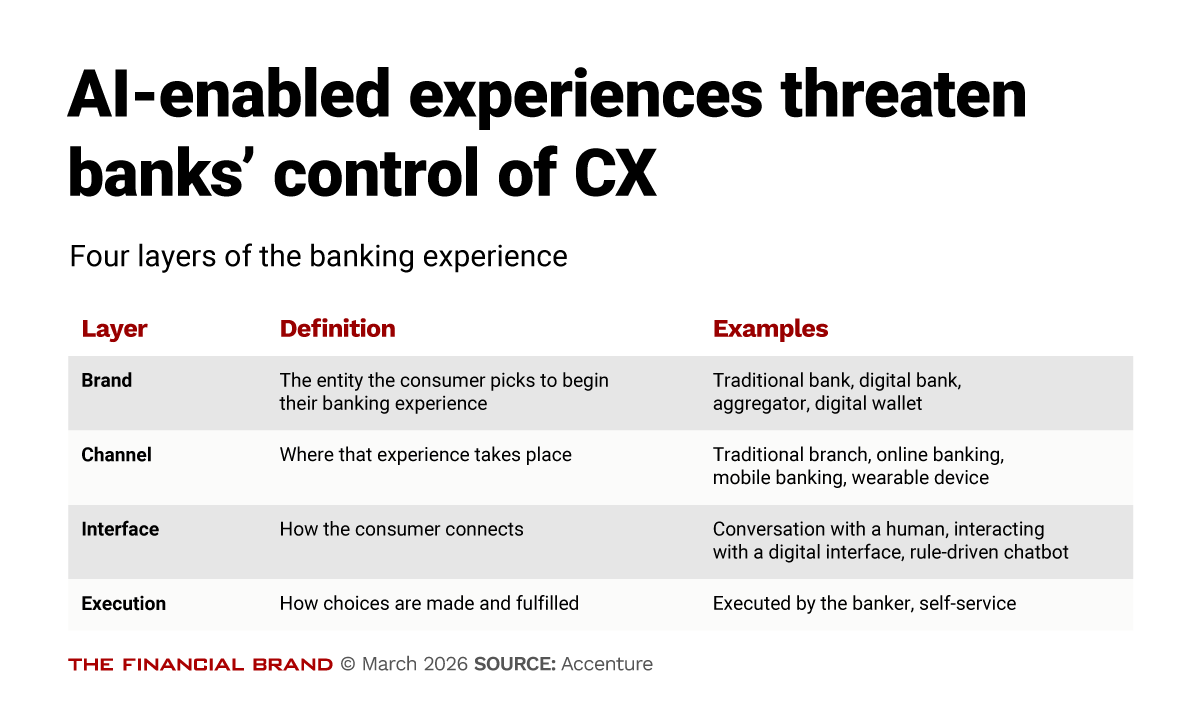
As shown in the chart below, from Accenture’s Banking Top Trends for 2026 report, as AI pushes further into financial services, banks and credit unions face multiple risks: erosion of their brands, control of the channel where business takes place, how consumers and businesses connect with financial services, and, in time, whether AI or the consumer actually makes the ultimate decision in the individual’s interests.
Reality check: This transition has been underway on several fronts even before GenAI and agentic AI even came on the scene. Every consumer who asks a waiter, “Do you take Apple Pay?” demonstrates how the bank or credit union issuers behind the actual card embedded in the digital wallet has experienced “brand disintermediation,” a term Accenture uses in its report.
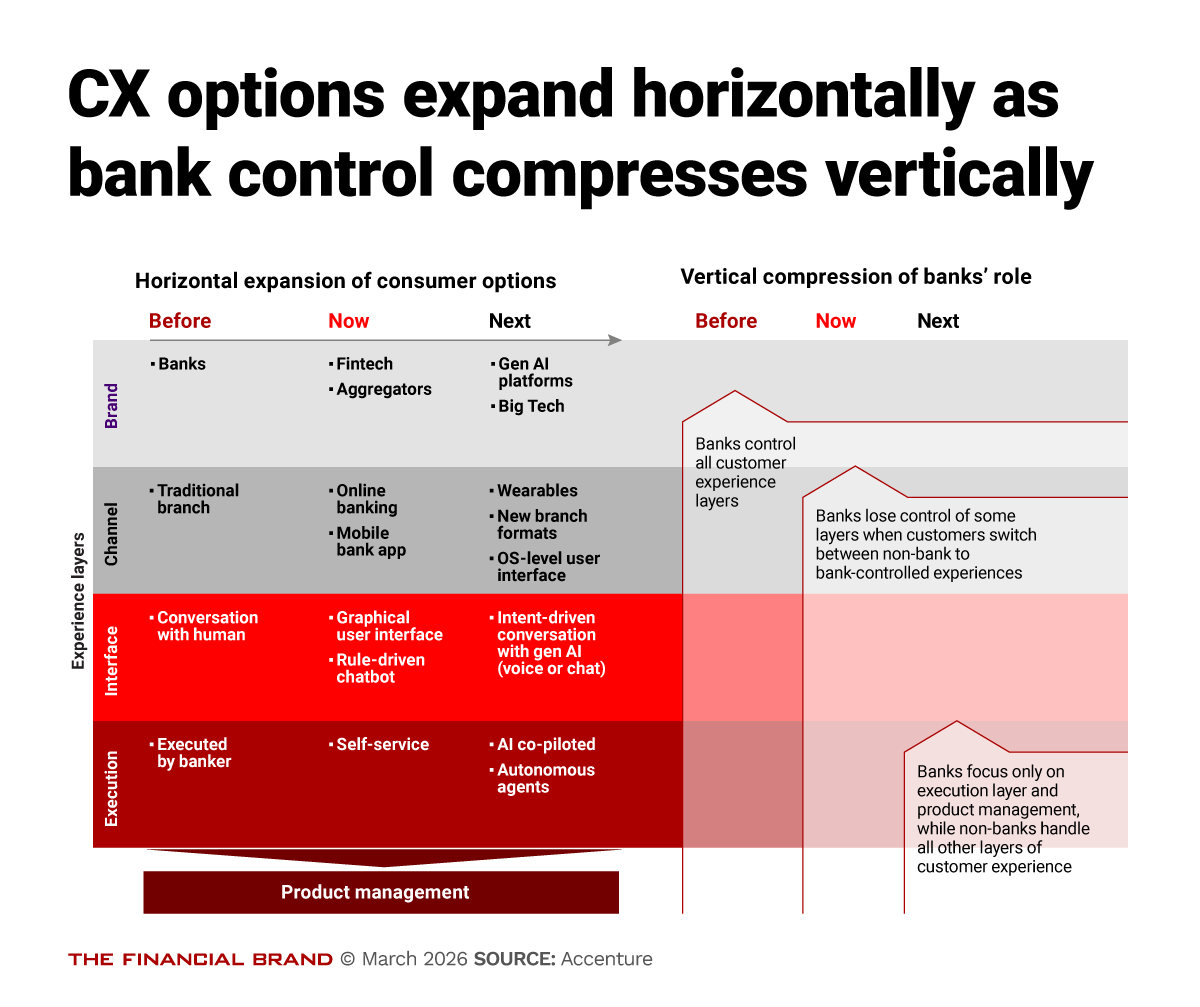
As the Accenture graphic below demonstrates, GenAI as well as other evolutions in banking services including improved wearable devices and new branch formats, are changing banking institutions’ control of the customer service experience.
Read more: How BECU’s AI Financial Advisor is Moving Beyond Product Answers to Customer Handholding
Five Strategies Banks Can Follow
How can banks respond? Abbott says the strategic options include:
• Join ’em. Figure out how to play in a business where large language models are replacing traditional search. “Search is breaking,” says Abbott. “You have to be prepared to meet clients where they’re going to come from — GPT.”
• Lean into your traditional strengths, like human relationship management, especially for community banks that have always relied on that, especially for small business accounts. But be ready to repackage the familiar.
• Run the AI-driven advisors instead of just playing defense.
• Rethink bank-based virtual assistants. Beef up virtual assistants that already exist. Where they don’t, start with a next-generation assistant, incorporating GenAI, instead of designing for obsolescence.
• Become a “manufacturer.” Abbott sees this as an iteration on bank roles such as white-label cards and banking as a service relationships.
Key point: In reality, according to Abbott, many institutions will combine multiple strategies.
Read more: ChatGPT Is Stealing Your Customer Relationships. You Already Have the Solution
Expose Your Bank to GPT Engines
In today’s competitive environment, having a seemingly solid relationship with a consumer or small business isn’t all that certain, according to Abbott.
He says a bank may have a good relationship with a small firm, for instance. Yet that firm’s CFO might decide to query a GenAI model with a prompt along these lines:
“I’m looking for a small business loan. I’ve got $5 million in sales. I’ve got two months sitting out in receivables. I need an accounts receivables loan for $750,000. Can you give me a recommendation?”
Key point: Banks must figure out how to put their institution on the map for the models, through generative engine optimization (GEO) and other tools, or they’ll become invisible, says Abbott.
This is critical not only when someone else’s customer is looking around via GenAI — you want to be on their radar — but also when there is a customer potentially leaving the fold.
Tech touchpoint: Getting this right may even require maintaining a parallel website that only GenAI visits.
Some bankers may cringe at that thought. But Abbott suggests they have to look closely at why the customer didn’t just contact their relationship manager.
“If I were a banker, I’d be worried about every loan I’m not getting — and why,” says Abbott.
Abbott also says institutions must think more holistically. Deposits are no longer “free,” as there were when rates were at rock-bottom levels, he says. Institutions must refresh product strategy to encourage customers to bring deposit business and borrowing to the same place.
Read more: More Banking Apps Offer Predictive Insights, But Many Alerts Arrive Too Late
Turn Your Mobile App into a Virtual Relationship Manager
A related, aggressive strategy is for your institution to become the AI hub for customers who seek such guidance.
Abbott speaks of the current bank mobile app experience as “functionally correct, but emotionally void” — banking with a vending machine.
“Your mobile app should become your institution’s relationship manager, your point of advice, your customer’s place to text with a banker,” says Abbott. “It should be a conversation, where the bank’s app is advising you, thinking for you, and helping you move your money forward. It has to remember you and solve your problems.”
Key point: Bring what your institution has been doing for decades with humans into the AI world.
Abbott also warns that merely catching up to today’s emphasis on GenAI isn’t enough. Institutions must build towards what may be happening next, which will likely be agentic AI tools.
“Feeling like you’re texting with your banker, that’s just the low bar,” says Abbott. (Abbott continues to believe strongly in the power of branches as well.)
From Accenture’s study: “Customers will expect assistants that are as responsive and intuitive as commercial GPTs to help them with financial decisions.”
A bonus option: Institutions that get this much right can add in another element — curating other brands within their AI experience. In other words, turning the tables and running the market.
Read more: Is AI Learning the Job Faster Than Banks Can Redefine It?
Become the Manufacturer
Bankers love their brands, but that’s not the only way to do business, advises Abbott. Banking institutions already work through other providers via B2B2C and B2B2B arrangements — a handful almost exclusively — and he believes that this will be the way some institutions go as GenAI increasingly runs the show.
Key point: In a sense, this equates to being one of multiple suppliers stocking the shelves of a virtual financial supermarket.
“The bank still owns regulated product management — design, pricing, risk, compliance and fulfillment — while external AI assistants own the customer interface and orchestrate comparisons across multiple providers,” the report says.
Key decision: This isn’t as simple as shipping cans of green beans to a grocery store. The report says banking players must decide how much brand disintermediation they are willing to accept — and how liability will be shared when an independent AI agent sits between the bank and the ultimate customer.
Read next: Your Customers Will Blame You When Their Shopping Bots Go Rogue


