
New Breeds of Partners Are Key to Community Banks’ Competitive Ambitions
By David Evans, Chief Content Officer at The Financial Brand
Simple Subscribe
Subscribe Now!
Executive Summary
- BNY’s first-of-its-kind Voice of Community Banks Survey reveals a sector caught between perception and reality. Nearly 50% of institutions believe they’re viewed as innovative within their communities, yet 25% simultaneously see themselves as constrained in delivering competitive services.
- The survey highlights critical capability gaps threatening community banks’ ability to meet evolving customer demands: 40% struggle to offer competitive loan rates, over 35% can’t provide high-yield savings or advanced investment options their customers request, and despite 90% claiming readiness to initiate digital transformations, fewer than 20% possess the data analytics expertise essential for success.
- For retail banking executives serving or competing with community banks, these findings reveal an industry eager to partner on new products, particularly wealth management and treasury services.
Community banks occupy a unique and vital position in the American financial ecosystem that larger institutions cannot replicate. Their deep local knowledge, relationship-focused service model, and commitment to community reinvestment make them indispensable to the small businesses, farmers, and households that form the economic foundation of thousands of towns and cities.
The numbers tell the story: despite representing assets of just a fraction of money center banks, community banks hold nearly one-fifth of total U.S banking industry loans, with outsized concentrations in the sectors that matter most to local economies — 70% of agricultural lending, over 35% of small business credit, and 30% of commercial real estate financing..
Yet BNY’s just-released Voice of Community Banks Survey, conducted in partnership with the Harris Poll organization, representing the views of 108 C-suite and senior executives from institutions ranging from $100 million to $10 billion in assets, reveals a sector wrestling with profound strategic tensions.
Want to read more like this? Check out Narmi’s content portal on The Financial Brand: Be Where Banking is Going
Nearly half of respondents believe their institutions are recognized for innovative approaches to serving clients. Yet, simultaneously, a quarter view themselves as constrained when delivering best-in-class services — a perception gap that signals competitive vulnerability in an era when customers compare every financial interaction against seamless digital experiences from fintech disruptors and technology giants entering banking adjacencies.
This constraint isn’t imagined. When asked about services customers most frequently request that they’d like to better provide, 40% of community banks cited competitive loan rates as a challenge. Over 35% struggle to offer the high-yield savings accounts and advanced investment options their customers increasingly demand after experiencing them elsewhere. These aren’t niche product gaps — they’re fundamental offerings that shape whether a household views your institution as their primary financial partner or merely a transactional checking account provider while their savings, investments, and borrowing relationships migrate to competitors with stronger capabilities.
The partnership imperative emerges clearly from these findings. Among surveyed community banks exploring capability expansion, 100% expressed interest in wealth management services and just over 95% in treasury services — provided partners demonstrate strong reputations for resilience, trustworthiness, and superior customer service. As one respondent explained, institutions want partners “who can cater to all our financial service needs to streamline operations and enhance efficiency,” particularly those with “deep knowledge and understanding of corporate trust, treasury services or financial markets” who can “ensure we receive tailored solutions that meet our specific needs.”
For retail banking executives at larger institutions, these statistics reveal opportunity. Community banks aren’t seeking to be absorbed or displaced — they’re looking for collaborative relationships that allow them to maintain local identity and relationship strengths while accessing specialized capabilities they cannot build themselves economically. The question isn’t whether community banks will partner, but which institutions will position themselves as the trusted collaborators helping community banks compete and grow.
The Technology Gap: Aspiration Meets Implementation Reality
Community banks understand that technology excellence increasingly determines competitive success, particularly as millennials — who constitute two-thirds of surveyed banks’ retail customer bases — expect digital-first experiences as table stakes. The survey reveals significant investment intentions:
- Nearly 40% plan to prioritize innovation in technology initiatives to enhance customer satisfaction,
- Over 25% are investing in instant payment capabilities and
- 20% prioritizing automated loan decision-making and account opening processes.
- Nearly 40% cite artificial intelligence and machine learning as part of their strategic vision for the next five years.
Yet intention doesn’t equal capability. The survey exposes a troubling disconnect between digital transformation readiness perceptions and actual foundational capabilities.
Over 90% of respondents said they’re prepared to initiate digital transformations — the adoption of technologies designed to modernize financial service delivery. However, when asked about their data analytics capabilities, fewer than 20% rated themselves as experts despite more than half considering their analytics capabilities advanced. This gap matters enormously because robust data analytics forms the foundation for effective digital transformation, enabling banks to analyze customer behavior, optimize operations, tailor services, and make the data-driven decisions that separate transformation success from expensive technology failures.
The technology priorities themselves reveal awareness of customer expectations. Nearly one in three surveyed banks mentioned e-signature technology, mobile wallets and payment apps, and biometric identification as services needed to stay competitive.
Beyond customer-facing innovation, 30% plan to prioritize technology for risk mitigation and just under 30% want to leverage technology for regulatory and compliance management. These aren’t optional nice-to-haves — they’re table stakes for institutions competing against digital natives who’ve designed compliance and risk management into technology architecture from inception rather than retrofitting it onto legacy systems.
The solution most frequently cited: strategic partnerships. Twenty percent of surveyed banks are exploring collaborations with fintech companies over the next five years to access technology capabilities they cannot build internally. As one respondent explained, they seek partners “that leverage cutting-edge technology and innovative solutions that can provide competitive advantages, such as real-time reporting, automated processes, enhanced security measures and improved decision-making capabilities.”
This represents a fundamental shift in community banking strategy — from trying to build everything internally to identifying which capabilities truly differentiate and which can be accessed more effectively through partnership.
Beyond Fintech: The Broader Partnership Landscape
While fintech collaboration captures headlines and survey attention, community banks are simultaneously exploring a broader partnership landscape designed to meet diverse customer needs more effectively. Nearly 30% of surveyed institutions identified non-fintech partnerships — collaborations with businesses outside the financial technology sector — as equally important opportunities over the next five years. These alliances span varied industries including education, retail, and traditional banking services, representing strategic moves to embed financial services within customer life contexts rather than expecting customers to always come to the bank.
This expanded partnership vision reflects sophisticated thinking about competitive positioning. Community banks increasingly recognize they’re not just competing with other banks — they’re competing for relevance in customers’ financial lives against retailers offering credit at checkout, employers providing earned wage access, and technology platforms integrating payments into social and commerce experiences. The institutions that will thrive don’t necessarily need to build all these capabilities themselves, but they must ensure customers can access them without leaving the community bank relationship.
The partnership priorities align closely with customer demand gaps. Among banks looking to expand capabilities, universal interest exists in wealth management services — an acknowledgment that affluent customers increasingly expect sophisticated investment advice, estate planning support, and trust services that most community banks cannot profitably deliver with internal staff. Similarly, 95% expressed interest in treasury services including real-time payments — a reflection that business customers, even small ones, now expect instant payment capabilities, sophisticated cash management tools, and integration with accounting systems that legacy banking platforms struggle to support.
Traditional treasury programs offer one partnership model already gaining traction. The Department of Treasury’s Bank Mentor-Protégé Program creates a platform enabling community bank protégés to collaborate with large commercial financial institutions, receiving management and technical assistance to strengthen balance sheets and better serve customers. This government-facilitated approach acknowledges that in certain domains, collaboration between community banks and larger institutions benefits the entire financial ecosystem by strengthening the community banks that serve populations and geographies larger institutions find less profitable.
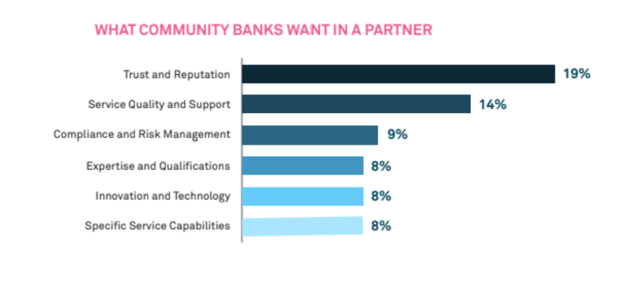
The survey reveals that partnering decisions ultimately hinge on alignment beyond just capability provision. When asked what they value most in partners, trust and reputation topped the list at 19%, followed by service quality and support at 14%, and compliance and risk management capabilities at 9%. Expertise and qualifications, innovation and technology, and specific service capabilities each garnered 8% of responses. These priorities underscore that community banks aren’t simply buying technology or outsourcing functions — they’re extending their brand through partners who must maintain the service standards and trustworthiness that community bank customers expect, even when delivering services the community bank itself doesn’t directly provide.
The bottom line: The BNY survey reveals institutions that understand the urgent imperative for digital transformation, advanced security, and expanded service offerings but lack the scale, specialized expertise, and technology infrastructure to build everything internally.
The path forward isn’t necessarily consolidation or decline — it’s strategic partnership. For larger financial institutions, fintech providers, and specialized service firms, community banks represent thousands of potential partners seeking trusted collaborators who can provide wealth management depth, treasury service sophistication, cybersecurity protection, and digital capabilities while respecting community banks’ local relationships and autonomy.
The institutions that position themselves as enablers rather than competitors — that understand community banks need partners who enhance rather than replace their community role — will capture disproportionate partnership volume as 4,455 community banks navigate the next phase of financial services evolution.


