
BofA Pivots Branches to Deliver Customer Consultations Over Transactions
By Steve Cocheo, Senior Executive Editor at The Financial Brand
Simple Subscribe
Subscribe Now!
Executive Summary
- Bank of America plans to open 150 new financial centers in 60 markets by yearend 2027. But they won’t be the branches your parents knew.
- Account opening and consultation drive BofA’s branch strategy. The bank says new ones produce fresh business directly and also in digital channels.
- A new corps of relationship bankers has been replacing conventional CSRs to help make these non-traditional branches work.
- Plus, a mini-tour of BofA’s new Manhattan flagship branch at Two Bryant Park.
The classic “Greek temple” bank branch once connoted solidity and strength. Where they are still standing, many are likely to be something else now — retail stores, fine dining restaurants, even burger joints.
“That’s banking of a generation ago,” says William Smayda, head of financial centers and division executive for Bank of America. Today, according to the BofA veteran, conveying safety and protection takes a different vocabulary — a digital one.
Where people once put their trust in stone and steel vaults, says Smayda, now they are asking questions like, “Can you protect my data? Can you protect my identity?”
“As a bigger part of what we do, that’s where safety has to happen,” says Smayda. Nearly eight in 10 BofA retail and small business customers do at least some of their business via online banking and apps now — a regular bragging point in earnings presentations.
But that doesn’t mean the branch is dead, dying or even doing poorly, according to Smayda. BofA finds that consumers may be doing much more transactional banking digitally, but they crave a combination of digital and physical.
“People want to know that you’re digitally present in their community and that continues to be an important part of our strategy,” Smayda says. For BofA, the key has been to regard branches — financial centers in the bank’s parlance — as an ever-evolving channel now.
“We’ll continue to adapt what goes on in our financial centers, the types of folks we bring in, how we train them, how we arrange our real estate — all based on the needs and interests of our clients,” says Smayda.
‘Six-Pack Branching’: Slimming Down and Bulking Up
Post-financial crisis, BofA peaked at about 6,000 branches, but “we’re happily at 3,700 today,” says Smayda in an interview with The Financial Brand. In general, the remaining branches are smaller, now that many transactions are digital.
“I was in a financial center in California recently. At one point that location had 19 teller windows because that’s what was required when everybody did their banking business across a counter,” says Smayda.
Yet, while BofA has slimmed down its branch system on a net basis, it continues to be a believer in branches as a means of doing business. It has opened 471 in existing markets since 2016, as well as opening branches in new markets, such as Louisville, Ky., in 2024. And now it has begun a wave of new add-ons to its network.
The bank recently announced plans to expand with 150 new financial centers in 60 markets by yearend 2027. That includes 40 new locations this year and 70 slated for 2026. The first of four offices for Boise, Idaho, opened in early June. Forays are planned for Alabama and Louisiana — multiple institutions are pushing into the Southeast — and in Wisconsin, among other places.
This comes on top of already investing over $5 billion in new locations and renovations of existing branches, an effort underway since 2016.
The bank opened a flagship branch in Manhattan as a state of the art set piece and example, writ large, of key concepts being applied through the existing and coming offices in the bank’s network.
Why is the bank starting to bulk up again, increasing its current network count by about 4% over three years? Beyond feeding consumer’s desire for proximity, in both new and existing markets, Bank of America finds it primes the pump of account opening both physically and digitally, according to Smayda. In 2024 BofA added 5.8 million new consumer clients, it said in its annual report, “while maintaining record-high levels of client retention.”
Increasingly, the branch/digital relationship amounts to cross-fertilization, says Smayda. A customer may visit a branch two to six times a year but they are also digitally active.
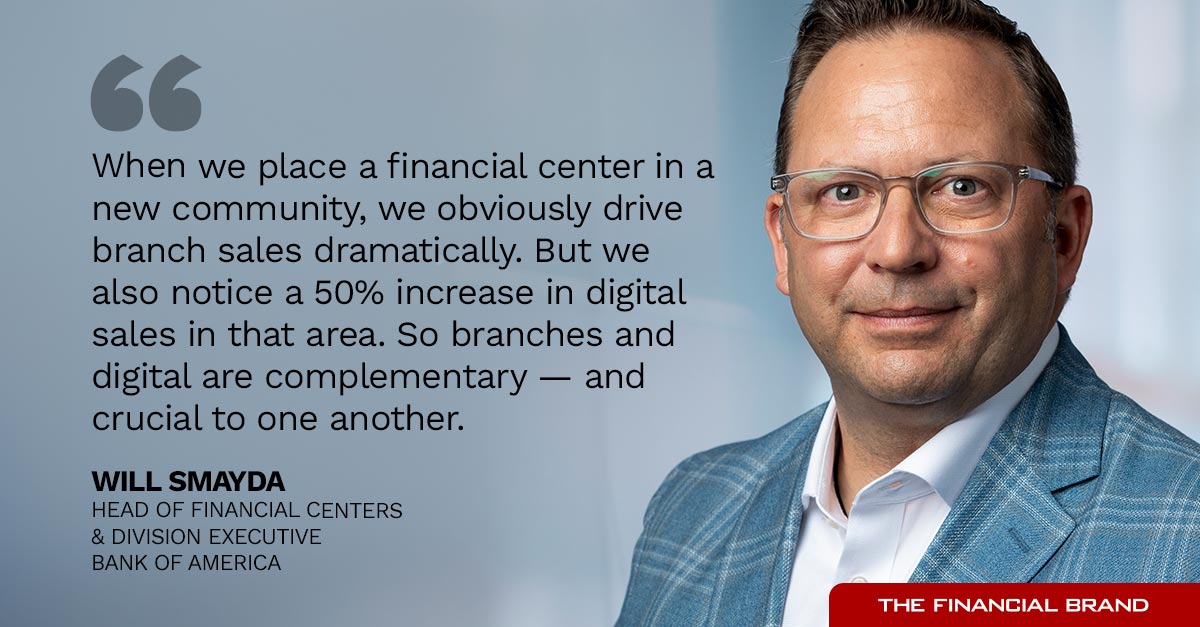
“We’ve got to follow our clients’ lead, as opposed to imposing our own perspective on branch banking,” says Smayda. “When we place a financial center in a new community, we obviously drive branch sales dramatically. But we also notice a 50% increase in digital sales in that area. So branches and digital are complementary — and crucial to one another.”
That consumers like to start a banking relationship with a branch visit is broadly known, as is the desire for obtaining face-to-face advice. On the latter front, Bank of America rankest highest in J.D. Power’s 2025 U.S. Retail Banking Advice Satisfaction Study. The company racked up 621 out of 1,000 possible points, as announced in late May.
Besides the sales boost, Smayda says an advantage of getting consumers into a branch is the opportunity to expose them to “all of our specialist capabilities, whether it’s lending, business banking or investments.”
“We have more than 12,000 relationship bankers now,” says Smayda. “Having employees with multiple skills and flexibility allows us to have a far more consistent staffing model.”
Read more:
How BofA Is Changing the Branch Mindset
“Historically, every financial center was its own franchise, and it was staffed according to the types of clients in the neighborhood and the type of traffic,” says Smayda. He says that nowadays the bank has shifted to a community orientation, using a hub and spoke setup. In this way, while employees have a home base where they spend most of their time, they can be moved to other locations to address absences, seasonal demand and other factors.
Hubs tend to be financial centers with heavy usage by small business that drives higher volumes. Spokes of the hubs tend to be in residential neighborhoods or areas that get somewhat less walk-in traffic than the hubs. Smayda says the ability to take appointments for consultations and move staff around accordingly helps make this work.
The cost of putting up a new branch “is north of $5 million” nowadays, according to the banker. Smayda says the company seeks markets and locations where a financial center has a good shot at a lifespan of more than a decade. He characterizes the decisions as a matter of efficient resource allocation.
Finding sites in a targeted market that has such potential, whether a new build or turning some other location into a banking office, hinges on deep analysis based on many factors — basic blocking and tackling on branch planning.
A factor going into decisions is not only what else is there now, but will be there. For example, will new condos be going up nearby, increasing customer potential for the financial center?
One factor is the branch density that a market will require to bring out its potential. The more that branches leave their transactional role behind, the more space there can be between branches.
More and more advice is dispensed during scheduled appointments with bankers and other professionals working in the branch. Smayda says this bolsters the ability to put more space between offices.
“A customer might be willing to drive an extra four miles or so to use a doctor, an attorney or a tax professional of their choice,” says Smayda. The bank increasingly places its financial professionals in a similar category. Smayda says the bank had 10 million appointments in its financial centers in 2024, “up from essentially zero five years ago.”
Read more: Wells Fargo Is Leaning Hard Into Branches Again – And With a Fresh Take
How the New N.Y. Flagship Branch Illustrates BofA’s Branch Philosophy
Bank of America recently opened a large flagship branch at Two Bryant Park, a corner building at W. 42nd Street and Sixth Avenue. An expansion and relocation of a branch originally across the street, it’s a hopping location, across from a busy New York City park directly behind the main New York Public Library. The branch, which dominates the ground floor of the building, sits across Sixth Ave. from Bank of America Tower, at One Bryant Park.
As shown in the photo tour below, the flagship branch puts its emphasis on consultation space. Teller stations and an ATM lobby are tucked away on the sides near entrances. There are open seating areas for informal chats with relationship bankers who work the lobby and private offices with doors for more personal advisory sessions with specialists.
Digital video displays offer details about the branch as well as information about nonprofit organizations that the bank works with in New York. Smayda says it’s part of the bank’s effort to be local in each branch’s neighborhood.
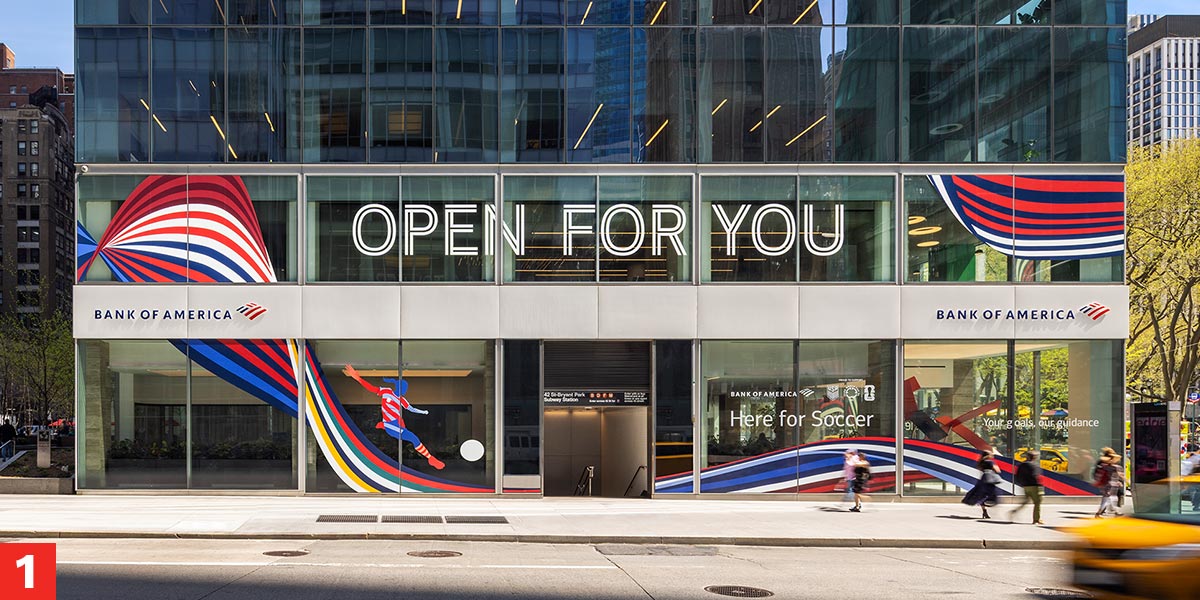
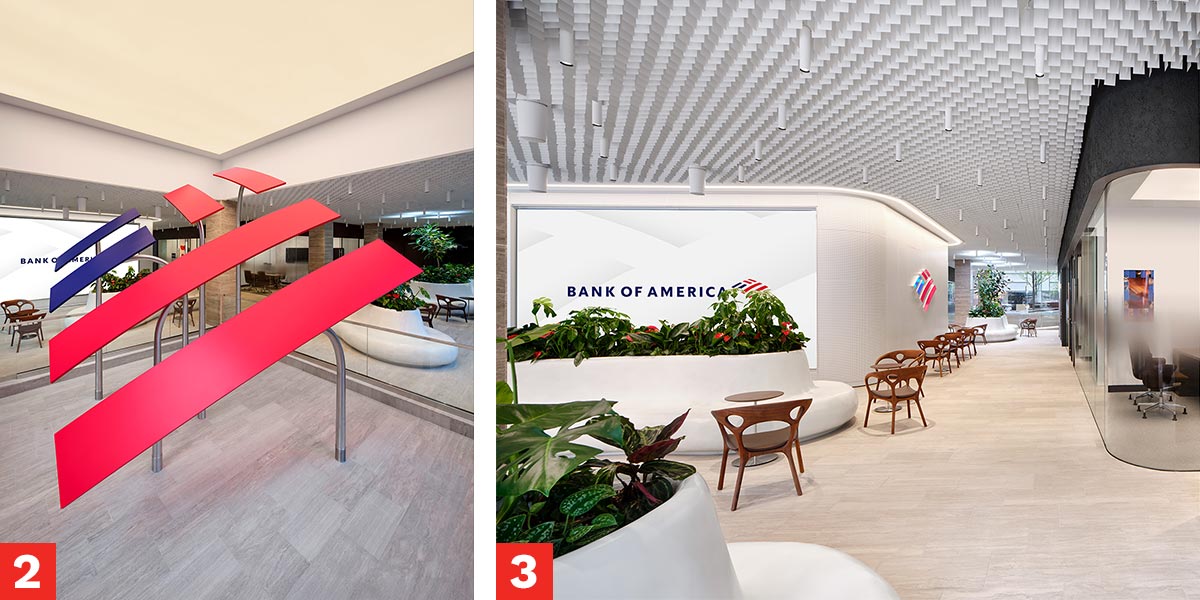
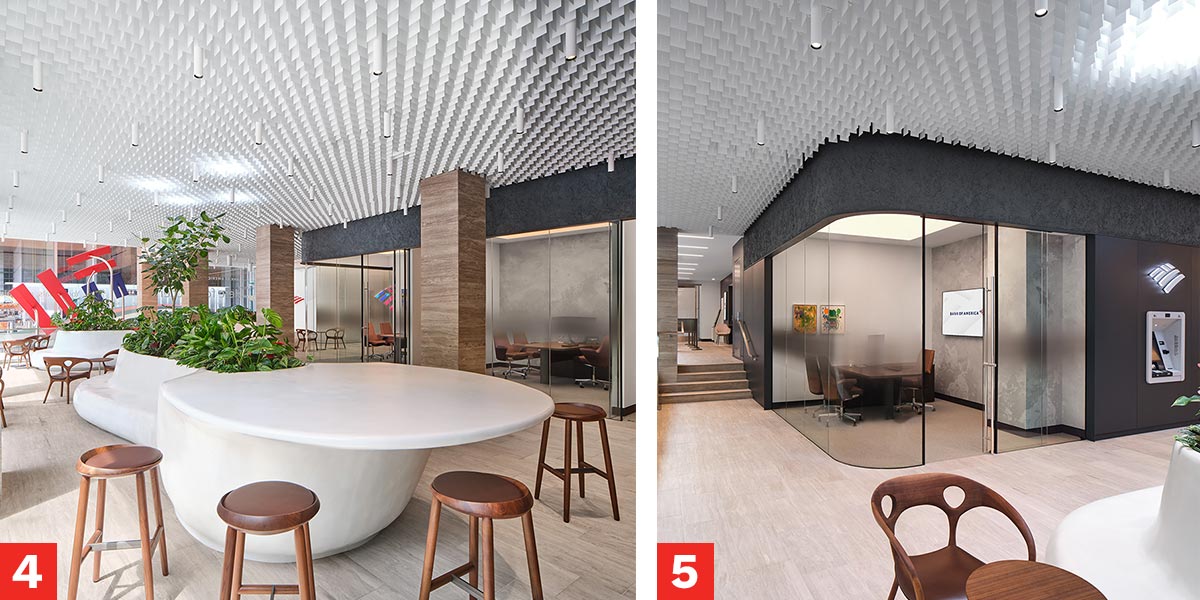
The new Bank of America flagship branch in Manhattan (1), across from busy Bryant Park, illustrates the bank’s approach to branches. (The subway entrance in the middle of the storefront predates the branch and the branch design works around it, inside and out.) (2) One of the first things visitors see is a dramatic art installation, a 3D version of the BofA logo with individual elements that rotate and then reset to form the familiar symbol. In (3) and (4) you can see seating areas for people awaiting appointments with advisors in private offices or for impromptu chats with roving relationship bankers. (5) Teller stations are tucked away, around a corner, left, from the main banking floor.
Artwork is also sourced locally in the flagship and other financial centers (about 1,600 thus far). The bank works with a nonprofit concern called ArtLifting. The organization places works by struggling artists, some of whom have been homeless, and some of whom have physical or mental difficulties.
“The art we buy and hang on our walls often corresponds to the communities where we are,” says Smayda. “This changes the conversation in those financial centers and reminds clients and prospective clients how important the community is to our company.”
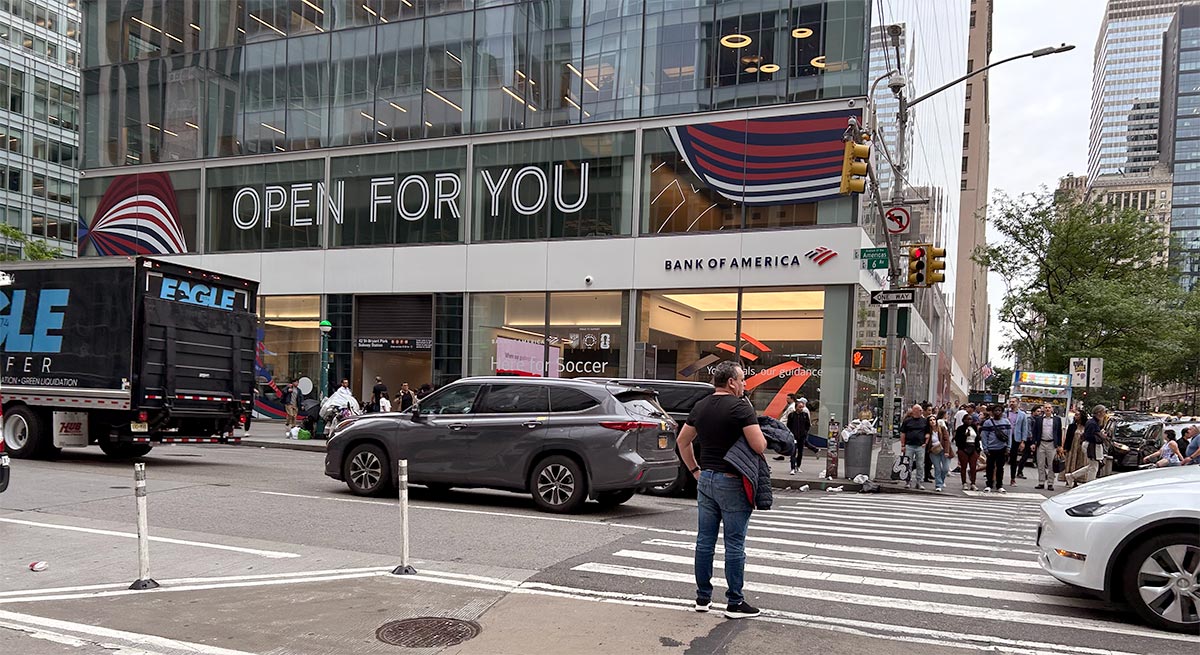
The new flagship branch serves as a vibrant billboard on its busy Manhattan corner at Sixth Avenue and West 42nd Street.
Read more: Big Banks Are Heading South… and Loving It


