
The Critical First 90 Days: Onboarding Is the Foundation of Long-Term Profitability
By Ben Udell, for Marquis
Simple Subscribe
Subscribe Now!
In financial services, new relationships come with a short but powerful window of opportunity. The first 90 days are not just a beginning they’re the moment that defines everything that follows.
Yet too often, financial institutions (FIs) treat onboarding as a checklist instead of a strategy. That mindset comes at a cost, both financial and relationship.
What the data shows, and what this paper explores, is clear: the early days of a relationship shape long-term engagement, profitability, and product depth. More than most bank or credit union leaders fully appreciate. The banks and credit unions that invest in onboarding win more, grow faster, and build more valuable customer relationships. Those that don’t? They chase growth that could’ve been locked in from day one.
At Marquis, we don’t just echo that insight, we expand it to help our clients’ long-term growth. The momentum established in the first 90 days unlocks long-term growth. This period is not just a “honeymoon phase.” It’s a time of unmatched opportunity. New customers or members are listening now, more than they ever will, to your communication.
Onboarding Is the Catalyst to Long-Term Growth
Done well, onboarding creates insights, awareness, and traction. It defines the relationship. It’s one of the most powerful levers an FI has to increase lifetime value. The ability to guide, communicate, and personalize in this phase has lasting ramifications on product adoption, retention, and profitability.
To illustrate this, let’s examine a real-world use case from a community FI. Data driven from Marquis’ Conversational Analytics tool KEYs.ai shows us a comparison of households (HH) with a tenure of less than one year, and the overall HH data. In STICK – An Adoption Analysis, we can review the penetration tab for instant analysis.
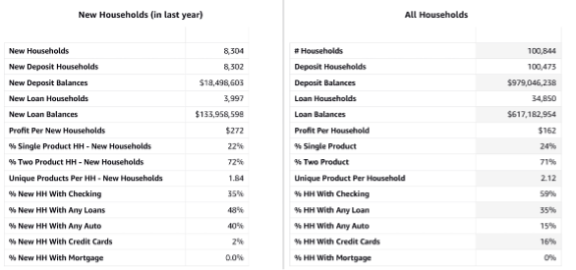
Product adoption: As expected, most products are acquired early, with limited cross-sell in future years. If you don’t capture opportunity in year one, it becomes exponentially harder to generate new opportunities later.
- New households (tenure < 1 year): 1.84 unique products
- All households: 2.12 unique products
This reinforces a critical point: a weak foundation in the first 90 days rarely leads to strength later in the year, and in year two, three, or over the life of the relationship.
Household mix: The percentage of single and double product HHs is nearly identical between new and tenured HHs. This also suggests HHs that don’t diversify early often don’t diversify at all.
- % Single Product HH – New Households 22%
- % Two Product HH – New Households 72%
- % Single Product (All Households) 24%
- % Two Product (All Households) 71%
Deposit Balances:
- New HH Average Deposit Balance: $2,228
- All HH Average Deposit Balance: $9,744
These numbers fit a sensible pattern. Moving funds takes time, direct deposits need to be switched, external relationships must be unwound. But the opportunity is clear: the early months are ideal for foundational steps. New accounts and product types are unlikely to be added in the future.
Key Insight: Focus on opening more than just a checking or savings account at the start. Banks and credit unions are often reluctant to add low balance money markets, CDs, or additional savings accounts focused on specific goals because initially these accounts will have smaller balances. Creating pathways for lower balance products, extending the time until minimum balance requirements are enforced, or tiering rates to account for lower balances while encouraging adding more deposits can help establish product relationships early. Plus, opening new accounts at a later date often carries friction which can be reduced if opened early.
With many banks and credit unions still struggling to streamline deposit account origination online, creating a roadmap for deposit product growth during onboarding becomes even more valuable. Making an investment in a long-term financial relationship starts early.
Lending Momentum and Decline: This institution also revealed an interesting dynamic that’s intuitive, but not always obvious.
Loan Balances:
- New HH Average Loan Balance: $33,515
- All HH Average Loan Balance: $17,710
FIs often attract new HHs with lending products. In this example, that’s exactly what’s happening. But over time, loan balances and loan products decline, while checking accounts are added.
What’s most telling is this:
Average profit per household:
- Year 1: $272
- All households: $162
This downward trend underscores a key challenge: high-value loan relationships often don’t translate to long-term profitability unless complemented by additional products and sustained engagement. Without intentional onboarding and cross-selling, institutions are simply swapping one product for another, checking account for a loan, without lifting overall profitability.
The Clear Story Onboarding Tells
The data couldn’t be clearer: the first 90 days define the relationship.
Across institutions, we see similar trends. HHs either engage early or never fully engage at all. Most products are adopted in the first year, often within the first few months. If you don’t capture those opportunities early, the window quickly closes.
Here’s the story the numbers tell if you’re not actively engaging with an onboarding program:
- Product adoption happens early, and then momentum drops significantly.
- Lack of early diversity persists throughout the relationship.
- Deposits start small and don’t often expand into new products.
- The marketing resources required to add additional loans or deposits after the initial onboarding period are high.
The takeaway: long-term value is built, or lost, in the first 90 days. Strong onboarding is a growth strategy.
The Financial Impact of Successful, or Unsuccessful Onboarding
One of the clearest demonstrations of onboarding’s long-term value is visualized in the chart below. Here, we see HH penetration by product category, segmented by tenure. The dark purple bars represent new HHs (less than one year), while the light purple bars represent all HHs.
The pattern is revealing. There are limited examples of significant growth in categories. In this case, we’re effectively swapping checking growth for a reduction in auto loans.
It visualizes a critical truth: the relationship is being defined and deepened early. If long-term relationships naturally built themselves, we would expect to see increases in products relative to year one. Instead, the data makes it clear: long-term growth is driven by short-term onboarding execution.
Putting the Math Behind the Opportunity and Risk
To understand the financial impact of onboarding, let’s quantify how even small changes in performance can significantly affect long-term revenue. Using this real-world FI as our baseline, we assume the following:
- Average margin: 3.5%
- Average deposit balance per household: $9,744
- Current number of new deposit households (Year 1): 8,302
- Average household tenure: 8 years
Now, let’s examine what happens with a 10% or 20% change in onboarding effectiveness of year one HHs, either an increase or decrease in performance.
- 10% change = +/-830 households
- 20% change = +/-1,660 households
Applying this change to the average deposit balance, margin, and tenure, we calculate:
- 10% change = +/-$2.2 million in lifetime revenue
- 20% change = +/-$4.5 million in lifetime revenue
These are conservative numbers, and they don’t account for additional sources of revenue like interchange income, fee income, mortgages, or referrals to investment services.
To put it in perspective: for this FI, that swing in revenue represents ~3 – 6% of their net income. That’s not just a performance stat. That’s budget-altering. It’s a clear, compelling reason to prioritize onboarding.
A Marketing Challenge Hiding in Plain Sight
Many banks and credit unions spend significant time and dollars marketing to long-tenured customers or members. Being a consumer’s Primary Financial Institution (PFI) opens the door for repeat business. But we’ve seen it across FIs of every size: the most efficient marketing investment happens in the first 90 days.
After that? The returns diminish. You spend more money and resources for a smaller relative lift. For FIs working with limited resources, this is a strategic issue. Knowing when to focus your attention is just as important as where.
Onboarding Is About More Than Sales
While much of the conversation around onboarding centers on deposit growth, lending, and cross-selling, it’s critical to remember that not every meaningful touchpoint involves a sales push.
The onboarding phase is a unique window to establish your FI’s identity, values, and relevance in a customers or members financial life. Complement your outreach in these ways:
- Provide education: Financial literacy, product guidance relative to financial goals, digital banking tool education
- Build credibility: Communicate your commitment to the community and your history of service
- Foster connection: A letter from leadership, welcome videos, personalized outreach
- Use every available channel: Email, online and mobile platforms, digital targeting, and yes, direct mail still works
New customers or members are paying attention now more than at any other point in the relationship. That makes onboarding the ideal time to be both helpful and assertive.


