
The Growth Secret of Fast Growing Small and Midsize Banks: Marketing Matters
By Ally Akins, Claude Hanley and Kunal Choksi, Capital Performance Group.
Simple Subscribe
Subscribe Now!
Executive Summary
- Higher Marketing Spend Correlates with Better Performance: Small and midsize banks that reported higher marketing spend in 2024 produced stronger growth in loans, revenue and, in some cases, deposits, compared to peers who didn’t report marketing expenses.
- Fintechs Are Winning with Bigger Budgets: Fintech bank holding companies spent significantly more on marketing and outperformed traditional banks in lending, deposit gathering and revenue growth.
- Budget Growth Slows Amid Rising Scrutiny: While marketing remains a growth lever, budget growth has slowed since 2022. Marketers now face mounting pressure to prove ROI, with a shift in focus from brand awareness to campaigns that directly generate revenue and contribute to deposit growth.
Marketing spend proves crucial in driving loan and revenue growth in the banking industry, particularly for small and midsize banks, according to a comprehensive analysis conducted by Capital Performance Group in partnership with The Financial Brand.
The study examines the marketing budgets of FDIC-insured institutions, segmented into two asset tiers ($1 billion-$10 billion and $10 billion-$100 billion), and assesses how marketing spend appear to have impacted their financial performance from 2023 to 2024.
Despite a decrease in marketing expense growth rates since 2022, institutions that invested more in marketing saw faster growth in loans, revenue and, in some cases, deposits.
The analysis also highlights the competitive edge fintech bank holding companies have due to their significantly higher marketing spend, which drives superior loan, deposit and revenue growth compared to traditional banks.
However, it’s important to recognize that marketing spending and financial performance are never 100% correlated. Many factors beyond marketing impact a bank’s profitability, including economic conditions, regulatory changes and competitive actions in the big picture and at the local level. Additionally, banks operate multiple business lines and undertake projects that marketing has no control over.
How the Study on Marketing Spend Was Conducted
CPG grouped institutions into the two asset tiers to track trends in marketing spend and financial performance from 2023-2024. To ensure standardization in the definition of marketing expense, CPG’s analysis draws on data from the Federal Deposit Insurance Corp., using the annual “advertising and marketing expenses” line item in call reports. Note that not every marketing expense gets rolled up into this line item. For example, marketing personnel salaries are not included, but marketing, advertising and promotional spending are. This makes that number a proxy.
CPG also tracks a peer fintech bank holding company group, comprising 11 direct-to-consumer, publicly traded fintech bank holding companies. (See analysis and data towards the end of this article.)
Banks are only required to submit information for the advertising and marketing expenses line item in the yearend call report when advertising and marketing expenditures total $100,000 or more and when these expenses exceed 7% of total “other noninterest expenses.”
The “reporting banks” are, by definition, investing more in marketing than those that don’t report marketing expenses. In the analysis for the article, CPG compared the banks that reported marketing expense to those that did not report marketing expense to weigh the difference in performance across a variety of key metrics.
How Bank Marketing Budgets Sized Up in 2024
CPG first evaluated the size of a bank’s marketing budget by measuring the marketing expense reported as a percentage of the bank’s total noninterest expense. Doing so shows how significant marketing is relative to a bank’s total budget. CPG also studied the percentage of average assets a marketing budget would make up, giving banks a good benchmark against similar banks and operating models.
Banks that spent on marketing in 2024
Source: Capital Performance Group analysis of FDIC dataSmall banks (banks $1 billion-$10 billion) typically spend 2.9% of their noninterest expense budgets on marketing, which accounts for 7 basis points of their total assets, whereas mid-size banks ($10 billion-$100 billion) spend slightly less, 2.7% of their noninterest expense budget and 6 basis points of assets.
Marketing Budgets Were Constrained in 2024
For both asset groups, bank marketing expense as a percentage of total assets and noninterest expense budget decreased from 2023 to 2024.
In addition, the growth rate of the marketing budget slowed considerably. Across every measure of marketing spend, banks were forced to hold back in 2024.
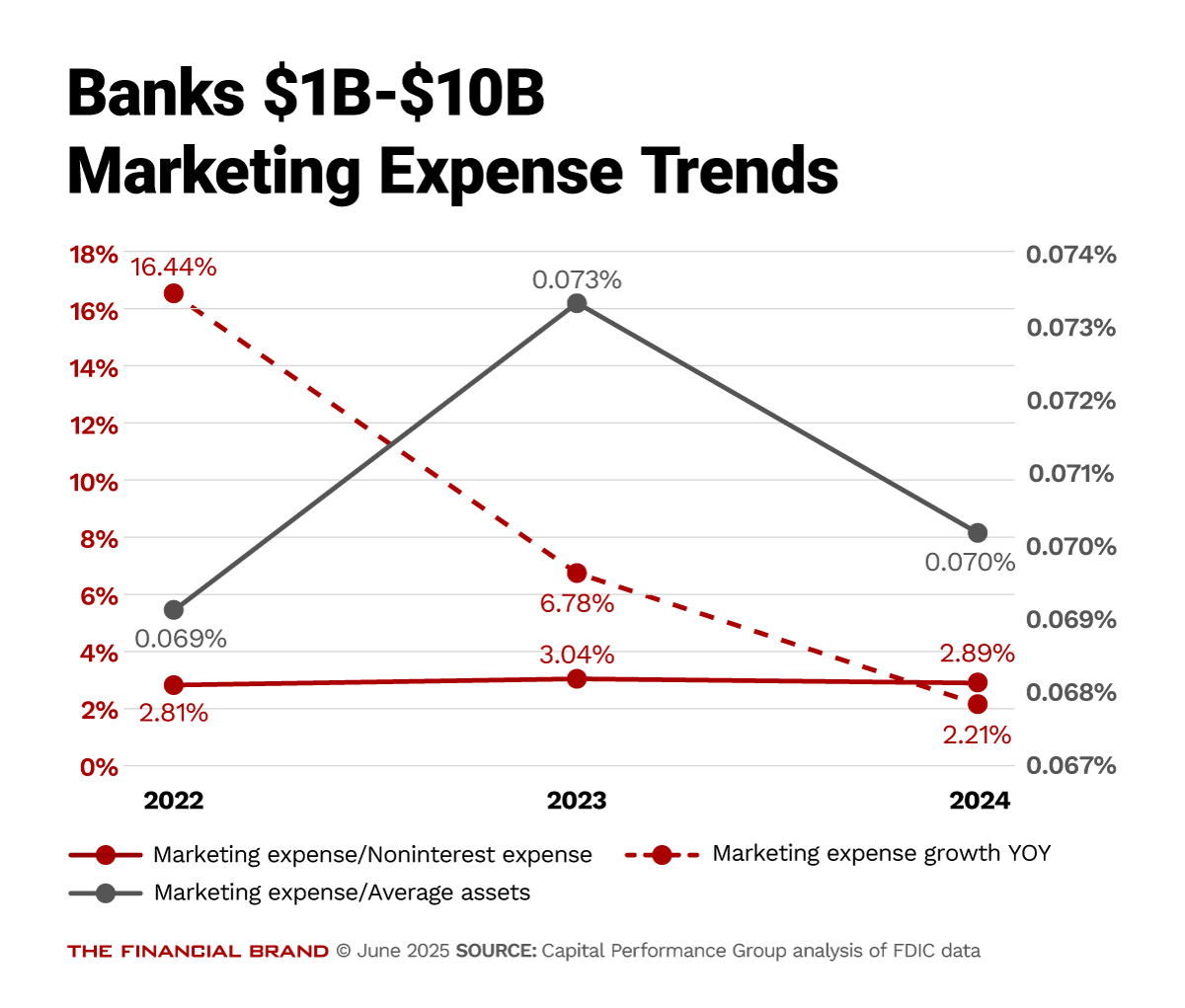
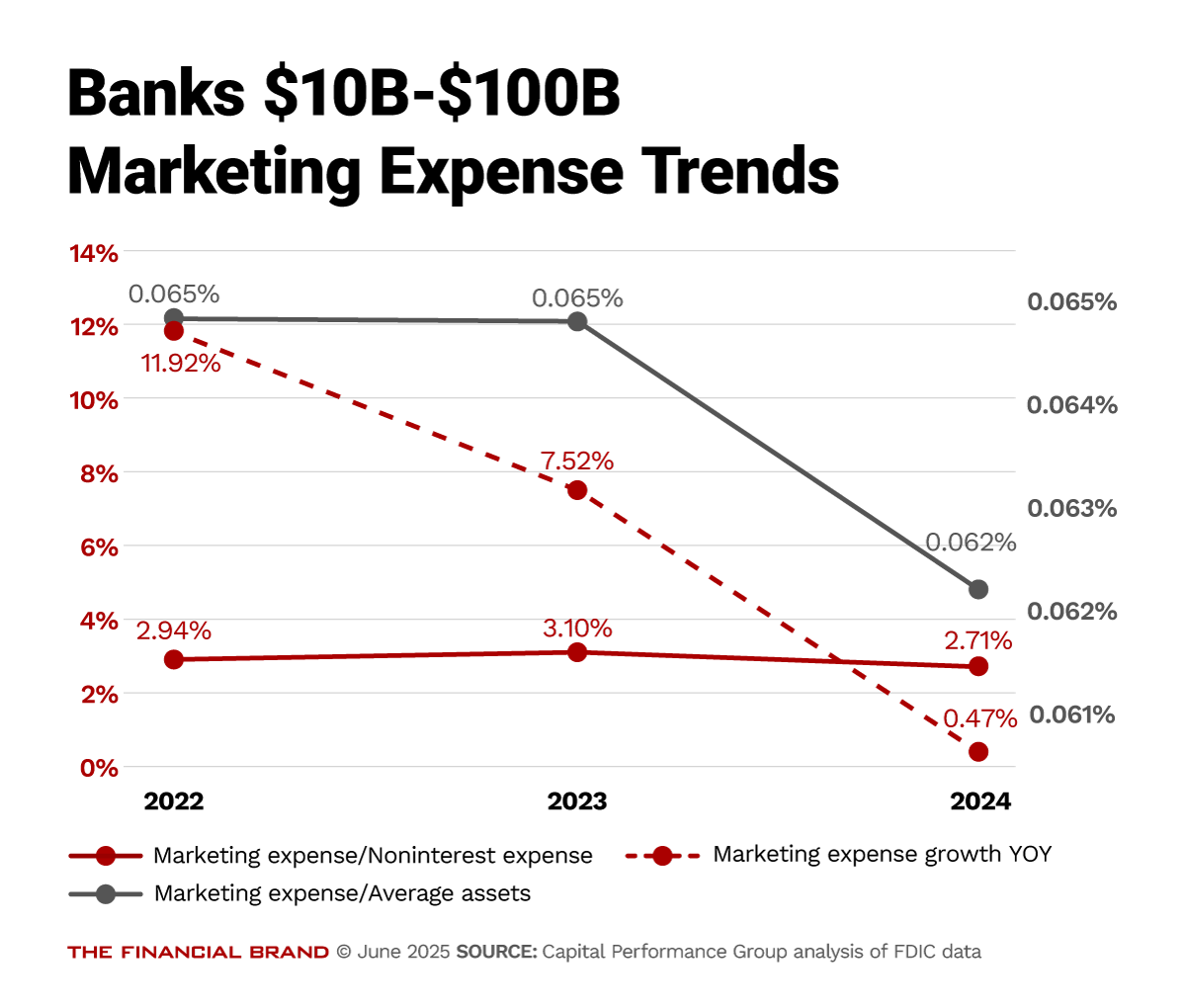
The marketing expense growth rate has decreased every year since 2022. Following the return from Covid, where budgets grew fast to jump-start initiatives or spend that may have been paused during the pandemic, budget growth has now come to a grinding halt.
Marketers will be forced to justify every dollar of their budgets in years to come.
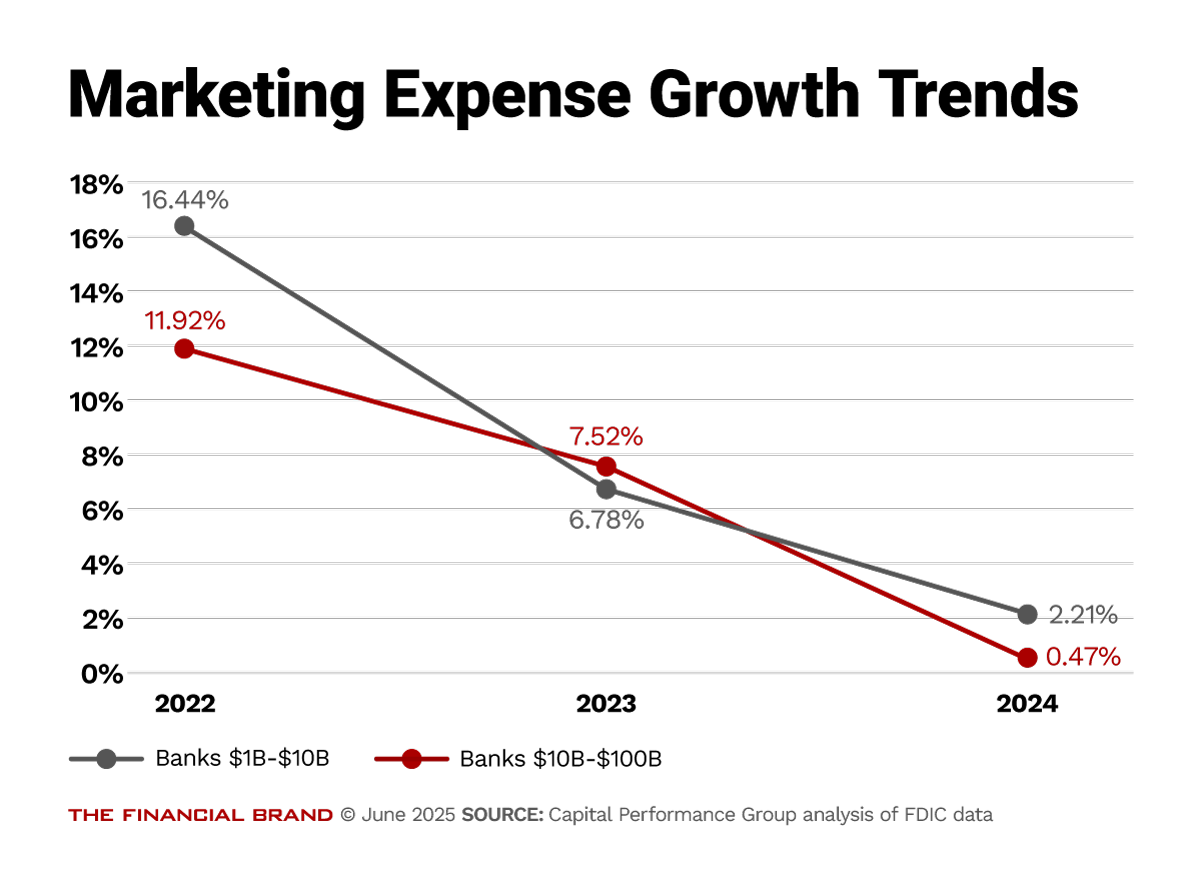
CPG expects the slower growth in marketing expenses to continue in 2025. As marketers face pressure to demonstrate a return, they must shift their focus from traditional marketing spending on communications and brand awareness to revenue generation, such as deposit promotions or marketing campaigns to attract new customers.
Read more:
How Marketing Spend Promoted Credit and Revenue in 2024
When comparing banks with marketing spending (a proxy for those who invested more of their budgets in marketing in 2024) to banks that did not report marketing spending, there are a few areas where performance may have been impacted, as reflected in the table below.
First, both small and mid-size banks that spent on marketing grew loans faster than their non-marketing spending counterparts.
Marketing spend drives loan and revenue growth in 2024
Source: Capital Performance Group analysis of FDIC dataMidsize banks outperformed their peers in non-brokered deposit growth and continued to drive growth in a year of uncertain interest rates. Banks that grew deposits without reliance on brokered funds contributed more significantly to their profitability.
Small and midsize banks grew revenue faster when they spent more on marketing than their peer groups. Midsize banks without marketing expense reported revenue shrinkage year over year, while those with marketing spend reported growth of 1.71%, highlighting a potential differentiator for the larger group.
Midsize banks with marketing expenses also saw a higher loan-to-deposit ratio than their counterparts, suggesting another way they may have contributed to profitability in 2024.
Read more: Prepare Now for a Historic Consumer Credit Comeback
Fighting with Fintechs: An Uneven Playing Field Tilted by Budgets
CPG also compared traditional banks to the direct-to-consumer fintech bank holding company peer group (11 institutions, listed below) for a consistent comparison of marketing expenses and performance trends across the group. The reporting requirements for these bank holding companies are identical to those of traditional banks.
These holding companies were much larger than the other bank asset tiers (average assets of $118.9 billion) and did not rely on branches or a physical distribution network (median of three branches and some with no branches) to maintain and grow their businesses.
Fintech banking organizations reviewed for the marketing spend analysis
Fintech bank holding companies spend significantly more on marketing compared to the rest of their budgets (8.46% of noninterest expense versus percentages below 3.0% for all banks).
A bit of perspective: If a $3.0 billion community bank currently is spending $2.1 million on marketing (7 basis points of total assets), a fintech bank holding company of that size would be spending $20.4 million (68 basis point of total assets).
How fintech banks’ marketing spending results compare to traditional banks’ results
Source: Capital Performance Group analysis of FDIC dataFintech bank holding companies grew their marketing budgets faster than other banks in 2024 (7.88%), but their loan, deposit, and revenue growth far surpassed that of traditional banks. This was a disadvantage in terms of their cost of funds, but their efficient operating models and business lines allowed them to maintain profitability in a difficult year.
Banks are increasingly challenged by the rise of fintech firms leveraging mobile-first platforms to capture market share. For instance, digital-only banks have revolutionized customer acquisition by offering seamless app-based account management, pressuring traditional institutions to adapt to these agile competitors and their innovative marketing strategies.
Read more: Inside Chime’s Plan to Become Even More Bank-Like
Fueling Growth with Marketing
Institutions that spent more on marketing grew revenue, loans and, for some, deposits faster last year. More money doesn’t necessarily mean more growth — you need to spend it wisely when you have it — but the study indicates it’s a necessary ingredient.
In 2025, bank marketers will be asked to demonstrate the return of all marketing investments, even traditional and brand-focused ones.
This study provides benchmarks for any institution trying to determine how much they should be spending and what kind of growth they should expect, especially as competition intensifies and banks compete against large and digital brands with fat marketing budgets.
Determining the optimal size of your bank’s marketing budget can be challenging, but benchmarking against similar business models and competitors can help ensure your institution remains competitive.
For details about the study and access to the full data and analysis, please contact Ally Akins at aakins@capitalperform.com.


