
Your Low Attrition Numbers are a Lie
By Corey Wrinn, Managing Director at Rivel Banking Research
Simple Subscribe
Subscribe Now!
For years banks and credit unions have taken comfort in a familiar metric: client churn. As long as customers and members aren’t leaving in large numbers, things must be fine because new deposits and loans will always replace them. Overall, deposits remain, accounts stay open and primary relationships look stable on paper.
Yet behind the positive numbers, a greater risk is emerging: silent disengagement, not mass attrition, is now the main challenge for retail financial institutions.
“I’ve been with [my bank] forever and will keep my direct deposit going, but they’ve started to add minimum requirements to my savings that they haven’t in the past. It’s too much of a hassle to call and figure out options. I recently opened an online-only account somewhere else that I’m getting a better rate on.” — Millennial Customer in Illinois (Q1 2026, Rivel)
Introducing Dormant Vulnerability
Rivel Banking Research has spent years measuring what we define as vulnerability: customers who are more likely to leave, less satisfied with their current institution or actively considering alternatives. Vulnerability, as we define it, isn’t a single signal. It can show up as low overall satisfaction scores, a declining share of wallet or frustration manifesting in considering new primary options.
Key insight: What’s becoming increasingly clear is that vulnerability doesn’t always lead to immediate switching. Instead, many customers enter a dormant state. “Dormant vulnerability” is customers and members who remain with their primary bank or credit union and appear stable in retention metrics, but are emotionally detached, quietly dissatisfied and actively open to alternatives. They haven’t left, but they’re no longer committed — and they may be hiding under the radar for most institutions.
Take one real-world case study of current retail consumers who are the most likely to leave their current institution, according to 227,173 interviews recently conducted across the United States: Higher income Millennials that every financial institution should be chasing.
Vulnerability Metrics: Millennial Households >$100k
37% are considered vulnerable because they fall into one or more of the following categories:
- 14% – Stated desire to perhaps leave current bank soon
- 11% – Seeking key products with competitor
- 10% – Have less than 25% of products at current bank
- 9% – Dissatisfied with current bank
Source: Q1 2026 Rivel Retail Prospect Banking Benchmarks
This is measurable and actionable, but only if you’re looking for it. Try pulling your own dormant segment of businesses and consumers this week. You likely have the data signals already: declining transaction volume, closing recent accounts and new primary address away from your core. Build that list and determine your immediate outreach.
What Dormant Vulnerability Looks Like in the Real World
Dormant vulnerability rarely shows up as complaints or account closures. Instead, it surfaces through behavior. Customers may:
- Keep their primary checking account but open savings accounts, credit cards or loans elsewhere
- Stop engaging with marketing and outreach, even while remaining digitally active in their accounts
- Most importantly, tolerate issues they once escalated because they are getting the help they need elsewhere
Among this same top vulnerable segment — Millennials over $100,000 income — 41% report having left their bank or credit union and not always “officially closed.” What jumps out is the catch-all around a bad experience. It’s not only one specific change or failure; it’s the accumulated disengagement.
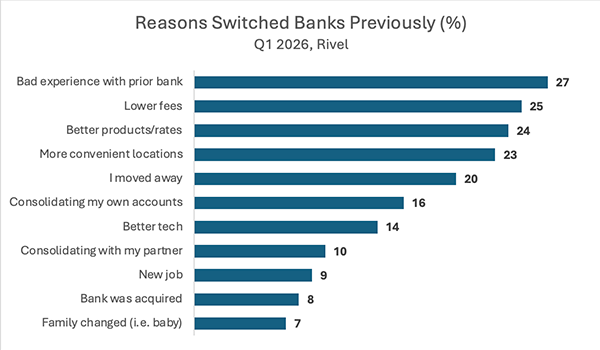
What can you do? Go on the offensive when it comes to service. Audit your complaint data differently. Stop counting complaints and measuring trends, start mapping which customers stopped complaining without a resolution. A customer who used to call about fees and went quiet didn’t get happier — they got resigned and probably brought assets elsewhere. That silence is a signal worth chasing on a larger scale, if possible.
Start Turning Toward Loyalty This Week
Low churn is not the win it used to be. The play now is to identify customers who are still “with you,” but already shifting products, balances and trust elsewhere — and intervene while the relationship is still recoverable.
The recommendations below are designed to be distinct for each of your different audiences, and each can be operationalized with a trigger, a clear owner and an outreach motion.
- Pull your multi-institution customers. You likely have this data already. Customers who have a checking account with you, but whose direct deposit recently dropped, or whose transaction volume declined. Those are your dormant vulnerable.
- Build a “last product date” report for win-back opportunities. When did each customer last open a new product with you? If it’s been 18–24+ months, they’re either fully served (rare) or shopping elsewhere (likely). That cohort needs a different conversation than your standard marketing calendar.
- Flag digital struggle as a retention signal. Customers who repeatedly fail at key tasks in-app (password resets, abandoned applications, transfer-limit errors, repeated fee searches) aren’t “less digital “they’re probably stuck. Build a simple trigger list and route those customers to proactive outreach or an instant in-app call offer before they solve it elsewhere.
- Assign every small business a banker as their anchor. In most markets, less than 50% of businesses have a dedicated banker, but the satisfaction is 90%+ within that group. Can you provide a unique opportunity to keep business clients in a way that bigger banks can’t compete with consistently?
- Add one question to your next survey: “Have you opened a financial product elsewhere in the last 12 months?” That single question will segment your customer base into loyal vs. dormant faster than any satisfaction score will, and it’s a simple add-on to internal NPS or regular check-ins.
- Close the awareness-to-consideration gap at the market level. If your brand awareness is strong, but consideration is flat or declining in a given market, that’s a vulnerability hotspot. Marketing dollars should flow toward relevance and trust building in those markets, not just top-of-funnel awareness spend, hitting both current and future prospects against local peers.


