
Four Imperatives for Banking CMOs to Navigate AI Disruption in 2026
By David Evans, Chief Content Officer at The Financial Brand
Simple Subscribe
Subscribe Now!
As artificial intelligence transforms marketing from campaign-based execution into enterprise value creation, disconnects between marketing and broader C-suite leadership threaten to stall effective AI implantation in marketing, according to a recent report from BCG.
CMOs expect AI to primarily enhance marketing effectiveness and personalization, while CEOs, CFOs, and technology chiefs think about AI in strategic terms, centered on enterprise growth and business model innovation. BCG’s survey of 60 senior marketing executives found that a small minority of AI initiatives deliver enterprise-level value, with most deployments confined to individual functions or pilot programs.
To align their AI strategies with key corporate goals, marketing leaders must shift focus to redesigning end-to-end workflows—particularly in creative personalization, content adaptation, media measurement, and programmatic buying.
Need to Know:
- Only 15% of marketing AI initiatives operate cross-functionally at scale to deliver enterprise-level value, according to the BCG’s survey, with 31% conducting functional pilots, 15% testing enterprise pilots, 19% achieving functional transformation, and 20% remaining in exploratory phases examining possible future applications.
- 57% of CMOs cite marketing effectiveness and 45% cite personalization as top ways AI will create future value, diverging sharply from their C-suite colleagues who prioritize enterprise value and growth.
- 99% of surveyed banks are prioritizing AI initiatives in customer-facing services, but only 32% realize significant returns from these efforts.
Realizing the Power of AI in Marketing Demands New Operating Models
Little disagreement exists amiong CMOs that AI will reshape marketing, but thinking too narrowly about technology is limiting AI’s impact, argues BCG. Real opportunities lie in AI’s ability to help CMOs reinvent entire marketing operating models to generate more profitable growth rather than simply automating existing campaign processes or improving creative production speeds.
This disconnect creates a practical barrier for CMOs seeking resources and organizational commitment for marketing AI initiatives. Marketing leaders need to move beyond sequential campaign processes and traditional brand stewardship models to drive measurable value across businesses while building organizational intelligence over time.
The fundamental challenge: Connecting internal and external ecosystems while sequencing and navigating significant changes in how marketing work actually gets accomplished.
How CMOs Can Unlock the Enterprise Value of AI Marketing
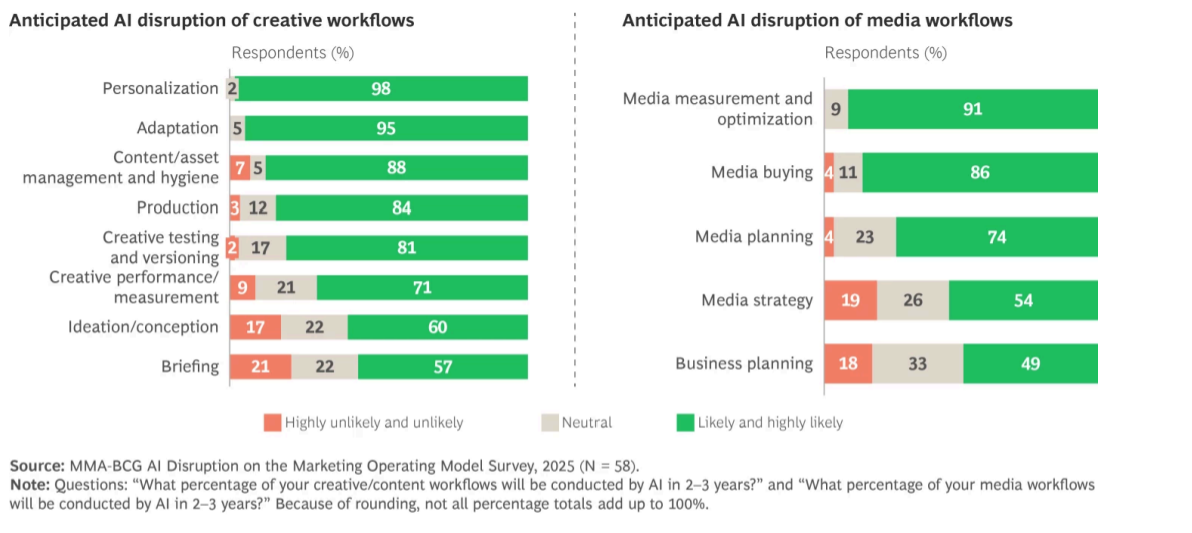
Although the long-term prize involves company-wide transformation, CMOs should focus initially on redesigning end-to-end workflows where AI disruption will likely be greatest and most rapid, according to BCG. AI initiatives scale quickest when organizations transform workflows that can and should become demonstrably easier with AI rather than layering new capabilities onto existing process structures that fundamentally remain unchanged.
In creative workflows, AI will most readily accelerate
- personalization
- adaptation including translation or localization
- creative testing and versioning
- content management
- and selected production tasks.
Identify the quick wins: AI excels in tasks that build on existing creative ideas and require less human judgment for execution. In BCG’s survey, CMOs reported that early wins come first in search, social, and programmatic content channels where creative workflows can make effective use of data and algorithms to build on human inspiration and strategic direction.
Media workflows track largely similar patterns. Measurement, planning, and buying benefit from upstream human judgment in processes like strategy development and business planning. These areas prove well-suited to AI-enabled acceleration within two to three-year timeframes. The priority list in media workflows should include:
- programmatic advertising
- search marketing
- social media
- online video
- e-commerce platforms including product detail pages.
How Agentic AI Will Reshape Marketing Accountability
As AI capabilities advance, decision-making focus shifts from false dichotomies of “in-house versus agency” toward nuanced designs governing who does work and when. BCG’s survey suggests that more marketing jobs will move from people to technology regardless of whether focus areas are creative or media.
The decline of agencies: In creative and media work, leaders expect agencies’ contributions to fall by 11 to 14 percentage points over the next few years. Technology will pick up most of the burden, with internal marketing team accountability rising modestly from 48% to 50% in creative work while technology will jump from 7% to 16%. Media shows similar patterns with internal teams increasing from 45% to 51% and technology expanding from 10% to 18% of total accountability.
Bottom line: Agentic AI will handle more than one-fifth of marketing’s total workload within two to three years.
Your Agency Partnerships Will Require Fundamental Restructuring
AI-led disruption will give CMOs opportunities to redefine agency relationships by leaning into top AI enablers. However, CMOs remain deeply skeptical of agencies’ ability to scale AI effectively:
- 86% of CMOs believe their creative agencies are not using AI at scale currently
- 67% hold similar views about their media agencies.
CMOs’ concerns center on abilities to align incentives properly, share value from AI-enabled efficiency gains equitably, and challenge fundamentally outdated business models.
What this means: CMOs have the opportunity now to use their buying power to redefine relationships as true partnerships rather than transactional vendor arrangements. BCG argues that means aligning on desired business outcomes first and then designing the right partnership operating model to support those goals effectively. Whatever the new balance might be between internal and external teams, handoffs to agencies must be tightly wired and transparent so that signals and value are not lost across organizational boundaries.
Four Strategic Imperatives for Marketing Leadership
Marketing leaders can take several clear actions to stay ahead in this transformative environment.
First, align with the C-suite. The C-suite disconnect on language and vision with regard to AI inhibits enterprise growth potential. Overcoming these barriers proves essential to unlocking company-wide investment and setting the tone for marketing to help lead cross-functional transformation at scale rather than remaining confined to functional silos.
Second, focus on measurable marketing wins, starting with initiatives where AI will most meaningfully reshape business performance. In marketing, that means focusing on priority end-to-end workflows in creative and media functions and building foundations for even broader cross-functional connectivity over time. By showing how AI supports enterprise value and growth rather than merely improving marketing efficiency, CMOs can make compelling cases for far broader company transformation efforts.
Third, rethink agency partnerships. Agencies will remain critical elements in future marketing landscapes. However, current agency partnerships will prove unsustainable in their existing forms. Leaders who redesign operating models holistically—addressing commercial structures, capability development, data sharing protocols, and accountability frameworks—will position themselves as true winners in the emerging environment.
Reimagine talent strategies. The rise of agentic AI will create fundamentally new connections between humans and AI within marketing workflows. As AI takes on more linear elements of the marketing equation including execution, optimization, and measurement, human talent can shift upstream to higher-value work including strategy, partnerships, business planning, and true creativity. The future of marketing is not a choice between humans and machines, but rather a new human-led and AI-empowered operating model that balances capabilities appropriately.


