
Quantcast
Third Degree Advertising | What's Your Storyful Moment
rss
Bancography | Branch Planning, Marketing research, Brand Strategy, Products & Profitability

SAC Uses New Look to Tout ‘The Credit Union Difference’

Share on Twitter
April 2, 2009 | Free Subscription

“Change means opportunity. Opportunity for our members, for our community, and for SAC Federal Credit Union.”
– Gail DeBoer, President/SAC FCU

After conducting research, SAC Federal Credit Union in Nebraska found that their somewhat dated, military look reinforced the perception that the credit union was for the military only, even though SAC had been open to everyone in the area for years.

The research also showed that people don’t generally know credit unions are different from banks, why they might want to join a credit union, or that they could even join in the first place.

So the $350 million credit union, along with their agency obi creative, set out to change things.

SAC wanted a new identity that would appeal to a wider, more progressive audience without abandoning their heritage. The credit union’s new logo evolves some central features of the old logo into a fresh, more modern design.

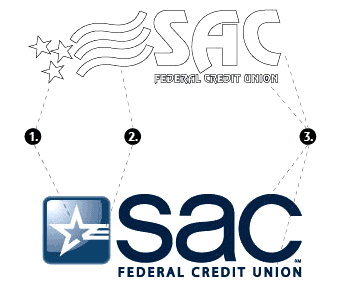
SAC got its start as an on-base credit union for the Strategic Air Command.

The credit union created a TV commercial — one that’s very well-produced — to support the rollout of the new logo.

Kiosk & Display | Digital Merchandising

In its campaign materials, SAC spends most of its time explaining the basic differences between banks and credit unions.

“Hi, my name is Amy…And my name is Bill. We’re members of…SAC Federal Credit Union…Unlike banks that are for-profit and shareholder owned…SAC’s owned by members, people like you and me…We have a say…SAC makes decisions based on our best interests…Because SAC is member-owned. It gives back profits to us…through better rates and services. That’s how I got a better deal on my car loan…More interest on my savings…Dividends on my checking account…Switch to SAC Federal Credit Union…It’s a better way to bank.”
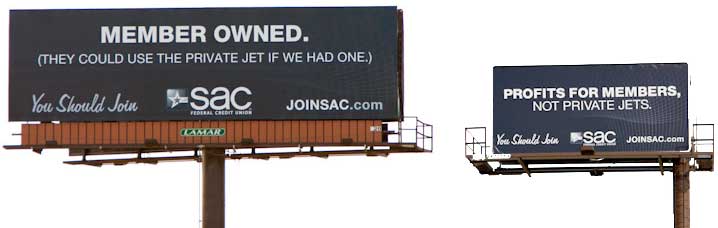
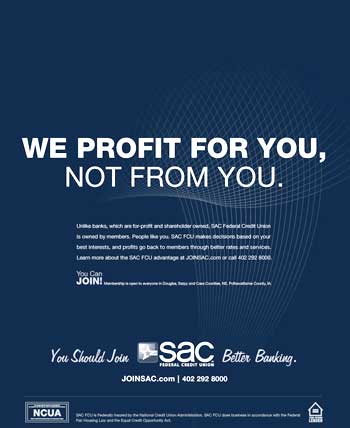
Reality Check: These kind of messages are the general “credit union difference.” If the credit union industry and its leaders could ever find a way to produce a national awareness campaign, then credit unions across the country could stop expending mounds of marketing capital conveying the most basic information about their financial model. Until that time, credit unions will  continue to tow the bulk of the party line.

As part of the rebranding effort, the credit union is replacing its old slogan, “Your Financial Partner for Life,” with “Better Banking.”

SAC has updated its website with an announcement about the changes, including a hotlink to their member newsletter.

SAC stresses that the makeover is not part of any reorganization, and that only the brand imagery will be changing. The credit union’s newsletter reassures members that “SAC FCU remains strong.”

According to data from CreditUnions.com, SAC has a capital ration just under 12%, which is considered to be strong and well-capitalized by any standard.

EHS Design | Strategic Planning, Interior Design & Architecture

Key Takeaway: In this economic environment, people seeing any changes in their financial institution will automatically assume the worst. When rates, fees and even logos change, you need to follow SAC’s footsteps and explain the changes, or people will draw their own, fearful conclusions — e.g., merger, buyout, collapse, failure, new management, etc.

SAC says its signs, stationery, and collateral material will be gradually updated over the next year. The credit union has started introducing the new look in an integrated media campaign including TV, radio, billboards and print.
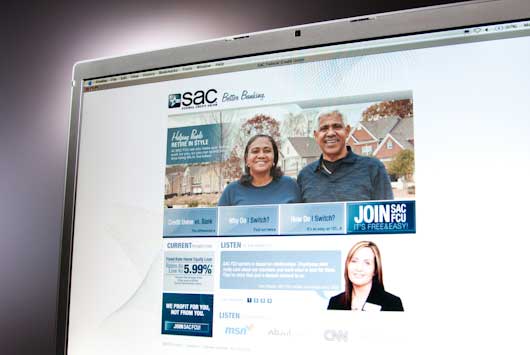
The old SAC website (left) gives way to a much more attractive and contemporary replacement
(photo, shown right). Using the web address joinsac.com, the new site is
pitching switching
solely to prospective members. The microsite is pretty slick, thorough and well-designed.


This article © 2012 by The Financial Brand and may not be reproduced.

Market Match | New How-To Sessions in 2012

Related Articles From The Financial Brand:

More stories about: Brand Identities, Credit Unions, Logos, ,

Comments (13)

RSS feed for commments on this article

  1. Melina Young says:

    Thank you for sharing this article. I appreciate and agree with your insight into the members’ mindset when things change during tough times.

    The first national credit union campaign since Dorothy Hamil in the 1970′s was launched this year at the CUNA GAC. It is called the American Debt Relief Challenge and the goal is to save 37,500 consumers $300 million while increasing credit union net revenue and awareness about the credit union difference.

    Credit unions are joining every day and the savings to date are $4,687,368. At the GAC, NCUA Vice Chairman Rodney Hood called the American Debt Relief Challenge, “something all credit unions should look at” during his speech to about 4,000 CUNA GAC conference attendees.

    It is only $500 for credit unions to participate and free to credit unions under $25 million.

    Ok, I’m done gushing. :) If anyone has any questions, please feel free to email me melina@adrchallenge.org or call (253) 200-0418.

  2. Great makeover – thank you for the inspiration! The billboards must have the neighboring bankers steaming!

  3. Bob London says:

    Enjoying your posts, keep it up!

    Don’t know if you heard about NAFCU’s program which “crowd-sourced” a series of spots via a competition (run by a third party). See http://www.nafcu.org/Content/NavigationMenu/NAFCU_Services_Corp/Press_Releases/CreditUnionAdsAvailablePressRelease_2-18-09.pdf

  4. Editor says:

    Yeah Bob, I’ve seen that work…on the internet, at the NAFCU site. I wonder if I’ll ever see it anywhere else?

    In all fairness, there are some great state leagues out there doing a good job to build awareness of credit unions and what they stand for. But there has never been (in my recollection) a single, high-profile national campaign.

  5. As of this morning, 19 credit unions are working with the free NAFCU Services ad designers (another 8 are in varying stages of process), and a total of 61 of the ads are currently being customized.

    Go to http://www.nafcuservices.com/creditunionads to see them, as well as one that was customized for Pacific Cascades FCU.

    We’re also hopeful that the ads will be used, and see this as a modest contribution we can make to assisting the industry in it’s branding and awareness challenge.

    Another round of free ads focused on promoting mortgage lending and housing finance for credit unions will be launched soon, look for them in about 6-8 weeks.

  6. Editor says:

    Hi David. Thanks for sharing NAFCU’s work. It’s very good work indeed. Nevertheless, I still wish the bulk of communicating the basic, fundamental differences between banks and credit unions would be handled on a national level instead of requiring the burden to be mostly shouldered by individual credit unions. It’s unfortunate that credit unions like Pacific Cascades feels it’s necessary to spend its marketing dollars conveying the general message about credit unions when they could be spending money to directly build their own, unique brand.

  7. We debated this question as we designed the ad program. First and foremost there is a resource issue — we don’t have the dollars that would be required to implement a national campaign, and even if we did it there is no guarantee that you would not just be ‘boiling the ocean,’ i.e, spending dollars to compete with much larger financial institutions and not really moving the needle with regard to enhancing credit union brand awareness.

    Instead, we drew a distinction between brand attributes and individual credit union brands. As you note, while there are certainly some common brand attributes that all credit unions share, each individual credit union’s brand is the sum total of the thousand touchpoints they have with Members and prospective Members every day. Everything from SEG versus community charter to branch layout and website design to the specific mix of products and services.

    There is no way for us to influence an individual credit union’s brand, but we decided we could offer an ad “platform” based on generic credit union brand attributes that empowers a credit union to (cost-effectively) raise the visibility of their individual brand.

    We also see this as a wholistic effort, that there is no single solution. So we’ve also undertaken other efforts to make it easier for consumers to find a credit union. Look at http://www.CULookUP.com, traffic is growing at a rate of about 30% a month since we launched it in October 2008.

    Understand these together don’t represent the same level of effort and splash that a glitzy national ad campaign might have, but call it guerilla marketing in the classic sense of the term.

  8. Editor says:

    Now is definitely the wrong time to bring this up, but funding a national campaign would require contributions from all credit unions — something that sounds extremely unlikely in the wake of NCUA assessments.

    I put the minimum funding level for a national campaign around $20 million (per year, for 5-10 years). $50-100 million would definitely do the trick, but $20 million would be enough to start making progress. The only problem is, “Where does this money come from?”

    How a national campaign would be funded has always been one of the major sticking points. Large CUs aren’t super excited about the idea because they already have budgets big enough to move the meter on their own, and can do so exclusively to their benefit.

    As long as the NCUA, CUNA and NAFCU work independently and are forced to work within their current budgets, and until all credit unions can agree on the need for such a campaign, the prospect of a national media seems admittedly remote.

  9. NCUA is a regulatory agency of the Federal government, unless they get dollars appropriated from Congress they can’t engage in an ad campaign. And you could combine the marketing budgets of NAFCU and CUNA and still not come anywhere near the amount you need. And you’re correct. given the issues facing the industry today, any dollars that were discretionary are headed (unfortunately) somewhere else.

    So why not look at this glass as half-full? One of the true competitive advantages of credit unions has always been their local focus — on a SEG, a community, and on Members. This is a factor of competition that large, national competitors simply cannot match.

    How much more frustrating would it be for our competitors to face a legion of ads across the country, each with a local focus?

  10. Great conversation!

    I’m surprised no one mentioned that CUNA already HAS a national brand campaign (maybe someone did but I missed it). Anyway – it was rolled out in the early 2001 and the tag line is perfect for today’s times:

    “Where people are worth more than money!”

    http://www.cuna.org/initiatives/cu_brand/index.html

    It’s done and paid for. People just have to pony up to use it.

    BUT, I personally LOVE LOVE LOVE the brand campaign that the Pennsylvania League developed (and Illinois, Vermont and Mississippi are now running).
    http://www.ibelong.org. Good stuff.

    Another way I think credit unions could get the most bang for their buck today in raising awareness of financial cooperatives – participate fully in shared branching. Banks are going to be merging, closing branches, reissuing account numbers and plastic cards like crazy in the next year – what an opportunity to do the unthinkable – allow ANY credit union member to go to ANY credit union to conduct business!

  11. Editor says:

    In any industry, an organization’s marketing dollars should be used to build the organization’s brand, not the industry’s brand. Having generic campaigns available is fine, but it’s unfortunate when a credit union must spend its own marketing dollars to run those ads.

    If credit unions could/would pool their dollars, it would yield greater efficiency. Not only would the pooled dollars yield more media, there would be a single message out there. This combination of repetition, frequency and consistency would have a far greater effect than the fractured efforts attempted so far.

    There are currently campaigns from CUNA, NCUA, NAFCU, the Pennsylvania League, the ADR Challenge, etc. It’s the same thing that’s been happening for years: everyone tries to do their part, but public perceptions aren’t changing (as SAC’s research reaffirms).

    My suggestion is for increased cooperation and consistency, whether that be at the local, state, regional or national level. That’s the basic strategy. Whether iBelong, NAFCU, CUNA or some other entity can pull this off makes no difference. All I know is that there is a place reserved in credit union history for the organization (or idea) that brings the industry together by pooling dollars, getting a single message out there, and changing people’s perceptions.

  12. @Jeffry – what are your thoughts about a Shared Branching blitz? Not a campaign, per se, but an urgency for credit unions to join forces in these hard times and “cooperate” by sharing their branches.

    Newsworthy? Significant? Differentiator?

    I think it fits all of those but would love to hear your opinion.

  13. Editor says:

    I think shared branching is a good thing to tout. One of the primary things research in the credit union industry tells us is that people view credit unions as “less convenient” than banks.

    It would be good to attack people’s perceptions that credit unions are inconvenient in any broad reaching campaign. The basic three-pronged approach would be to hype…

    1) Shared branching (if you participate),
    2) XX,000 fee-free ATMs members can access (again, if you’re on the right network),
    3) free online banking and bill pay.

Post a Comment


If you want a picture to show with your comment, go get a Gravatar.

Next article recommended for you