
Weber Marketing Group - Brand Solutions Brand Partners | Bank and Credit Union Design & Merchandising PSST! Want to hear a secret? Momentum - Building. Branding. Breakthroughs. Digital Mailer Webinar: Upselling Subscribe

The good reason vs. the real reason

August 21, 2008

“Doesn’t this dress look cute on me?
Oh and look, it’s on sale.”

Anonymous Consumer

“A person usually has two reasons for doing something:
a good reason and the real reason.”

Thomas Carlyle, Victorian essayist

Human beings, as intelligent and sophisticated as we like to think we are, are actually highly emotional creatures. Every decision we make is made for emotional reasons. Those are the real reasons. We then back-up those decisions with logical justifications — the “good reasons.”

If you think about it and you’re really honest, what’s truly driving our choices is our emotions.

And we aren’t just talking about buying decisions. We’re talking about every decision.

There was a Porsche ad a few years ago that captured the internal struggle between our emotions and logic with naked perfection:
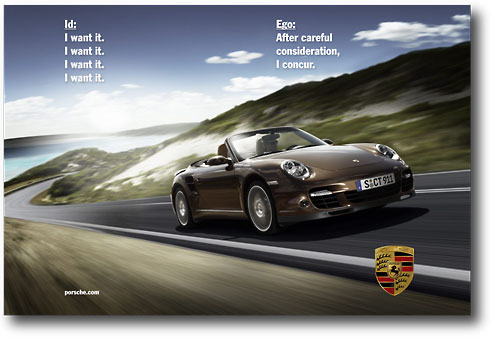
We do things because we want to — plain and simple. We may talk ourselves into thinking it’s a smart decision, but ultimately, we let our emotions run our lives.

We don’t have to buy the more expensive option. We don’t have to upgrade. You don’t really need premium gas. Logically, there is no reason to spend $400 on athletic shoes (especially when you don’t do anything athletic). No one really needs a $85,000 car when they can get from A to Z perfectly fine in a $15,000 car.

Most Americans almost never choose the least-expensive option (think “generic brand”). Why do we do this?

Because we want to.

“I want, I want, I want.”

We fork over millions of dollars every day because we want to. Not because we need to. Not because we really think it’s smart. Because we just feel like it.

As Nike says, “Just do it…”

Reality Check: Marketers are “want makers.”

Good marketing taps people’s emotions — base emotions — the fundamental psychology that drives us. Things like Greed. Fear. Envy. Trust. Love. Spite.

“Spite? People buy stuff out of ’spite’?” you ask. “You’re joking?”

No joke. Kids make buying decisions to spite their parents. They do it when they’re 15. They do it when they’re 50.

Wives (and ex-wives) buy stuff to get even with their husbands:
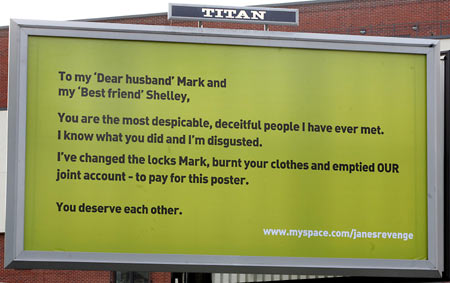
Jane’s revenge billboard cost £2,500. But how much does she think it was worth?

Is it rational? No.
Does it make any sense? No.
Does it feel good? Yes.

“Just do it…”

Parents don’t take their kids to McDonald’s for rational reasons. It’s not because McDonald’s is nutritious. It’s not because it’s cheap. Not because “the kids just lovvve it.” Parents take their kids to McDonald’s because it’s easy…on them, the parents. Parents can trust McDonald’s to make their lives a little easier. That’s what makes McDonald’s “convenient,” not the fact that there’s one on every corner.

You’ll notice McDonald’s never runs ads saying they are “fast, affordable, convenient and consistent.”

Why?

Because McDonald’s is a smart marketer, and smart marketers know you can’t rationalize people into making their decisions.

Unless, of course, you’re willing to make the ultimate marketing rationalization: “We will always be the cheapest.”

Key Takeaways:

  • Logical arguments aren’t always effective and “running the math” doesn’t always work.
  • People will pay a huge premium when you address their psychological and emotional needs.
  • Stop pushing features. Start selling the benefits — just make sure you provide enough rationale for people to justify their decisions.


Previous related stories from The Financial Brand:

Katrina. Haiti. Floods. Tornados. Are you prepared if disaster strikes? Check out this free playback of a Bankerstuff webinar, “Disaster Planning for Financial Facilities: Beyond IT and Business Continuity,” brought to you by Momentum, a world-class design-build firm for financial institutions and a sponsor of The Financial Brand. CLICK HERE FOR INFO

Print This Article
Momentum | A Design Build Firm

Tags:

Filed under: Branding, Marketing

5 Responses

  1. Tim McAlpine Says:

    Excellent post. This is so true: lists of features and benefits are what marketing people lean on. “We are paying for all that white space, let’s fill it up!”

  2. MaximumCMO » Blog Archive » Good enough to share: Final Olympics edition: branding, creative branding, strategic branding, interactive marketing Says:

    [...] the wrong direction. His discussion about the emotional vs. rational decision making is echoed in this post by Jeffry [...]

  3. The Financial Brand » Blog Archive » What’s the return on branding? Says:

    [...] If you really want to understand the ROI on branding, all you need to do is take a look at the difference in profits between branded- and more generic products. If price was the driver of people’s purchases, Nike couldn’t sell a pair of sneakers for $500; everyone would buy $25 Keds instead. We would all be driving a Kia or Hyundai instead of a BMW or Lexus. But price isn’t the key. Almost every buying decision is driven by people’s emotions. [...]

  4. Tina Pilcher Says:

    The medical community has proven that we can not make “logical” decisions without emotional input. When injuries damage the area of the brain responsible for our emotions, people lose the ability to make logical decisions. It takes these people a long time to try to make the simplest of choices like — to wear their slippers or not.

  5. The Financial Brand » Mega merger creates synergies…and concerns Says:

    [...] innate survival reflex — their emotions, not their intellect. As The Financial Brand wrote in “The Good Reason vs. The Real Reason,” logical arguments aren’t always effective and “running the math” doesn’t always work. This [...]

Leave a Reply