
Weber Marketing Group - Brand Solutions Brand Partners | Bank and Credit Union Design & Merchandising PSST! Want to hear a secret? Momentum - Building. Branding. Breakthroughs. Digital Mailer Webinar: Upselling Subscribe

Credit unions, welcome to the financial crisis

March 22, 2009

Before last Friday, credit unions had remained fairly immune to the fallout from the financial meltdown. But with the implosion of U.S. Central and WesCorp, credit unions are now knee deep in the economic crisis.

Welcome to hell.

Credit unions have some serious explaining to do. What happened? Who did what when? What’s the difference between a “corporate credit union” and a “natural person credit union?” And the million-dollar question:

“Are credit unions safe?”
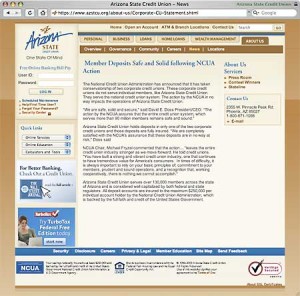
There are some credit unions who got started with the damage control over the weekend by posting updates about the situation on their websites. That’s a good start, but it’s only the beginning.

Here are some of the things credit unions — all of them — need to get started on immediately. Today. Now.

  • Staff – They are going to be bombarded with questions all week. They are going to have to explain things in plain, simple English, which means they first must understand the situation themselves. And remember, every concerned member with a question gives you the opportunity to talk-up your strength and safety. Even if members don’t call specifically about the NCUA seizures, you should take the time to see what they’ve heard and offer reassurance.
  • Website – Build a page dedicated to explaining what happened and what it means to members. Link to this page right off your homepage, preferably with a banner ad.
  • Direct Mail – Craft a letter. Send it to all members. If you don’t have one in the mail by Tuesday afternoon, you’ve taken too long.
  • Email – Send one in the next 24 hours.
  • Public Relations – Don’t wait for the press to call you. Contact them right away. Don’t wait until Tuesday or Wednesday. Do it today. You may only have one chance to get the right story out. (Update: Here’s a good example.)

If you didn’t do business with either of the failed corporates, tell them. If you have a capital position worth bragging about, do it. You can’t overwhelm members with too much information in this situation. People are starved for information about the health and well-being of their financial institutions. Embrace this as a chance to fully explain your position.

When you’re done taking care of the most important communications priorities, you can circle back and take a look at all your other communications channels to see what else should be used to convey your message — statement stuffers, on-hold message recordings, newsletters, etc.

Bottom Line: Members are going to be scared as hell, so you need to do everything possible to reassure them. Fair or not, they are going to blame ANYTHING they perceive as negative — any change in rates, any change in fees, any change in their favorite teller’s attitude — on the implosion of the corporate credit union system.

Note: If credit unions go out of their way to reassure an anxious public now then find themselves taking TARP money sometime down the road, the industry will lose all credibility, all the good-will and all the consumer confidence that’s been built up over the last few months.


Previous related stories from The Financial Brand:

Katrina. Haiti. Floods. Tornados. Are you prepared if disaster strikes? Check out this free playback of a Bankerstuff webinar, “Disaster Planning for Financial Facilities: Beyond IT and Business Continuity,” brought to you by Momentum, a world-class design-build firm for financial institutions and a sponsor of The Financial Brand. CLICK HERE FOR INFO

Print This Article
Momentum | A Design Build Firm

Tags: , ,

Filed under: Public Relations

25 Responses

  1. Ginny Brady Says:

    Jeffry, thanks for your thoughtful post. It’s helpful to take the lead in addressing what may continue to be challenging media coverage. I’ll be sending your post to our CEO. I also want to encourage CU Boards to read and ask questions about the recent NCUA actions as well as the positions that are being taken by CUNA, NAFCU and state credit union organizations. Gone are the days when boards could sit back and let their CEOs keep them abreast of the news and issues flowing from the national CU scene. It is the responsibility of boards to make policy decisions which are informed by what is happening nationally, in the CU environment, and how this translates into what is best for their members.

  2. Brian McDaniel Says:

    Pretty much the exact advice I gave our CEO Friday night. Nice work.

  3. Brian McDaniel on Strategic Communications Says:

    What Credit Unions Should Be Telling Their Members...

    As credit unions react to the collapse of U.S. Central and WesCorp, credit unions leaders need to react quickly to reassure members and the communities they serve. Here is what you should be saying

  4. Editor Says:

    Thanks for your comments and feedback Brian and Ginny.

    This is a big week for credit unions.

  5. Winter Prosapio Says:

    Many of us at Leagues are preparing information and direction for our credit union members and samples abound. We are also creating an update to our consumer website with a few facts on the situation. It’s a place credit unions can link to so they don’t have to do it themselves. It will be up Monday.

    While we have an aggressive plan in place for dealing with media inquiries (we sent out a statement state wide), time will tell if reporters do actually jump on this story. WE know how big this is, but with the decline of newspapers and business sections publications are running out of people who know what questions to ask. It’s tragic, really. Sure the nationals will pick it up, but it appears that many accounts I’ve seen are treating this as if some local CU failed. They have literally lumped it in with other banks.

    We’ve got a one pager we created for members – if anyone would like a copy, drop me a line (wprosapio (at) tcul.coop), I’m happy to share.

  6. Editor Says:

    The local media includes TV stations. There’s no reason to limit one’s PR efforts to just print and newspapers.

    The national press brings an issue to the public’s attention, then the local press looks for ways to pick up the story and spin it with a focus on how it impacts their communities. The local press might not be interested in running a story solely about the failure of U.S. Central and WesCorp. They will be much more interested what local impact (or lack thereof) this major national development has. They can be talked into running a story.

  7. U.S. Central and Wescom in conservatorship - the links « Free Checking Says:

    [...] the understated Jeffry Pilcher, writing at the Financial Brand, welcomes CUs “to hell” and offers some PR tips for dealing with confused, scared [...]

  8. Editor Says:

    There is palatable dissent in the credit union world about my advice on the PR issue. Many/most credit unions seem to hope that the story will go away quietly.

    I don’t know what constitutes a “major national story,” but by my definition, something that’s carried in the Wall Street Journal, the New York Times, CNN Money, Reuters, Bloomberg, Forbes and the national nightly news fits that description.

    Like it or not, many members saw this headline (or a version of it): “Feds seize two big, failed credit unions.” Worse, many non members saw it too.

    This story hasn’t finished playing out yet. What’s going to happen when the next development comes along? What happens when a bevy of credit unions drop below the “well-capitalized” level due to the corporate bailout? What happens if/when Congress figures out how to get TARP money into the corporate system? Trust me, this story is far from over. It ain’t going away. Bad news never does. If you heard what the NCUA said today, you’ll know this story isn’t going to die a quiet death. This is only the first page of one really ugly chapter in the history of the credit union industry.

    There is data all over the place saying that consumers (including your members) are frustrated that their financial institutions aren’t communicating enough with them. Is your credit union communicating with members often enough? About the right things?

    Credit unions can choose to wait for the story to explode, in which case it will be reported without their side of the story. That’s REACTIVE. I am advocating PROACTIVE public relations, not damage control after the fact.

    If the local press only runs one story about this, is your credit union ready to gamble with the spin they put on it? Knowing how poorly — even inaccurately — the press covers credit union issues, I wouldn’t trust them one iota. Do you want to get your 2¢ in or not?

    A smart credit union can work this story on a local level to get positive press about the strength and security of their organization. Yes, the macro story sucks, but no, the micro/local angle doesn’t. There is plenty of good news to share about your credit union and credit unions in general. Unfortunately there’s a negative “hook.”

    Just because you (meaning an executive at a credit union) picked up this morning’s local paper and breathed a sigh of relief does not mean the story has played out. The local press is notoriously slow and behind the national media. They are busy looking for the local angle. They want to find out which credit unions in their area did business with either of the failed corporates and what it’s going to mean to these credit unions.

    The decision to ignore this situation from a PR angle and hope it goes away is foolish. Embrace the truth. Share it. Don’t run and hide from it.

    And the truth is U.S. Central screwed up. They screwed up BIGTIME. They gambled, and they lost. BIGTIME. Innocent credit unions will now suffer. That’s news. In fact, it’s a story Americans deserve to hear. And guess what? Reporters have an uncanny way of finding and reporting such stories.

    But the story also includes that “our credit union didn’t do anything like what U.S. Central did because we can’t.” Natural person credit unions can’t invest in “Credit Default Swaps” and “Mortgage Backed Securities.” “Our credit union is well capitalized and will continue to be even after we get slapped with this assessment to bailout the foolish corporates who gambled and lost.” If that’s the story you can tell, you owe it to yourself and your membership to go tell it.

    Every credit union can’t spend enough time talking itself up in the press, even if that means doing something uncomfortable like drawing attention to the failure of two corporates.

  9. Editor Says:

    Here are some of the mainstream media articles about the seizure of the credit union industry’s two largest corporate credit unions:

    Wall Street Journal
    The Washington Post
    Los Angeles Times
    New York Times/Reuters
    Reuters
    Forbes
    CNBC
    Bloomberg
    CNN Money
    Yahoo!

    And here’s a taste of how consumers are interpreting all this news:

    And I Thought Credit Unions Were “Safe”, Shame On Me
    “I am running out of ideas. I have parked much of my liquid assets in the American Airlines credit union thinking it was one of the “safer” places to be. My nights are becoming more sleepless.”

  10. Paul Stull Says:

    Dear Editor,

    You are 100% correct! My 25 years of PR and Marketing experience have included floods, fires, strikes, fraud, death, death threats, shareholder actions and senior management being hauled out in hand cuffs. There is more, but I think I better stop.

    If there is one thing I know, its crisis communications. The other thing I know is that your message on Sunday was some of the best advice available.

    I would wager that those using the head-in-the-sand approach are also those who think it’s their credit union. It blongs to the member/owners and they deserve better. I would also bet these are the folks who have yet to announce their year end earnings, but are quick to get a photo of their mascot Monty Moose kissing the Mayor on the front page of the newsletter that no one reads. Now that’s top notch PR.

    Keep telling the story. Some will get the message, others never will.

  11. Editor Says:

    Good point Paul. As you said on Twitter yesterday and intimated above, ultimately it will be members who pay for this mess with their own money. They should be informed about what’s happening with their money by the people who are responsible for managing it.

  12. Shared iDiz » Posts » Public resentment is a terrible thing to waste Says:

    [...] for you. If you’re not sure how to proceed, Jeffrey Pilcher of The Financial Brand wrote a great post on how to communicate to your members and the media. But the important point to remember is that [...]

  13. Editor Says:

    Here’s a good example of something that came out Monday.

  14. Editor Says:

    Example of a local article here, referencing higher insurance premiums:
    http://sarahpalininformation.wordpress.com/2009/03/29/alaska-dodges-banking-collapse/

  15. Bill Says:

    Creidt unions are now in the game just like banks. For those not aware, most credit unions do not pay federal or state income taxes like banks, however they offer all the same services as banks and in many cases to all the same customers as banks. Until Credit Unions pay taxes they should not be eligible for Government assistance. Credit Unions pushed to get into the banking business including commercial lending so they should work through their problems or joing the party and pay into the federal and state payrolls.

  16. Editor Says:

    Here’s a great example: Security Service FCU takes a positive story about itself and CUs to the press following the failure of 2 corporates.

  17. Paul Stull Says:

    I can’t leave Bill’s comment on April 9 alone. So lets see, government $$ should be used to bailout FOR PROFIT companies so they can continue to pay shareholders and executive bonuses….but it should not be used to help NOT for profits that serve the average guy? I see that really makes sense. I am writing my congressman now asking to have the fed pump more $$ into all of the DJ top 100. It only make sense.

    CU’s pay state and local property taxes, sales and use taxes and payroll taxes. They do pay taxes. Many banks, under sub chapter S, pay little or no taxes and many are getting TARP money.

    If I use Bill’s logic, banks getting tarp $$ is finally leveling the playing field…they are getting the tax break they need to compete with CU’s. Afterall an industry that serves less than 2% of all American HH’s is a giant thret to all banks and should be eliminated as quickly as possible.

    I dont care if CU’s get Tarp $$, but this dude is just wrong. Sorry Bill, you just are.

    Check out this TV News story…you will get the picture
    http://www.ky3.com/news/contactky3reports/42704847.html

  18. The Financial Brand Says:

    Article in the San DIego Union Tribune: “Economic heat encroaching, credit unions seek U.S. help.” It details the local impact of the corporate credit union meltdown.

  19. The Financial Brand Says:

    Another example: “Iowa credit unions pay price for others’ bad choices.”

  20. The Financial Brand Says:

    This one from the Seattle Times dwells on BECU in Seattle: “Corporate troubles prove costly for BECU.”

  21. The Financial Brand Says:

    Another example from the St. Petersburg Times: “Some credit unions — like banks — pursued risky ventures and lost.”

  22. The Financial Brand Says:

    And this story about Bay Fed comes from the San Jose Mercury News: “Bay Federal Credit Union posts $12.5 million loss”

  23. Paul Stull Says:

    Articles like this one in Tampa point up issues with losses, investments and everything CU’s don’t want to discuss. For many members this news story will be the first time hey start questioning their own CU. Many CU’s choose to ignore the situation…what is your CU doing?
    http://tinyurl.com/cy9cwl

  24. The Financial Brand Says:

    “Credit Unions Stressed Like Banks”
    http://www.pe.com/rss/business/stories/PE_Biz_S_creditunions05.36305e3.html

  25. The Financial Brand Says:

    Las Vegas Review Journal: “Nevada credit unions face losses”
    http://www.lvrj.com/business/44444867.html

Leave a Reply