NAFCU 46th Annual Conference | July 9-13
rss
Bancvue | Executive Innovation Forum

Overdraft America: Consumer Utilization, Confusion And Concerns

June 18, 2012 | Subscribe Free

Are consumers knowingly consenting to overdraft coverage or are they signing up for a potentially costly product that they don’t understand?

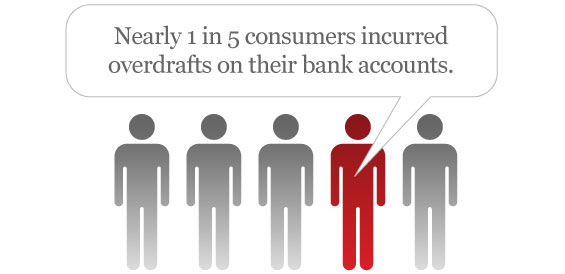
A survey of consumers commissioned by Pew’s Safe Checking in the Electronic Age Project found that although almost one-fifth (18%) of consumers have incurred an overdraft penalty fee in the last year, their understanding of overdraft rules is weak.

More than one-third of respondents surveyed were not aware their bank offered overdraft coverage until they incurred a penalty, and many also didn’t understand their bank’s tactics to increase profits, such as reordering deposits and withdrawals. Lower-income and younger consumers are hit the hardest by these penalty fees.

Frequency of Overdrafts

Most respondents overdrafted more than once. In fact, within the past year, over half of respondents (54%) overdrafted two to five times, and 14% overdrafted six to 10 times.

Almost all respondents (90%) said they overdrew their checking account by mistake. Only 7% zsaid they did so intentionally.
Kiosk & Display Shows Off New Interactive Engagement Station at GCUA

Who Is Likely to Incur Overdrafts?

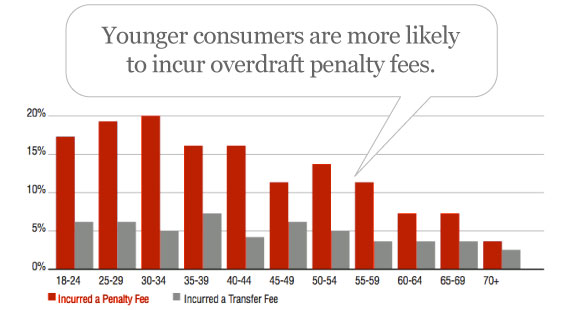
The survey found that age and income matter when it comes to incurring these fees. Consumers under the age of 44 are nearly twice as likely to incur an overdraft penalty fee than those 44 and older (17% vs. 9%).
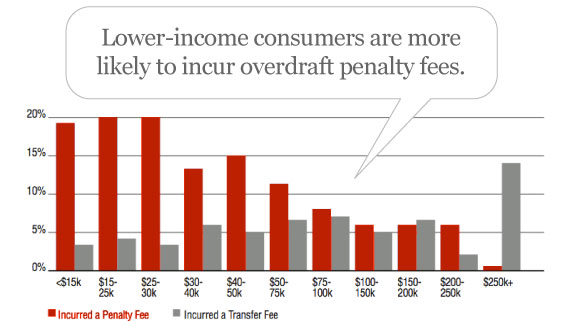
Consumers making less than $30,000 a year are nearly twice as likely to incur an overdraft penalty fee than those making more than $30,000 (20% vs. 10%).
EHS Design | Strategic Planning, Interior Design & Architecture

Frustrations, Questions and Confusion

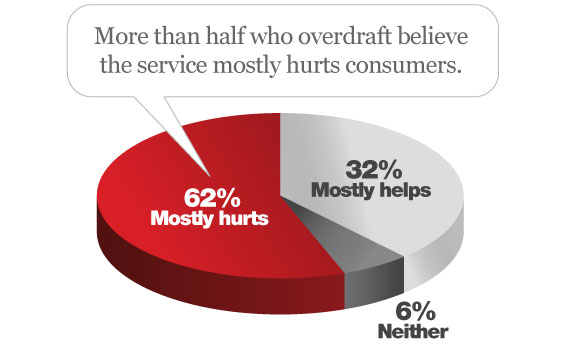
Forty percent think the terms and conditions of their financial institution’s overdraft policies are somewhat or very confusing, and more than 60% of consumers who incurred overdraft fees believe this service hurts more than helps.

Most people were surprised when they incurred a fee. They only learned of the fee after receiving their account statement, which may have taken days or weeks to arrive, potentially resulting in additional fees and/or compounded overdrafts.

Respondents overwhelmingly (75%) stated they would prefer that a transaction be declined if there is not enough money in their account rather than have it processed and subsequently be charged a $35 penalty fee.

Consumer dissatisfaction with overdraft procedures and fees is driving many to leave their financial institution. In fact, about one-third of respondents reported that they had closed their checking account due to overdraft fees.
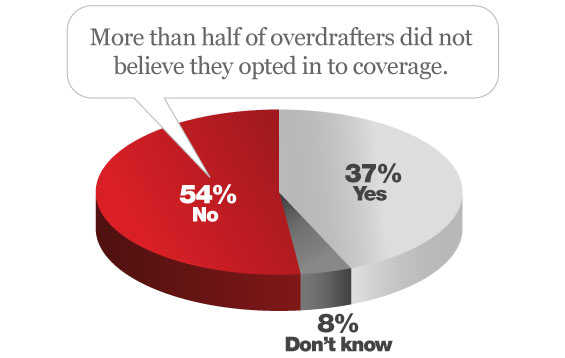
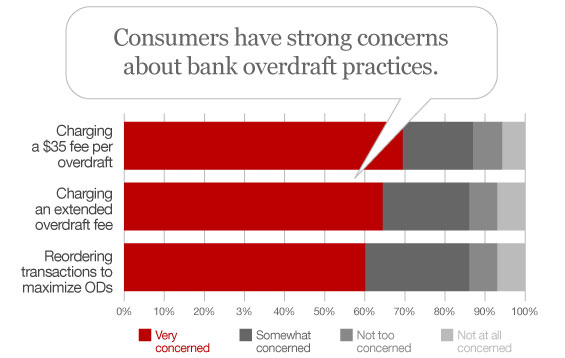
Methodology: To assess the impact of overdraft fees, Pew commissioned a survey of 6,043 consumers age 18 and older who overdrafted in the past year. Of those, a total of 606 respondents qualified to complete the interview because they had been charged an overdraft penalty fee by their financial institution in the past year for using their debit card to make a purchase or withdraw money that caused their account to have a negative balance.

Search For More: Product Marketing, Reports, ,

All content © 2013 by The Financial Brand and may not be reproduced by any means without permission.

Yes, You Can... With MarketMatch

Comments (4)

RSS feed for commments on this article

  1. Nathan says:

    Matters should be accurately depicted though, and the survey needs to include those that are fee’d however the item is returned. The Insufficient funds item being paid is a ‘service’ versus the embarassment of it being returned. An accurate survey of those assessed a fee for a returned item versus the satisfaction of those having had the item being paid would likely show consumer sentiment more than just those dissatisfied with no comparison.

  2. Editor says:

    First day in statistics class in college, the professor pointed out how surveys can be easily skewed to satisfy the author’s narrative slant. He showed the class two mainstream media articles. One said “75% are anti-abortion,” the other headline said “75% are pro-choice.” In one survey, the question was phrased this way: “Do you oppose the senseless killing of unborn babies?” The other survey question: “Are you in favor of a woman’s right to control all medical decisions affecting her body?”

    “On a scale of 1 to 10, how much do overdraft fees irritate you?”

    vs.

    “Do you feel that your overdraft service helps you avoid embarrassment and hassles by temporarily covering your purchases?”

  3. Joe says:

    This is a FAR more complex issue and PEW has done a poor job of addressing it. Why were customers unaware of fees until they received their statement? Did they not receive the notice in the mail (that, as far as I know, every financial institution sends when an overdraft happens)? Do they not keep a checkbook? Do they not look at their accounts online? In what ways do they find overdraft options confusing? If 75% prefer that a transaction be declined, then why are some banks reporting numbers well in excess of 25% of consumers who are opting in to coverage anyhow? Instead of villifying financial institutions, perhaps someone should look at root causes such as, “Why do cosumers overdraw their accounts?” and go from there.

  4. steve says:

    I doubt there will ver be any real meaningful statistics regarding this. Consumers do not want to admit that they overdraft to begin with. Many today also know full well how the overdraft protection works and they know how to manipulate the system. They in effect have an evergreen line of credit, albeit expensive – very much like a pay day loan. Bottom line is, most of them will never admit this, but will also be the first to scream at the banks about charging too much.
    Like most things in today’s society, isn’t it time that people start being held responsible for their own actions? Leave the banks alone on this one – they offer a product, there is a fee, the fee is disclosed and most people are aware of it – other than those that have their heads buried in the sand for the last twenty years – you want to avoid the fee, then don’t be overdrawn – if you do, then don’t blame the banks – time to get government out of this one too!

Post a Comment


Next article recommended for you
overdraft_showdown