
Welcome to Blingola
“Welcome to Blingola,” an imaginary world where everyone has “all the happiness in the world,” courtesy of their Virgin Money credit cards. With headlines like “The land of milf and honeyz,” you’re probably thinking this campaign is a joke. It isn’t. These ads are fo’real cuz.
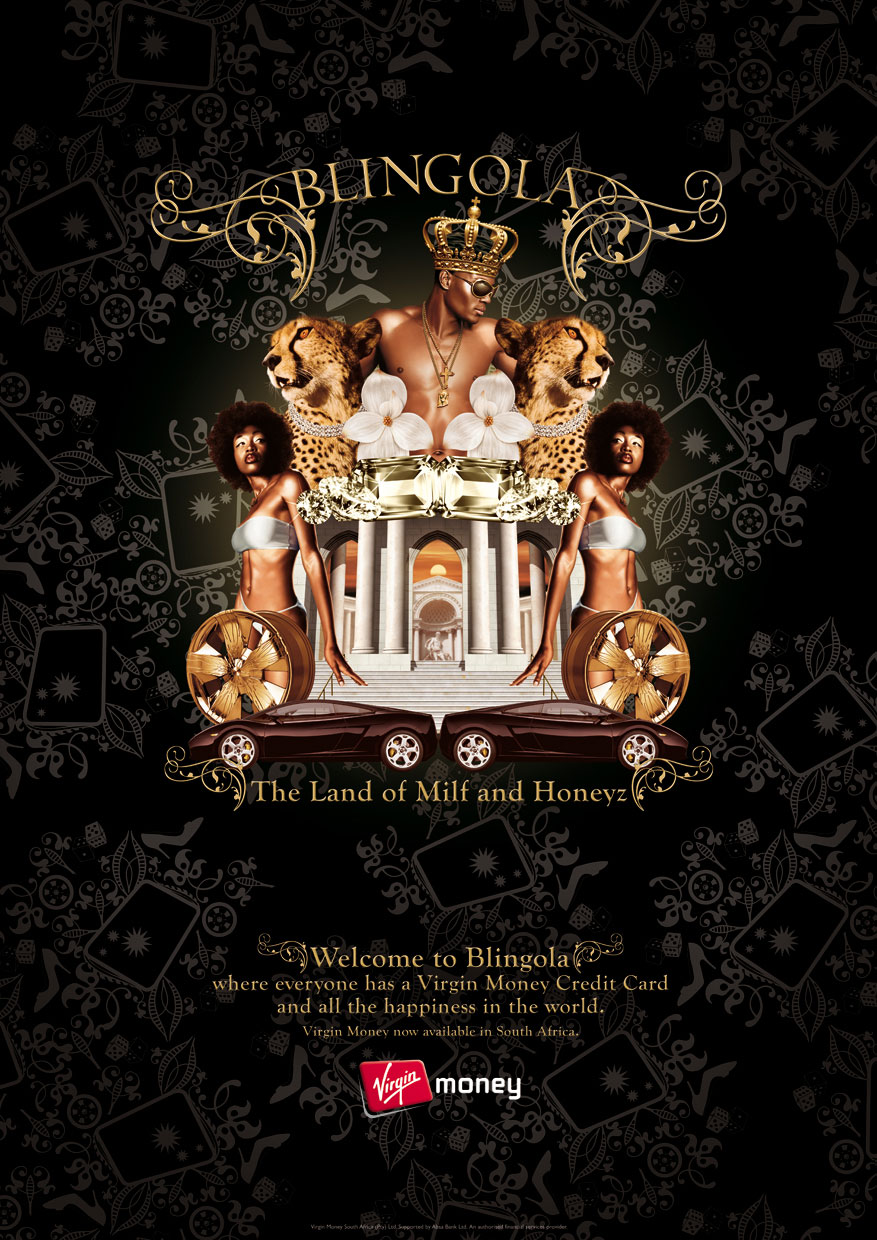
Apparently in South Africa, where these Virgin Money ads are running, “wish fulfillment” means all your pimp-daddy, gangsta-wannabe, holla-balla, schnizzle yo’ dizzle dreams come true. This campaign is sure to offend the puritanical — if not frequently hypocritical — sensibilities of many Americans. But remember: Americans aren’t the target audience. Nor are puritans.
Check out this TV spot. It looks more like a promo for MTV’s Cribs than for a financial institution.
It’s easy to get distracted by the campaign’s socio-cultural fantasies — it’s blinginess, if you will — but the actual product it’s promoting has one feature that’s pretty slammin’. South Africa’s “Bling” edition of Virgin Money’s credit card actually pays “a whopping 9.5% interest rate on all positive balances.” The downside: 20.5% on negative balances.
Key Question: Does Virgin cap the size of balance you can earn 9.5% interest on?
The fact that you can both earn interest and borrow money from a single, card-based account is really amazing. It’s a big enough breakthrough that Virgin Money should have probably renamed the product. “Credit card” just isn’t right.
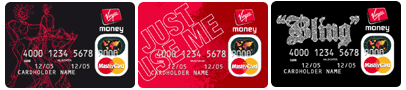
The cards themselves come in three flavors. One is fire red and says, “Just use me.” Another has a crazy line-drawing of gawd-knows-what. A third one has a faux diamond-encrusted “Bling” in gangsta lettering.
All content © 2013 by The Financial Brand and may not be reproduced by any means without permission.


I’ve been to Blingola. It’s a bit of a hike from where I live, which is “Live within my means-opolis”.
Question, Jeffry – how on EARTH do they offer a program like this? Would it ever work here (note: not the branding…no CU on EARTH would take on branding like this. I meant that aggressive rate).
I really like the card concept that switches back-and-forth between a deposit- and credit account, but I have no idea if (1) it’s legal in the U.S., or (2) if a financial institution can make money with it. But it’s smart, and someone in the U.S should find a way to offer it if the answers to both questions is “yes.”
From an advertising/PR standpoint, the cards remind me of those CapitalOne cards that you can put your own picture on with some web uploading. More and more, Credit and Debit cards are becoming a reflection of ourselves. But personally? I’d rather know the money in my account is safe than pretty. Interesting point: AmEx offers something called the “Black” card that only the Super Rich can afford. There’s a $2500 membership fee and you have to spend a quarter million per year. Talk about “bling bling”.
It goes without saying that the “gamble” of offering the high 9.5% deposit yield is paid for by the return on the high APR — and the obvious fact that most of the cardholders will live with a negative balance. The overall strategy is akin to Las Vegas comps. You pay at the craps table.
What I think is most clever about this branding: it’s almost guaranteed to turn off (i.e. offend) the high-deposit, unprofitable, financially stable individuals — the folks already well served by UBS and others — while simultaneously attracting the high-profit, high-debt, credit driven consumer.
Pretty darn smart.